

The June school holidays, National Day long weekends and mid-year leave all push Singaporeans towards the beach between June and September. The catch is that this is southwest monsoon season across much of the region, and picking the wrong coast can mean grey skies, choppy seas and closed dive sites. A good beach holiday July Southeast Asia plan starts with one simple question: which side of the mountains, or which side of the peninsula, is sheltered from the monsoon winds?
This guide compares the main beach regions within easy reach of Singapore, showing which tend to be dry and calm in the middle of the year and which are better saved for other months.
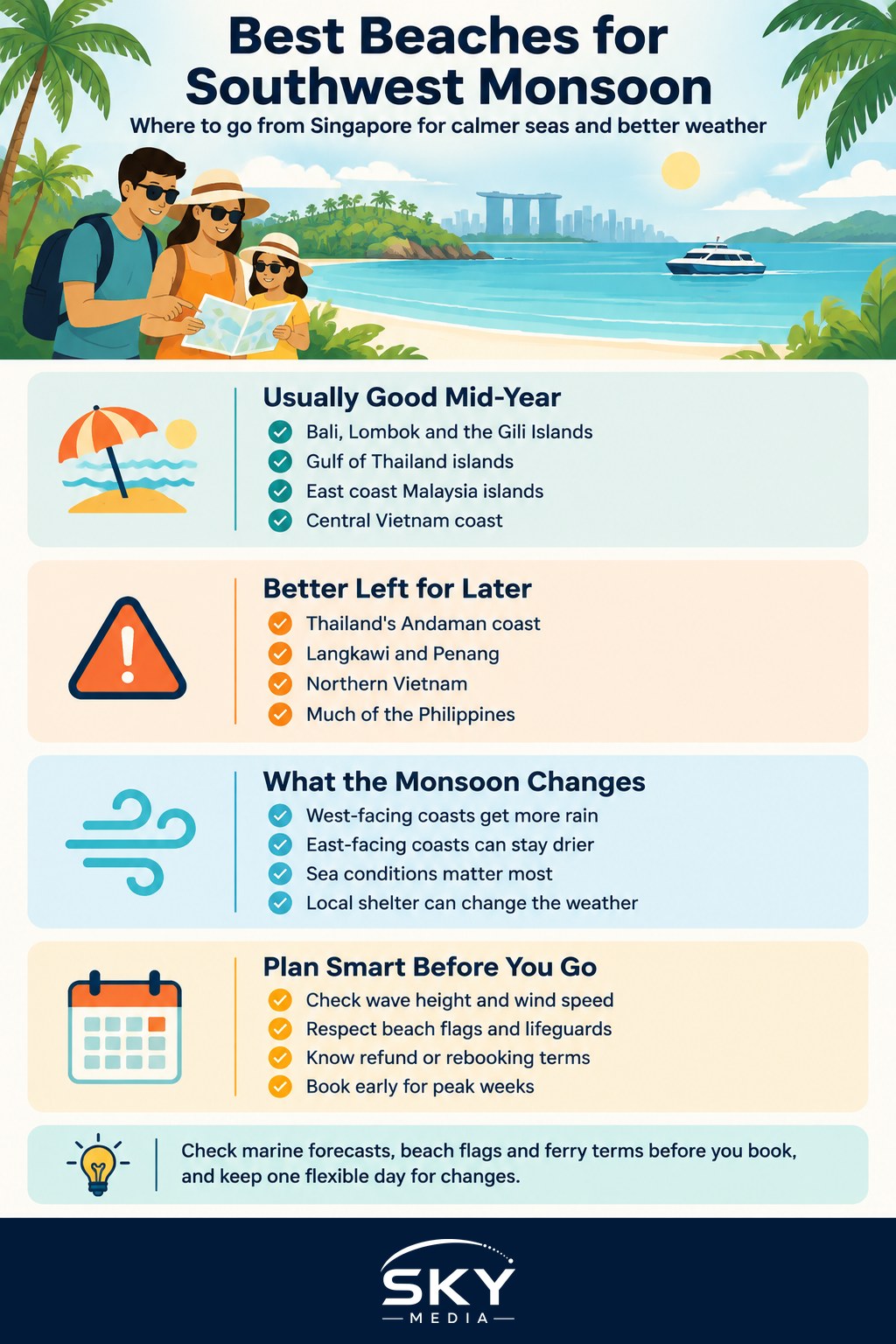
How the Southwest Monsoon Shapes Beach Weather
From roughly June to September, prevailing winds blow from the southwest across the Indian Ocean and the Andaman Sea. These moist winds bring heavy rain and rough seas to west-facing coasts, particularly in Thailand’s Andaman side and Myanmar. Coasts facing east or sheltered by mountain ranges often stay much drier.
Further south, the pattern is different. For much of Indonesia, including Bali and Lombok, the middle of the year is the dry season, because the winds arriving there come from the drier Australian side.
A few general points help:
- Monsoon rain is rarely nonstop. Even on the “wrong” coast, you may get sunny mornings and heavy afternoon showers. The bigger issue is often the sea, with rough waves, poor visibility for snorkelling and some boat services suspended.
- Patterns vary from year to year. Climate cycles can make a season wetter or drier than usual.
- Local geography matters. A bay sheltered by a headland can be calm while the next beach is rough.
For a broader picture across the whole year, see our guide to the best time to visit Southeast Asia.
Coasts That Are Usually Good From June to September
Bali, Lombok and the Gili Islands
This is the classic mid-year beach choice from Singapore. The dry season generally covers the middle of the year, bringing more sunshine and lower humidity than the wet months. Bali’s west and south coasts are famous for surf during this period, while calmer bays suit families. The trade-off is popularity: July and August are peak months, so book flights and accommodation early.
Gulf of Thailand islands (Koh Samui, Koh Phangan, Koh Tao)
Sitting on the eastern side of the Thai peninsula, these islands are partly sheltered from the southwest monsoon. Mid-year is often a pleasant time to visit, with diving around Koh Tao popular during these months. Their main rainy season tends to arrive later in the year, around October to December.
East coast of Peninsular Malaysia (Tioman, Redang, Perhentian)
These islands are a mid-year favourite because their season is the opposite of what many people expect. They face the South China Sea and are hit by the northeast monsoon at the end of the year, when many resorts and ferry services pause. From around March to October they are generally open, with clear water for snorkelling. Tioman can be reached from Singapore by a short flight or a combination of road and ferry.
Parts of the Philippines and Borneo
Weather here is more mixed. Some areas, such as Sabah’s coast, can be good mid-year, while many parts of the Philippines enter their rainy and typhoon season. Check specific destinations rather than treating the country as one region.
Coasts to Think Twice About Mid-Year
Andaman coast of Thailand (Phuket, Krabi, Koh Lanta, Phi Phi)
These west-facing coasts take the brunt of the southwest monsoon. Expect more rain, rougher seas and dangerous rip currents at some beaches, signalled by red flags. Some island resorts and boat routes reduce operations. Prices are lower, which attracts budget travellers, but this is not the time for snorkelling-focused trips.
Langkawi and Penang
On Malaysia’s west coast, these can see more frequent showers mid-year. They remain visitable, and many travellers enjoy them for food, culture and nature as well as beaches, but sea conditions are less predictable than on the east coast islands.
Northern Vietnam and much of the Philippines
Typhoon season can affect these areas, especially later in the summer. Central Vietnam, by contrast, is often drier mid-year, with its rains coming later in the year.
Mid-Year Beach Regions at a Glance
| Region | Typical June to September conditions | Best for |
|---|---|---|
| Bali, Lombok and Gili Islands | Dry season, sunny with lower humidity | Families, surfing, resort stays |
| Gulf of Thailand islands | Partly sheltered, generally pleasant | Diving, island hopping |
| East coast Malaysia islands | Open season, calmer seas | Snorkelling, short trips from Singapore |
| Central Vietnam coast | Often drier mid-year | Beach plus heritage towns |
| Thailand’s Andaman coast | Monsoon rain, rough seas, red flag days | Budget stays, non-beach activities |
| Langkawi and Penang | More showers, variable sea conditions | Food, culture and nature |
Planning Tips for a Monsoon-Season Beach Trip
Choosing the right coast is the biggest decision, but a few habits make any mid-year trip safer and smoother:
- Check marine forecasts, not just rain forecasts. Wave height and wind speed tell you more about swimming and boat trips.
- Respect beach flags and lifeguard instructions. Rip currents can be strong even on sunny days.
- Read ferry and boat terms. Weather cancellations happen. Know the refund or rebooking policy before you pay.
- Buy travel insurance that covers weather disruption and confirm what it includes for missed connections.
- Book early for peak weeks. Singapore’s school holidays overlap with European and Australian summer holidays, which pushes up demand in Bali and the Thai islands.
- Keep a flexible day. If a boat trip is cancelled, you can reschedule rather than lose it.
If you are travelling with children during the June break, our guide to travelling during school holidays from Singapore has tips on booking and budgeting.
Matching the Beach to Your Trip
Use the monsoon pattern as your filter, then pick based on what you want from the trip. Families after easy, sunny resort days usually do well in Bali or the Gulf of Thailand. Snorkellers on a short break can look at Malaysia’s east coast islands. Surfers often head to Bali’s southern breaks. If you love Phuket or Krabi, they are still there in the dry season at the end of the year, when the Andaman Sea is at its best.
For more ideas on island escapes within a short flight, see our roundup of beach and island holidays from Singapore.
Further reading: Khao Lak From Singapore: Beaches and the Similan Islands