

Singapore is one of the easiest places in Asia to travel from. Changi Airport connects to many cities, and short trips to neighbouring countries are popular over long weekends and the year-end holidays. For people who have recently moved from mainland China, though, planning holiday travel from Singapore involves a few gaps that are easy to miss. Leave works differently from what you may be used to, payment apps do not always work the same way overseas, and your pass and passport now both matter when you leave and come back.
This guide covers the practical differences. It is general information only. Visa, entry and pass rules change and depend on your nationality and pass type, so always confirm details with the official bodies named below before you book.
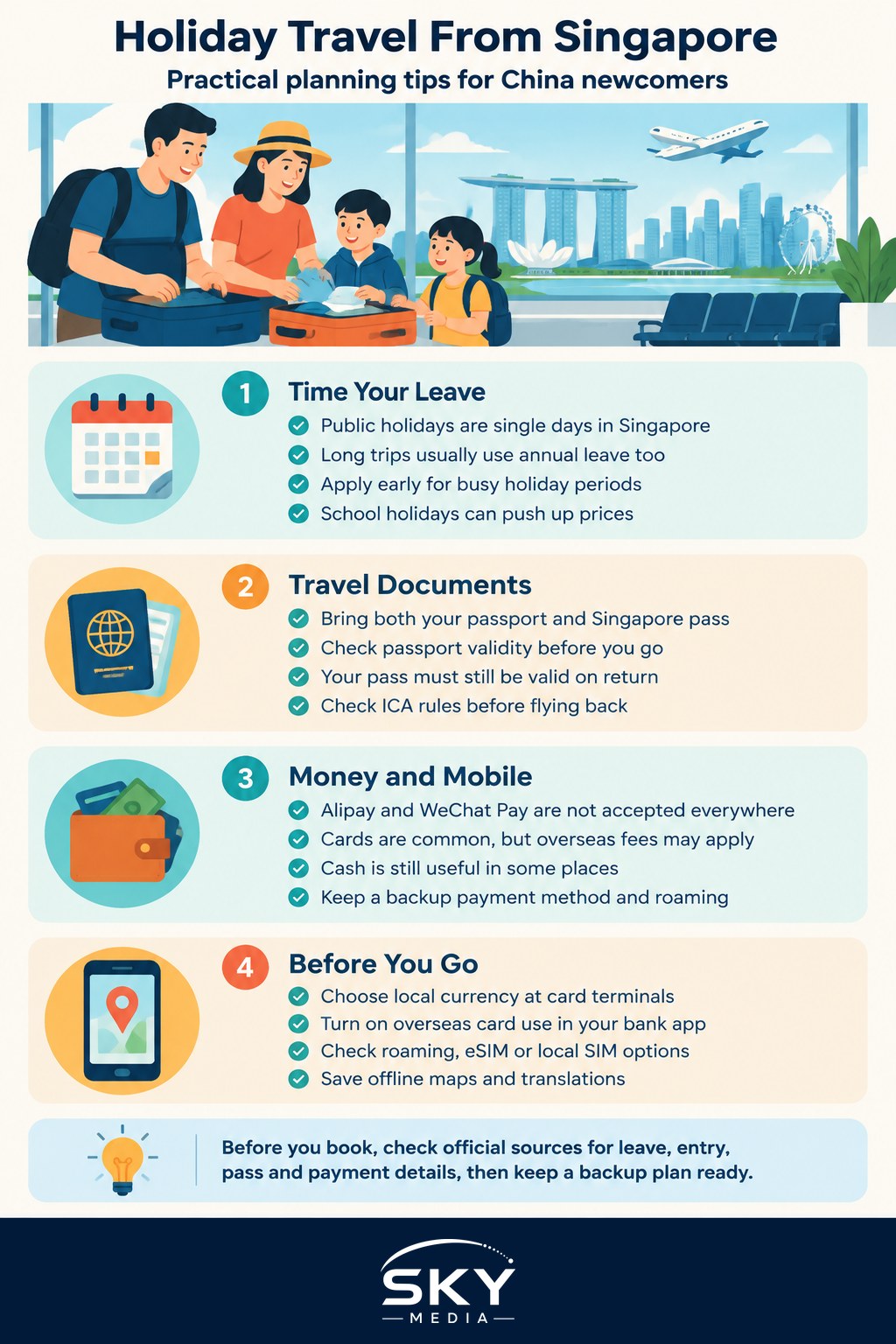
Timing Your Leave the Singapore Way
In China, you may be used to fixed national holiday blocks such as Golden Week, where many people travel at the same time and make-up working days are arranged around them. Singapore works differently.
- Public holidays are single days. Singapore has a set of gazetted public holidays each year, published by the Ministry of Manpower (MOM). When a holiday falls on a Sunday, the following Monday is generally a holiday too. There is no system of swapping weekend working days to create long breaks.
- Long trips use annual leave. To travel for a week or more, you usually combine a public holiday with your own annual leave. Your entitlement depends on your employment contract and the Employment Act where it applies, so check with your HR team.
- Apply early. Many colleagues want the same weeks off, especially around Christmas, New Year and Chinese New Year. Teams often approve leave on a first-come basis or try to keep minimum cover, so submit requests well ahead.
- School holidays shape prices. If you have children in local schools, the June and year-end school holidays are peak periods for flights and hotels. Our guide to travelling during school holidays from Singapore explains how to plan around them.
A useful habit is to check the coming year’s public holiday list early and mark the long weekends.
Documents: Passport, Pass and Re-Entry
When you live in Singapore on a pass, you travel with two important documents: your passport and your Singapore pass (such as an Employment Pass, S Pass, Dependant’s Pass or Student’s Pass).
- Check passport validity. Many destinations require your passport to be valid for a certain period beyond your travel dates. If your Chinese passport needs renewing, this is handled through the Embassy of the People’s Republic of China in Singapore. Check its official website for current procedures and allow plenty of time.
- Make sure your pass is valid for your return. Your pass must be valid when you re-enter Singapore. If it is close to expiry or under renewal, check with your employer and MOM or the Immigration & Checkpoints Authority (ICA) before travelling.
- Visa rules depend on your passport, not where you live. Living in Singapore does not usually change the visa requirements that apply to your Chinese passport. Check the destination country’s official embassy or immigration website.
- Arrival declarations. Singapore requires travellers to submit an arrival declaration through ICA’s official channels, and requirements can change, so check ICA’s website before your return trip.
- Automated lanes. Eligible pass holders may be able to use automated immigration lanes at checkpoints. ICA’s website explains who qualifies.
Money, Payment Apps and Cards Overseas
Payment habits are one of the biggest differences for China newcomers. At home, Alipay and WeChat Pay may cover almost everything. Overseas, acceptance varies a lot by destination and by merchant.
Here is how common payment options typically compare when you travel from Singapore:
| Payment method | How it usually works abroad | What to check before you go |
|---|---|---|
| Alipay or WeChat Pay (China accounts) | Accepted in some places popular with Chinese visitors, but not everywhere | Whether merchants at your destination accept it, and any linked card or limit rules |
| Singapore debit or credit card | Widely accepted where card payments are common | Overseas transaction fees, and whether to pay in local currency |
| Multi-currency or travel card | Lets you hold or convert foreign currencies | Exchange rates, fees and top-up method set by the provider |
| Cash | Still essential in some countries, markets and taxis | How much to carry, and where to exchange at fair rates |
A few practical tips:
- Always choose to pay in the local currency when a card terminal offers to charge you in Singapore dollars. The conversion offered at the terminal often costs more.
- Inform your bank or check app settings. Some Singapore banks let you enable overseas card use in their app.
- Carry a backup. Bring at least two payment methods in case one fails.
Fees and rates change, so check current terms directly with your bank or card provider.
Staying Connected: Roaming and eSIMs
Your phone matters even more when you travel, for maps, ride-hailing, bank authentication and keeping in touch with family.
- Roaming plans. Singapore telcos offer roaming add-ons for different regions. Activate one before you fly and check the data allowance and validity.
- Local SIM or eSIM. Buying a local SIM or a travel eSIM at your destination can be cheaper for longer stays. Check that your phone supports eSIM and is not locked.
- Keep your Singapore number reachable. Many Singapore banks and Singpass send one-time passwords by SMS. If you swap SIMs, you may miss these unless you keep your Singapore line active, for example on a dual-SIM phone.
- Apps that may not work everywhere. Some apps common in China may behave differently in other countries, and some apps common elsewhere may not work if you travel back to China. Download offline maps and translation packs before you leave.
Our comparison of mobile plans for calls to China is useful if you also want cheaper calls home.
Travel Habits That May Differ From Home
A few everyday differences can surprise new arrivals:
- Travel insurance is common. Many people in Singapore buy travel insurance for each trip or an annual plan. Read the policy wording for medical cover, delays and cancellations. Your local health insurance may not cover overseas treatment, so check with your insurer.
- Ride-hailing apps vary. The apps you use in Singapore may not operate in your destination. Check which services are common there.
- Airport timing. Changi is efficient, but peak holiday periods are busy. Leave enough time for check-in and immigration, and check whether your airline offers early or online check-in.
- Getting to the airport. The MRT reaches Changi Airport, which is handy outside peak luggage hours. Our guide to public transport for newcomers from China explains fares and routes.
- Home before you go. Set mail on hold if possible, unplug appliances, and tell your landlord or condo management if you will be away for long.
A Simple Pre-Trip Checklist
Before each holiday, run through this list:
- Leave approved by your employer, with handover done.
- Passport valid well beyond your travel dates.
- Singapore pass valid for re-entry.
- Visa or entry requirements checked on official sources.
- Payment methods tested, with a backup card and some cash.
- Roaming or eSIM sorted, and Singapore number reachable for OTPs.
- Travel insurance bought and policy saved on your phone.
- Arrival declaration requirements for your return checked on ICA’s website.
With these basics in place, holiday travel from Singapore becomes one of the real perks of living here.
Frequently Asked Questions
Can I swap weekends to create a long holiday like Golden Week? No. Singapore public holidays are single gazetted days published by MOM, and there is no system of swapping weekend working days. For longer trips, combine a public holiday with your own annual leave and check your entitlement with HR.
Do I need a visa for my Chinese passport just because I live in Singapore? Living in Singapore does not usually change the visa requirements that apply to your Chinese passport. Check the destination country’s official embassy or immigration website, and confirm any entry rules with the official bodies before you book.
Can I use Alipay or WeChat Pay when travelling from Singapore? Sometimes, in places popular with Chinese visitors, but not everywhere. Bring at least two payment methods, such as a card and some cash, and when a terminal offers to charge you in Singapore dollars, choose the local currency, since the terminal conversion often costs more.
How do I receive bank OTPs on my Singapore number while overseas? Many Singapore banks and Singpass send one-time passwords by SMS, so keep your Singapore line reachable, for example by using a dual-SIM phone with a local or travel eSIM. Activate a roaming add-on before you fly if you prefer.
What should I check about my pass before leaving Singapore on holiday? Make sure your pass is valid for your return. If it is close to expiry or under renewal, check with your employer and MOM or ICA before travelling, and look at ICA’s website for the current arrival declaration requirements for your return.
Further reading: How China Newcomers Can Visit JB for the First Time