

If you are researching how to become an insurance agent in Singapore, you will quickly find two kinds of content: glossy recruitment pitches and vague career overviews. Neither tells you what you actually have to do before you can sell your first policy. This guide focuses on the practical path: the regulatory requirements, the exams, how appointment works, and what the first months tend to look like once you start.
This is general information, not legal or career advice. The rules are set by the Monetary Authority of Singapore (MAS) and can change, so always confirm the current requirements on the MAS website and with the company you plan to join.
Who Regulates Insurance Agents in Singapore
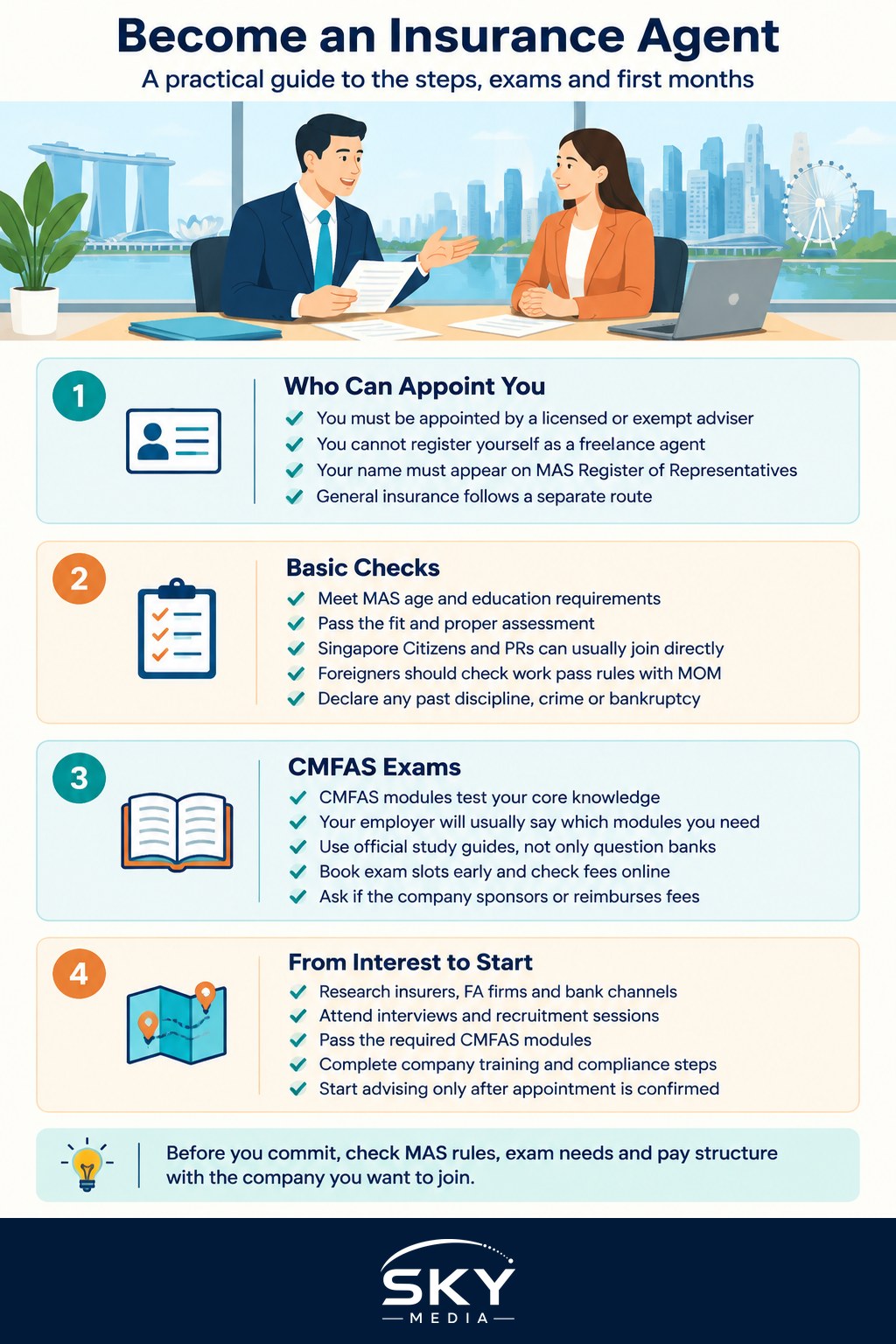
In Singapore, people who advise on and sell life insurance and investment-linked policies are regulated under the Financial Advisers Act, which MAS administers. You cannot simply register yourself as a freelance agent. Instead, you must be appointed as a representative by a licensed or exempt financial adviser, which usually means a life insurer, a financial advisory (FA) firm, or a bank’s advisory arm.
Once appointed, your name is added to the public Register of Representatives that MAS maintains. Clients can search this register to check whether you are authorised and which activities you may carry out. If your name is not on it, you are not allowed to advise on or arrange the products in question.
General insurance (car, home, travel and similar policies) has its own registration route, typically handled through the insurer and the relevant industry body. If you are only interested in general insurance, ask the company which exams and registration steps apply to that line of business.
Basic Eligibility: What Companies and MAS Look For
Before any exam, you need to meet baseline requirements. MAS sets minimum age and academic qualification standards for representatives, and every applicant must satisfy “fit and proper” criteria. In plain terms, that means honesty, integrity, financial soundness and competence. Past fraud, certain criminal records or undischarged bankruptcy can be serious obstacles.
Check these points early:
- Age and education: confirm the current minimum age and academic requirement on the MAS website, as these have been tightened over the years.
- Work eligibility: Singapore Citizens and Permanent Residents can generally join directly. Foreigners on a work pass should check with the hiring company and the Ministry of Manpower (MOM), because commission-based agency work does not fit every pass type.
- Background declarations: you will be asked to declare past disciplinary actions, criminal records and financial difficulties. Be truthful; a false declaration is itself a problem.
The CMFAS Exams You Need to Pass
The Capital Markets and Financial Advisory Services (CMFAS) exams are the core competency tests. For life insurance work, the modules most commonly required cover the rules and regulations for financial advisory services, life insurance and investment-linked policies, and health insurance. The exact list depends on the products you will handle, so your future employer will usually tell you which modules to sit.
Practical tips for the exams:
- Get the official study guides. The exam provider publishes study texts for each module. Read them properly rather than relying only on question banks.
- Book your slots early. Many recruits register for several modules at once; spacing them out a week or two apart helps you absorb each one.
- Focus on regulation and ethics. The rules module covers disclosure, suitability and conduct obligations that you will use every day, so it is worth understanding rather than memorising.
- Check fees and validity periods on the official exam provider’s website, since these are updated from time to time.
Some companies sponsor or reimburse exam fees for recruits who sign on. Ask about this before you pay out of pocket.
Step by Step: From Interest to First Client
The path below is the typical order. Individual companies may adjust it, but the core steps are the same.
| Step | What you do | What happens next |
|---|---|---|
| 1. Research companies | Compare insurers, FA firms and bank channels; talk to current agents | You shortlist where you want to be appointed |
| 2. Interview and selection | Attend recruitment sessions and interviews with a manager | The company decides whether to sponsor your application |
| 3. Pass CMFAS modules | Study and sit the modules your company specifies | You receive results to submit with your application |
| 4. Complete company training | Attend product, compliance and sales process training | You learn the company’s systems and disclosure procedures |
| 5. Appointment and notification | The company submits your details to MAS | Your name appears on the Register of Representatives |
| 6. Start advising | Begin client meetings under supervision | Your work is reviewed and you begin earning commission |
Do not meet clients to discuss products or collect personal financial information until your appointment is confirmed and your name is on the register.
Tied Agent, FA Firm or Bank: Choosing Where to Start
Your first big decision is which kind of company to join. A tied agency at a life insurer means you sell that insurer’s products only, usually with structured training, a clear career ladder and strong brand recognition. An FA firm lets you compare products from several insurers, which some advisers prefer for client conversations, though training and support vary widely between firms. Bank channels often provide warm leads from the bank’s own customers, with a more salaried structure and stricter scripts.
When comparing offers, ask:
- How is pay structured? Commission only, a basic allowance, or a salaried role with incentives?
- Is there a starter allowance or support programme for new recruits, and what targets are attached to it?
- Who will mentor you, and how many new agents does that manager look after?
- What happens to your clients if you leave?
If you are coming from another commission-based field, our guide on how to become a property agent in Singapore shows how a different licensing system handles similar questions about agencies and support.
What Your First Year Really Looks Like
The first year is where many new agents either find their footing or leave. Expect a lot of activity that does not pay immediately: prospecting, follow-ups, training sessions and paperwork.
Common features of year one:
- Building a list of contacts. Most new agents start with friends, family and former colleagues. Handle this gently. Pushing people you know into a sale can damage relationships and your reputation.
- Continuing education. MAS requires ongoing structured training each year to remain on the register. Your company will track your hours, but it is your responsibility to complete them.
- Compliance checks. Expect your recommendations to be reviewed, especially early on. You must document a client’s needs, explain why a product suits them, and disclose fees and key risks clearly.
- Irregular income. Commission arrives in uneven amounts and may be clawed back if a policy lapses early. Keep a personal buffer before you switch careers, and understand how CPF contributions and income tax apply to commission earners by checking with CPF Board and IRAS.
Patience matters here. Agents who focus on genuine needs analysis rather than quick sales tend to build referrals and repeat business over time.
Checklist Before You Commit
Before you sign with a company, make sure you can answer yes to these:
- I have checked the current MAS eligibility rules and I meet them.
- I know which CMFAS modules I need and how much time I can give to study.
- I understand the pay structure, any clawback terms and how long I can support myself while building income.
- I have spoken to at least one agent who has been with the company for a few years.
- I am comfortable with the conduct and disclosure rules I will have to follow.
Explore more: if you are weighing other sales careers, see Property Agent Commissions and Fees Explained for a comparison of how commission works in another regulated field.
Frequently Asked Questions
Can I be an insurance agent while holding a full-time job? That depends on your employer’s rules and the company you join, so check both before committing. Your employment contract may restrict outside work, and the appointing company will want to know your availability for training and client meetings. Get any approval in writing.
How can I check whether an insurance agent is properly appointed? Search the public Register of Representatives that MAS maintains, using the agent’s name. It shows whether the person is authorised and which activities they can carry out. If the name does not appear, do not hand over personal financial details or sign anything.
What happens if I fail a CMFAS module? You can generally sit the module again, but you will need to rebook and may pay the exam fee again. Check the exam provider’s website for retake rules and fees. Ask your company whether it reimburses exam costs, and review the study guide before the next attempt.
Is a commission-only insurance career worth it for a fresh graduate? It can suit someone who is self-driven and has savings to cover a slow start, but income is uneven and commission can be clawed back if a policy lapses early. Compare pay structures, speak to agents who have stayed several years, and plan a personal buffer.
How do CPF and income tax work for insurance agents? Commission earners are often treated differently from salaried staff, so the rules for CPF contributions and tax filing depend on your arrangement. Ask your company how your income is classified, and confirm the details with the CPF Board and IRAS.
Official sources: Monetary Authority of Singapore (MAS)
Further reading: How to Become a Chartered Accountant in Singapore