

Many retirees find that the years after full-time work are the perfect time to learn something deeply and share it with others. Becoming a museum docent in Singapore does exactly that. A docent is a trained volunteer guide who leads visitors through a museum’s galleries, telling the stories behind the objects. It is different from general volunteering or simply visiting museums. It asks for study, practice and a steady commitment, and it rewards you with knowledge, friendships and the pleasure of watching a visitor’s face light up.
This guide explains how training works, how much time it takes and what guiding is like, so you can decide before you apply.
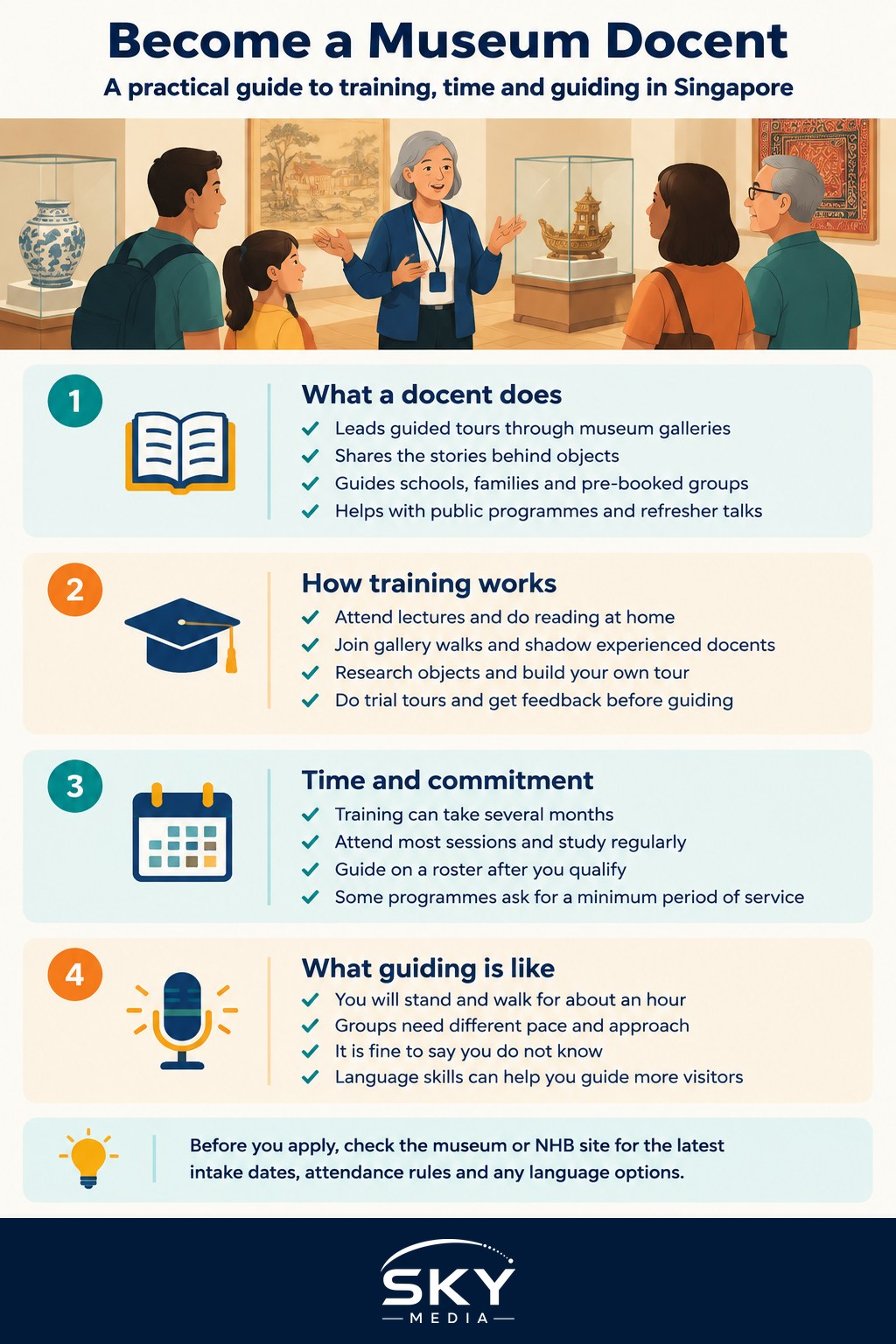
What a Museum Docent Actually Does
A docent’s main job is to lead guided tours. That might be a general highlights tour of a museum, a focused tour of one gallery, or a special tour linked to a temporary exhibition. Some docents also guide school groups, run tours in languages other than English, or help at family days and public programmes.
The word “docent” comes from the Latin for “to teach”, and that is the spirit of the role. A good docent does not recite a script. They choose a handful of objects, connect them into a story, and invite visitors to look closely and ask questions.
Typical docent tasks include:
- Leading scheduled public tours, usually lasting around an hour
- Guiding pre-booked groups such as schools, community groups or corporate visitors
- Researching objects and themes to build and refresh tour content
- Attending refresher talks when galleries change or new exhibitions open
- Mentoring newer docents once you have some experience
If you have enjoyed exploring places like the National Museum of Singapore or the Peranakan Museum, docent work lets you go far deeper than a regular visit ever could.
Who Runs Docent Programmes in Singapore
In Singapore, docent programmes are usually run either by the museums themselves or by long-established volunteer organisations that work closely with them. Friends of the Museums Singapore, a volunteer society, is well known for training docents for several national museums and heritage institutions. The National Heritage Board (NHB), the statutory board that oversees many national museums and heritage sites, also runs volunteer programmes. Other museums, galleries and heritage centres may run their own guide schemes.
Because programmes, intakes and partner institutions change over time, check the current details on the official museum website, the NHB volunteer pages, or the volunteer organisation’s own site. Intakes are often only once a year or so, and some programmes ask for a membership with the organising group before you can join training.
How Docent Training Usually Works
Docent training is the part that surprises most people. It is closer to a structured course than a quick briefing. Each programme sets its own format, but most share a similar shape.
Lectures and reading
Trainees attend a series of talks on the museum’s collection, Singapore and regional history, art history or the cultures represented in the galleries. Expect reading lists and handouts, and plan time at home to study them.
Gallery walks and shadowing
You will walk the galleries with experienced docents, watch their tours and take notes on how they move a group, pace their talk and handle questions. Shadowing is often the most useful part, because you see the craft of guiding in action.
Building your own tour
Trainees usually research and write their own tour, choosing objects and linking them with a theme. A mentor may review your draft and suggest changes.
Practice and assessment
Before you guide the public, you typically give one or more trial tours to mentors or fellow trainees. This is a supportive step rather than an exam to fear. Feedback helps you fix timing, clarity and voice projection.
The whole process can take several months from the first lecture to your first public tour. Programmes publish their own schedules, so confirm the expected duration and attendance rules before you sign up.
The Time Commitment, Before and After Training
Before applying, be honest with yourself about time. Most programmes expect you to attend the majority of training sessions and then guide regularly once you qualify. Many also ask new docents to commit to guiding for a minimum period so that the museum’s investment in training is worthwhile.
Here is a broad picture of how the commitment tends to change as you progress. Actual requirements vary by programme, so treat this as a general guide only.
| Stage | What it involves | Time and effort to expect |
|---|---|---|
| Application | Forms, sometimes an interview or information session | A few hours spread over a few weeks |
| Training period | Lectures, reading, gallery walks, shadowing | Regular weekly sessions plus home study, over several months |
| Trial tours | Writing your tour, practising, giving assessed tours | Intensive preparation in the final weeks |
| Active guiding | Leading public and group tours on a roster | A set number of tours per month, as the programme requires |
| Ongoing learning | Refresher talks, new exhibition training | Occasional sessions through the year |
If you travel often or care for grandchildren, ask how rosters are arranged.
What Guiding Is Really Like
Guiding is part storytelling, part crowd management and part improvisation. On a typical tour you meet your group at a set point, introduce yourself, and set expectations about how long the tour will run and how far you will walk. You then move through a series of stops, usually spending a few minutes at each object.
Some realities worth knowing:
- You will be on your feet. Tours involve standing and walking for an hour or so. Comfortable shoes matter. If you have mobility concerns, ask whether shorter or seated formats are possible.
- Groups vary a lot. A family with young children needs a very different pace from a group of history enthusiasts. Docents learn to read a group quickly and adapt.
- Questions you cannot answer will come. It is fine to say you do not know and offer to find out. Visitors appreciate honesty.
- Voice care matters. Galleries can be noisy. Some museums provide portable microphones; otherwise you learn to project without straining.
- Language skills are valued. If you speak Mandarin, Malay, Tamil, a Chinese dialect or another language, you may be able to guide tours in that language, which helps reach more visitors.
Many docents say the best moments are small ones, like a visitor sharing a childhood memory sparked by an object.
Why Docent Work Suits Many Seniors
Docent work can be especially rewarding later in life. It keeps the mind active through continuous learning. It gives a regular routine and a reason to get out of the house. It also builds a new social circle, because docent groups often become close communities with shared outings, study groups and talks.
It takes patience too. Learning a large collection, handling a restless group or rewriting a tour after feedback all ask for a calm, steady temperament. If you want to work on that side of yourself, our guide on how to become more patient has practical ideas.
How to Get Started
- Visit as a learner first. Join a few free guided tours at different museums. Notice which tours you enjoy and which docents inspire you.
- Choose an institution you love. You will spend many hours with one collection, so pick one whose stories genuinely interest you. Our guide to the best museums in Singapore can help you compare options.
- Check intake dates. Look on the museum, NHB or volunteer organisation website for the next training intake and any information sessions.
- Ask about requirements. Find out about attendance rules, minimum guiding commitments, any membership needed and language options.
- Prepare your schedule. Clear regular time for the training period so you do not fall behind.
- Go in with curiosity. You do not need a history degree. Most programmes value enthusiasm, reliability and a willingness to learn far more than formal qualifications.
Becoming a docent is a long-term commitment, but for many people it turns into one of the most meaningful roles of their later years.
Frequently Asked Questions
Are museum docents in Singapore paid? Docents are volunteers, so the reward is learning, friendships and the experience of guiding rather than a salary. Some programmes may cover limited things like training materials, but that varies, so ask the organising body what is provided before you apply.
What is the difference between a docent and a licensed tour guide? A docent is a trained volunteer who guides within a specific museum or heritage site. A tour guide is usually a professional who may lead wider tours for a fee. Check the Singapore Tourism Board for rules on professional guiding.
Can working adults become docents, or is it only for retirees? Working adults can, as long as they can attend training and guide regularly. Many programmes hold sessions on weekdays, so check the schedule and whether weekend options exist. Be realistic about your time before applying.
Can foreigners and permanent residents volunteer as docents? Nationality is generally less important than commitment, but each programme sets its own rules. Contact the museum, NHB or the volunteer society to ask about eligibility, language needs and any membership requirements before you register for an intake.
What happens if I cannot keep up with the guiding commitment later? Speak to the programme coordinator early. Many programmes ask for a minimum guiding period, but life changes, and coordinators can often suggest a break or a lighter schedule. Honest communication works better than quietly dropping out.