

Your best friend has been your default supper buddy, your weekend plan and the first person you text when something happens at work. Then they start dating someone, and suddenly the group chat goes quiet, Saturday plans need “checking first”, and you find yourself sitting across from a couple at a hawker centre wondering where you fit. If you are navigating a third wheel best friend relationship for the first time, the mix of happiness for them and loss for yourself can be confusing.
This guide is about that specific moment: the early months after your friend gets a partner. It is not about a friendship that is ending, and it is not about envy of their relationship. It is about adjusting, so the friendship survives a big and normal life change.
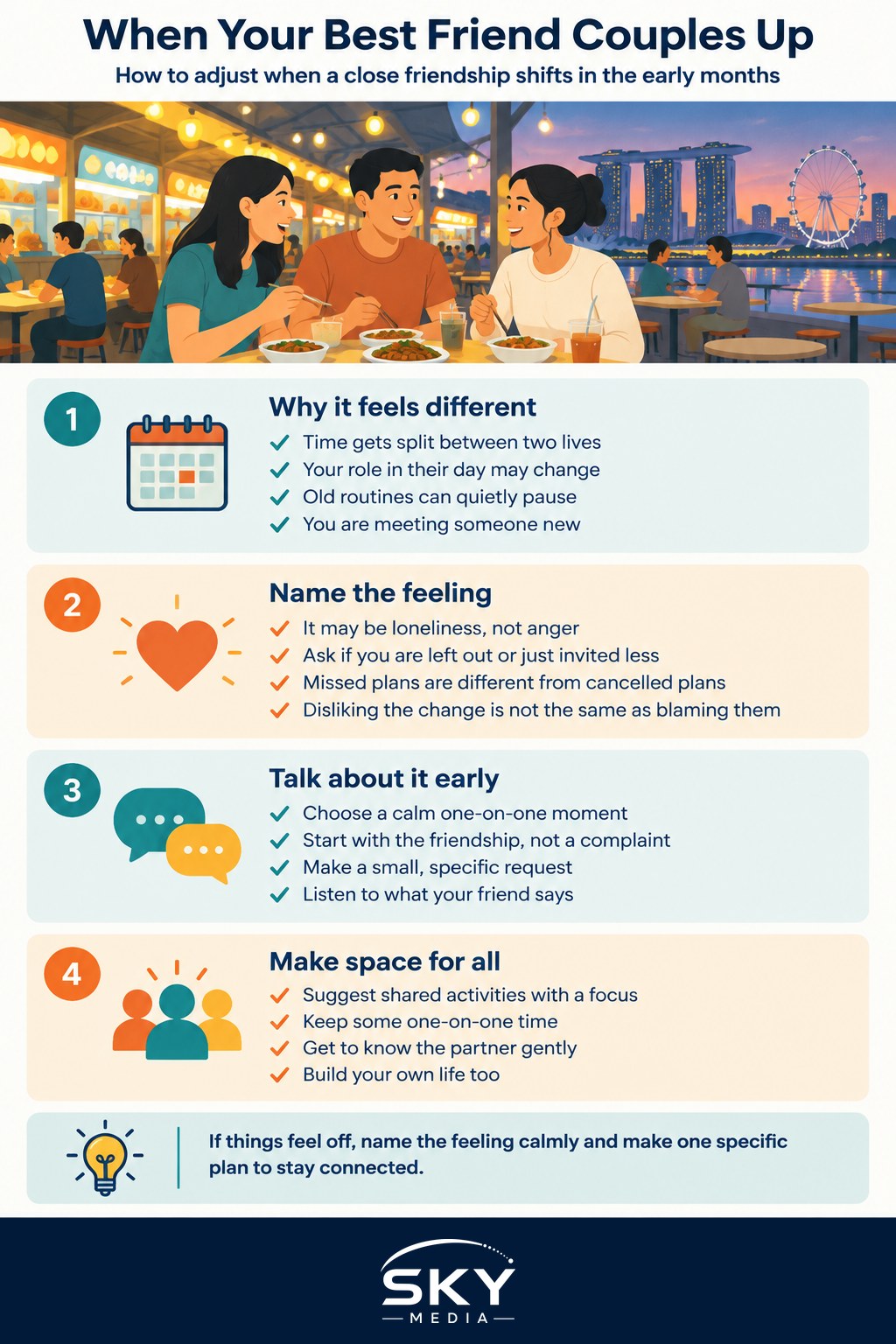
Why a New Relationship Shakes Up a Friendship
New relationships take up time and attention, especially in the first few months. Your friend is not necessarily choosing their partner over you. They are learning how to fit a new person into a life that, until recently, had a lot of room for you.
A few things usually happen at once:
- Time gets split. Evenings and weekends that were yours by default now get shared or negotiated.
- Your role changes. You may no longer be the first person they tell things to, at least for a while.
- Routines disappear. The Friday bubble tea run or the regular gym session might pause without anyone saying so.
- You meet a stranger. Your friend’s partner is new to you, and you may not click straight away.
In Singapore, where many young adults live with family and couples have little private space, new couples often spend their free time out together, which can make your friend seem always busy.
None of this means the friendship is broken. It means it is being rearranged.
Naming the Feeling Without Blaming Anyone
Third-wheel feelings are a mix of loneliness, awkwardness and sometimes a quiet fear of being replaced. It helps to separate what you feel from what your friend is actually doing.
Ask yourself honestly:
- Am I being left out, or am I just being invited less often than before?
- Is my friend cancelling on me, or simply booking fewer plans?
- Do I dislike their partner, or do I dislike that their partner exists?
Your feelings are valid even if your friend has done nothing wrong, but knowing the difference helps you respond fairly. If your friend is genuinely flaking repeatedly, that is worth raising. If you simply miss them, that is worth saying too, in a different way.
If you find you actively dislike their partner because of how they treat your friend, that is a separate issue. Our guide on when a friend is in an unhealthy relationship covers how to approach that carefully.
How to Bring It Up With Your Friend
Most friends do not realise they have gone quiet. A calm, specific conversation usually fixes more than silent resentment.
Pick the right moment. Talk one-on-one, not in front of their partner and not over text in the middle of a busy day. A walk or a quiet meal works better than a crowded group outing.
Lead with the friendship, not the complaint. “I’m really happy for you, and I miss hanging out just us” lands better than “You’re always with them now.”
Be concrete. Instead of “You never have time for me”, try “Can we keep our Sunday breakfast going, even twice a month?” A small, specific request is easy to say yes to.
Listen to their side. Your friend may be feeling pulled in different directions. They might be worried about neglecting you, or adjusting to a partner who wants a lot of time together. Give them room to say so.
Avoid ultimatums. “Me or them” never ends well. You want a friendship that fits alongside their relationship, not one that competes with it.
Third-Wheel Situations and What Helps
Not every outing with your friend and their partner needs to feel awkward. Here is how common scenarios tend to play out, and what makes them easier.
| Situation | What often goes wrong | What helps |
|---|---|---|
| Dinner as a trio | The couple shares inside jokes and you feel like an audience | Suggest an activity with a shared focus, like a board game café or a movie, so conversation is not the only thing happening |
| Group outings with mutual friends | The couple pairs off and you end up alone | Bring another friend along or plan the outing around a group activity |
| Your regular one-on-one plans | They get cancelled or quietly drop off | Agree on a light, recurring slot that stays just for the two of you |
| Getting to know the partner | You stay polite but distant, and it shows | Ask about their interests and find one thing in common to build on |
The goal is not to avoid the couple altogether. It is to make sure some of your time together stays one-on-one, and that time with both of them feels natural rather than forced.
Getting to Know Your Friend’s Partner
It is easier to be happy for your friend if their partner is a real person to you, not just “the one who took my friend away”. You do not have to become best friends with them, but a friendly connection makes everything smoother.
- Say yes to the occasional invite, even if it feels a bit awkward at first.
- Ask open questions about their work, hobbies or family, and actually listen.
- Do not quiz the partner on your friend’s behalf or act like a gatekeeper.
If you are on the other side of this one day, our guide on how to win over your partner’s friends shows what the partner may be feeling too. Seeing it from their angle often makes you more patient.
Building a Life That Is Not on Hold
One of the hardest parts of being the single friend is realising how much of your social life ran through one person. This is a good time to widen it, not as a replacement for your best friend, but so your happiness does not depend on their availability.
Some ideas that work well for young adults in Singapore:
- Reconnect with other friends from school, NS, university or work that you have lost touch with.
- Join a regular activity such as a community sports group, a running club, a CCA-style interest group at a community club, or a volunteer programme.
- Try a solo plan you have been putting off, like a class, a weekend walk or a day trip.
- Keep your own routines instead of waiting to see if your friend is free.
Having more going on also makes your time with your best friend better. You will have more to share, and you will be less likely to feel hurt when they are busy.
When the Friendship Settles Into a New Shape
Most friendships settle after the first few months of a new relationship. The couple finds a rhythm, your friend starts reaching out again, and you find a new pattern that works for both of you. It might be less frequent than before, but it can be just as close.
If months pass and your friend consistently cancels, never initiates and seems uninterested, it may be time for a more honest conversation about where the friendship stands. Sometimes friendships do shift for good, and that is painful, but it does not erase what you shared.
For a broader look at how people juggle both sides, read balancing a relationship and friendships. And if your friend’s partner and you genuinely clash, what to do when your partner hates your best friend looks at that tension from the couple’s side.
Being a good friend through this change is mostly about patience, honesty and a little effort to stay in each other’s lives. The friendships that survive a new partner are often the ones that last the longest.