

You bring up something important, and your partner goes quiet, cracks a joke, picks up their phone or says “can we not do this now?” Weeks pass and the issue is still sitting there. When a partner avoids hard conversations, it can feel lonely and frustrating, and it is easy to start reading it as not caring.
Usually it is more complicated than that. This guide focuses on one specific dynamic: shutdown, deflection and avoidance. It looks at why some people pull away from difficult topics, how to tell the different patterns apart, and practical ways to open the door without turning every talk into a standoff. For general skills on raising tough topics, see our guide to having difficult conversations with your partner.
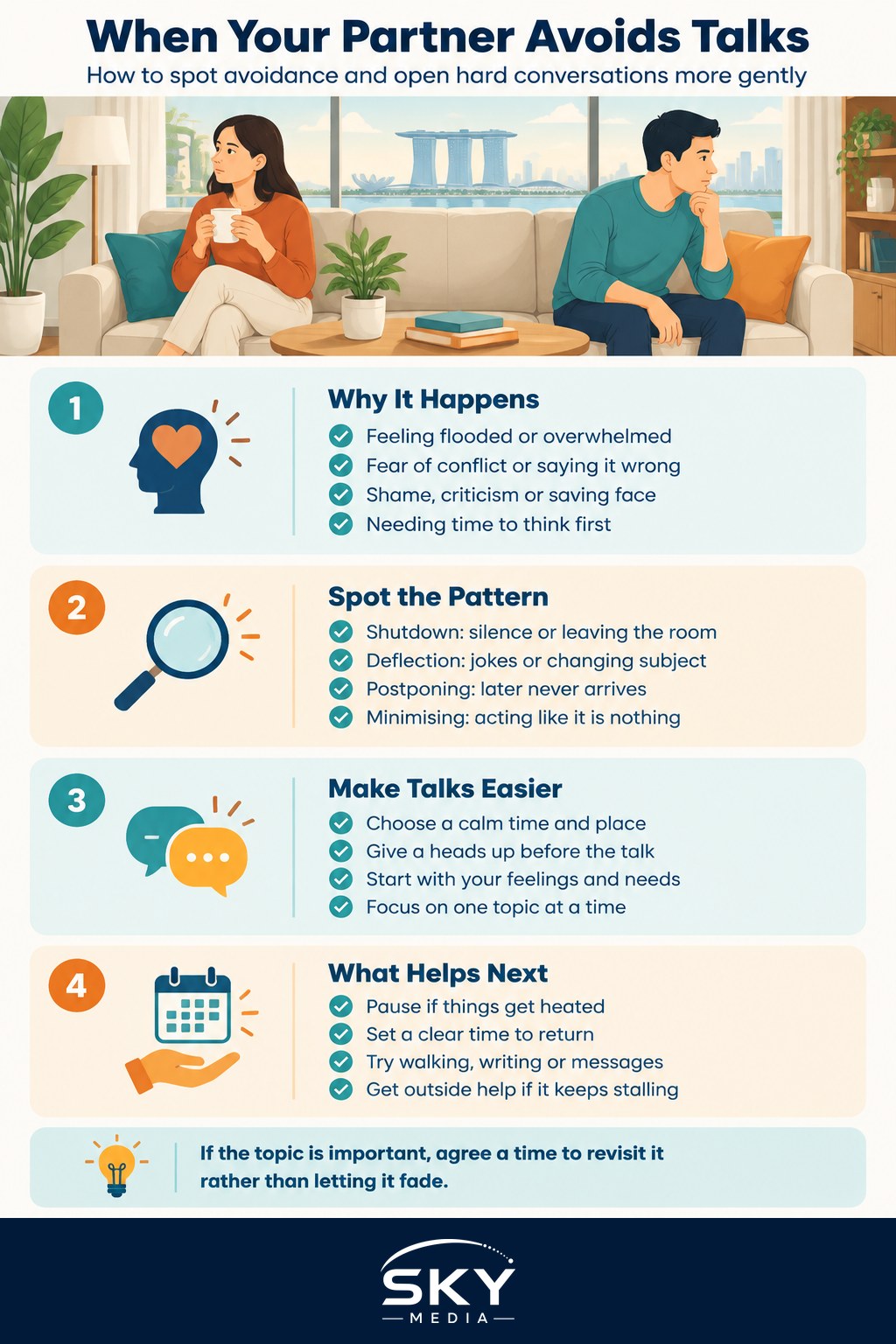
Why Some People Avoid Difficult Talks
Avoidance is often a form of self-protection rather than indifference. Common reasons include:
- Feeling flooded. When emotions run high, some people’s bodies go into a stress response. Heart rate rises, thinking narrows and shutting down feels like the only option.
- Fear of conflict. People who grew up in homes where arguments were explosive, or where disagreement was simply not allowed, may have learned that silence keeps the peace.
- Fear of getting it wrong. Some partners avoid a topic because they do not know what to say and worry they will make things worse.
- Shame or feeling criticised. If a conversation feels like a verdict on them as a person, they may defend by withdrawing.
- Different processing styles. Some people need time to think before they talk. Being pushed for an answer on the spot feels like an ambush.
- Cultural and family norms. In many families, including some in Singapore, saving face and not airing problems openly is valued. That can make direct emotional conversations feel unfamiliar.
None of this means your needs are unimportant. It does mean that pushing harder in the same way rarely works.
Shutdown, Deflection and Avoidance: Spotting the Pattern
These behaviours look similar but need slightly different responses. The table below can help you recognise what is happening.
| Pattern | What it looks like | What it often means | What tends to help |
|---|---|---|---|
| Shutdown (stonewalling) | Going silent, staring away, one-word answers, leaving the room | Feeling overwhelmed or flooded | A short agreed break, then coming back |
| Deflection | Jokes, changing the subject, bringing up your faults instead | Discomfort or feeling blamed | Gently naming the shift and returning to one topic |
| Postponing | “Not now”, “later”, but later never comes | Dread of the topic or fear of conflict | Agreeing a specific time to talk |
| Minimising | “It’s not a big deal”, “you’re overthinking” | Hoping the issue will fade | Explaining why it matters to you, calmly |
Watch the pattern over time rather than judging a single bad evening. Everyone shuts down occasionally. It becomes a problem when important topics never get resolved.
How to Raise a Topic So It Is Easier to Stay
The way a conversation starts often decides how it goes. Try these approaches:
- Choose the moment. Avoid raising serious topics when either of you is tired, hungry, rushing to work or in front of family. A quiet weekend walk can work better than late at night after a long day.
- Give a heads up. Something like “There’s something about our weekends I’d like to talk about. Could we sit down on Saturday morning?” lets a slow processor prepare instead of feeling cornered.
- Start soft. Lead with how you feel and what you need, not a list of their failures. “I’ve been feeling a bit disconnected and I miss our time together” lands better than “You never make time for me.”
- One topic at a time. Bringing up several grievances at once makes withdrawal more likely.
- Keep it short at first. A 15-minute conversation that ends well builds more trust than a two-hour one that ends in silence.
- Show you are on the same side. Phrases like “How can we sort this out together?” signal teamwork rather than prosecution.
What to Do When They Shut Down Mid-Conversation
Even with a good start, your partner may still pull away. In that moment:
- Notice and name it gently. “It looks like this is getting a lot. Do you want to take a break?”
- Agree on a break with a return time. Twenty minutes to an hour is common. The key is that the break has an end, so it is a pause, not an escape.
- Use the break to calm down, not to rehearse arguments. Take a walk, drink water, breathe slowly.
- Come back as agreed. If your partner comes back, acknowledge it. That effort deserves recognition.
- Try a different format if talking is hard. Some couples find it easier to write things down first, talk side by side while walking or driving, or exchange messages and then discuss.
If you notice that you also escalate, by raising your voice, following them from room to room or demanding an answer, it is worth working on that too. Pursuing and withdrawing often feed each other.
Looking After Yourself in the Meantime
Living with repeated avoidance can leave you anxious, resentful or doubting yourself. Some ways to protect your wellbeing:
- Keep up friendships and activities that are yours, so the relationship is not your only source of support.
- Write down what you want to say before talks. It helps you stay clear and calm.
- Notice your own limits. You are allowed to say that an issue cannot stay unresolved forever.
- Be honest about practical topics that cannot wait, such as finances, housing or plans for children. If money is one of them, our guide to money conversations before marriage offers structured ways in.
When to Seek Outside Help
If the pattern has gone on for a long time, or important decisions keep stalling, a neutral third party can help. Options in Singapore include couples counsellors and therapists in private practice, family service centres, and counselling services offered through some community and religious organisations. Many people find that a counsellor makes it safer for an avoidant partner to speak, because there is structure and nobody is “winning”.
Please also know the difference between avoidance and something more serious. If silence is used to punish, control or frighten you, or if you feel unsafe at home, that is not a communication style issue. Reach out to a trusted person or professional support services, and in an emergency call 999.
Avoidance rarely changes overnight. But with gentler starts, agreed breaks and patience on both sides, many couples learn to stay in the room for the conversations that matter. For more general techniques you can use anywhere, read how to have difficult conversations.
Further reading: Having the Exclusivity Conversation · Understanding Your Partner’s Triggers