

Some of the most surprising stories on a Singapore screen never reach a multiplex. They come from film students making their first serious work: short dramas shot in HDB corridors, documentaries about hawker uncles, animated pieces about growing up between languages. Watching student films in Singapore is a way to spot tomorrow’s directors early, see local life through younger eyes, and do it all for little or no money.
This guide focuses on where student and emerging filmmakers actually show their work, from campus showcases to public screenings and online archives. It is not a guide to commercial cinemas or the big international festivals, though student work sometimes appears there too.
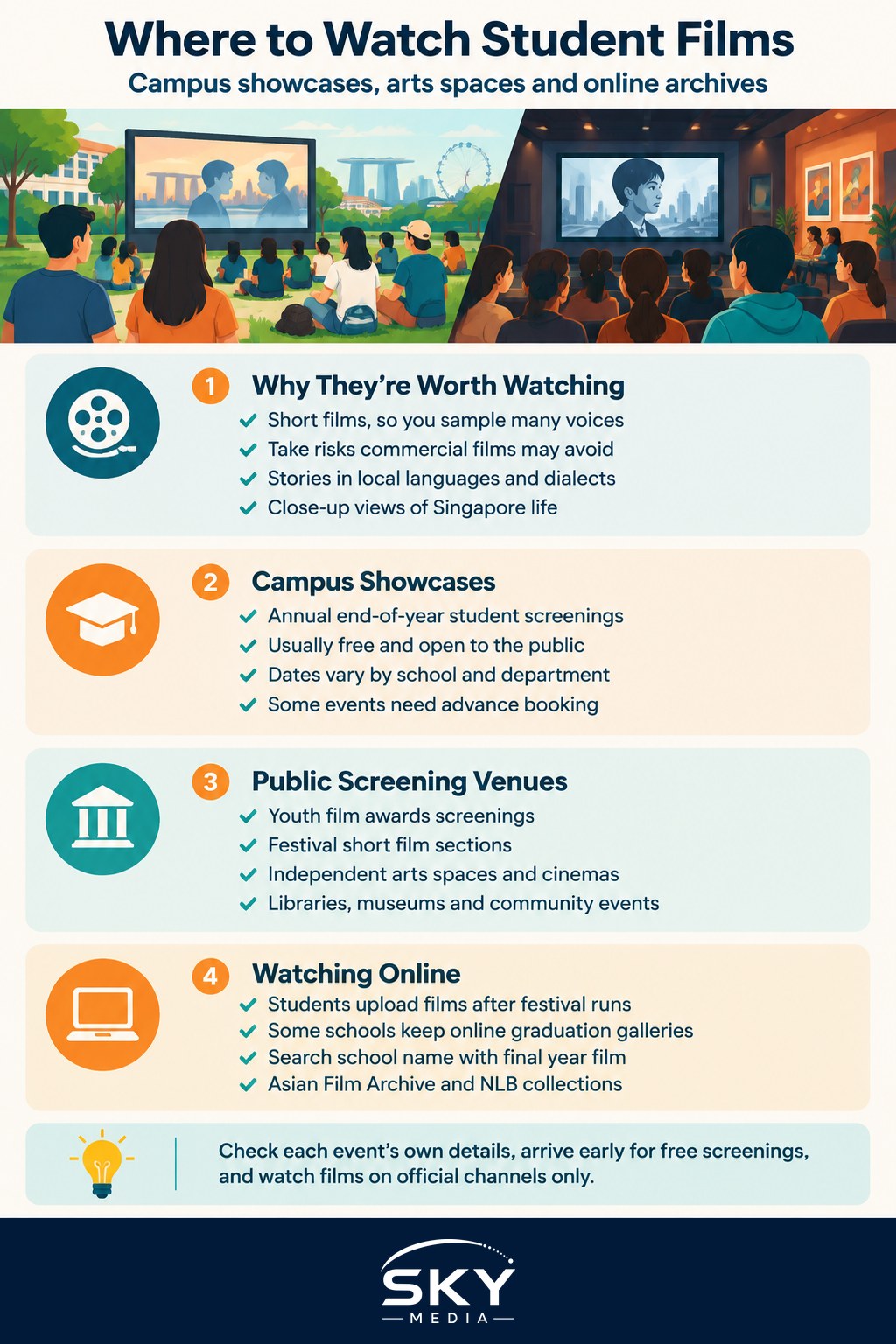
Why Student Films Are Worth Your Time
Student films are short, usually somewhere between a few minutes and half an hour, so a screening programme lets you sample many voices in one evening. They also tend to take risks that commercial projects avoid. You will see experiments with form, stories in Mandarin, Malay, Tamil, Singlish and dialects, and subjects close to home, such as national service, family businesses, caregiving and migrant life.
For students, these screenings are a chance to meet people working in film, theatre and media. For anyone new to Singapore, they offer a candid look at the questions young Singaporeans are asking about identity and the city they live in.
Graduation Showcases at Film Schools and Polytechnics
The richest source of student films is the annual graduation showcase. Universities, polytechnics and arts institutions with film, media or animation programmes typically hold an end-of-year exhibition where final-year projects are screened, often free and open to the public.
Institutions that run film or moving image courses include the arts university formed by LASALLE College of the Arts and NAFA, the art, design and media school at Nanyang Technological University, and the film and media programmes at several polytechnics such as Ngee Ann Polytechnic. Other universities and schools run media or communications courses with film components, and the specialist arts secondary school also holds student showcases.
Things to know about showcases:
- Timing varies. They usually take place towards the end of the academic year, but each school sets its own dates. Follow the school or department’s social media pages and website from a few months before.
- Formats differ. Some are cinema-style screenings with set times; others play films on loop in an exhibition alongside design and art work.
- Registration may be needed. Popular sessions can need advance booking, even when free.
- Filmmakers are often present. Many screenings include short Q&A sessions. It is fine to approach students afterwards and say what you liked.
Public Screenings, Awards and Arts Spaces
Beyond campuses, student and youth films reach audiences through a handful of regular channels.
- Youth film awards. Singapore has had a national youth film awards programme that recognises student and young filmmakers, with screenings of shortlisted and winning work. Check its official channels for the current edition.
- Film festivals. Major local festivals sometimes run short film or youth sections, and student work can appear in these programmes. Look for strands labelled short films, Southeast Asian shorts or youth.
- Independent arts spaces and cinematheques. Several small cinemas, film societies and arts centres run short film nights, student showcases and open screenings. Their programmes are usually posted on their own websites and newsletters.
- Libraries and museums. Public libraries and national museums host film screenings and talks from time to time, occasionally featuring young or student filmmakers.
- Community and cultural events. Arts festivals, community centres and heritage events sometimes include outdoor screenings of short local films, a relaxed way to watch with family.
If you also enjoy older work, our guide on where to watch classic films in Singapore covers the cinematheques and repertory screenings that often share audiences with student film nights.
Comparing Your Options
Different venues suit different moods and budgets. This comparison shows what to expect in general; check each event’s own details before you go.
| Where | Typical cost | What it feels like | Best for |
|---|---|---|---|
| Graduation showcases | Usually free | Busy, festive, filmmakers and families present | Discovering many new voices at once |
| Youth film award screenings | Free or low cost, varies | Curated selection of shortlisted work | Seeing the strongest student films of the year |
| Festival short film sections | Usually ticketed | Cinema setting, mixed audience, Q&A | Serious film fans |
| Arts space and film society nights | Free to low cost, varies | Small, informal, chatty | Meeting local filmmakers and regulars |
| Online channels and archives | Free | Watch anytime, at home | Catching up on past showcases |
Watching Student Films Online
Many students upload finished films to video platforms after their festival runs, and some schools keep online galleries of graduation work. Search by school name plus terms like “final year film” or “graduation showcase”, and follow student filmmakers you liked on social media to hear about future screenings.
The Asian Film Archive and the national library also hold collections of Singapore films, including some short and early-career work. Access rules vary, so check how to view their collections.
Respect copyright: watch films on official channels, and do not download or re-upload work without the filmmaker’s permission.
Tips for Getting the Most From a Screening
- Arrive early. Free showcases fill up, and seating is often first come, first served.
- Check the content advisory. Some films are made for mature audiences. If you bring children, read descriptions first.
- Silence your phone. Small venues make every buzz audible.
- Stay for the Q&A. Hearing how a film was made on a student budget is half the fun.
- Give feedback kindly. Students appreciate thoughtful comments, and many collect audience responses.
- Support crowdfunding thoughtfully. Some students raise funds for future projects. Contribute only to projects you understand.
How Students Can Get Involved
If you are a student yourself, watching is only the start. Many showcases need volunteers for front-of-house, and film societies welcome new members. Offer to help on a classmate’s shoot, enter youth film competitions, or organise a screening night with your school’s media club. The connections you make in a small Q&A room can lead to your first crew role.
Keep an eye on school calendars and arts listings throughout the year, and you will soon have a steady stream of fresh, local stories to watch.
Explore more: Film Festivals in Singapore and Arthouse Cinema Singapore.
Frequently Asked Questions
How can I get my own student film shown at a screening in Singapore? Look out for calls for entries from your school’s showcase, youth film awards and festival short film sections, and check their deadlines and rules. Arts spaces and film societies also run open screenings, so message the organisers with a short synopsis and a viewing link.
Are student films in Mandarin, Malay or Tamil subtitled in English? Many screenings provide English subtitles for films in other languages, but it is not guaranteed for every title. Check the event listing or ask the organiser beforehand. Student films often use mixed languages, including Singlish and dialects, so subtitles vary.
Can I hire a film student for a small video project? Many students take on small projects to build their portfolio, and some film societies or schools can connect you. Agree on scope, timing, payment and who owns the footage in writing, and look at their previous work first.
Is it okay to record or take photos during a student film screening? Usually no. Filming a screen is often banned, and unreleased student work is protected by copyright. Ask the organiser about photography rules, and take pictures only where they say it is allowed, such as the lobby or Q&A.
Are student films worth watching compared with professional shorts? They often have rougher production values, but they take creative risks and show fresh local voices that commercial work avoids. A mixed programme gives you variety in one evening, and the filmmakers are usually present to talk about the work.
Further reading: How to Join a Film Screening Q&A in Singapore