
The honest answer to the question of the best time to visit Singapore is this: almost any time works, as long as you know what to expect. Sitting just over one degree north of the equator, Singapore does not have spring, summer, autumn or winter. It has one long, warm, humid season that runs all year, gently nudged by two monsoon periods and a busy calendar of festivals. So rather than chasing a perfect week, the smarter approach is to match the timing to your priorities, whether that is drier skies, lower prices, thinner crowds, or catching a particular event.
This guide walks you through the climate in plain terms, what the singapore weather months tend to feel like, how the monsoon season shapes your days, and which entries on the singapore events calendar are worth planning around.
A Tropical Climate With No Real Seasons
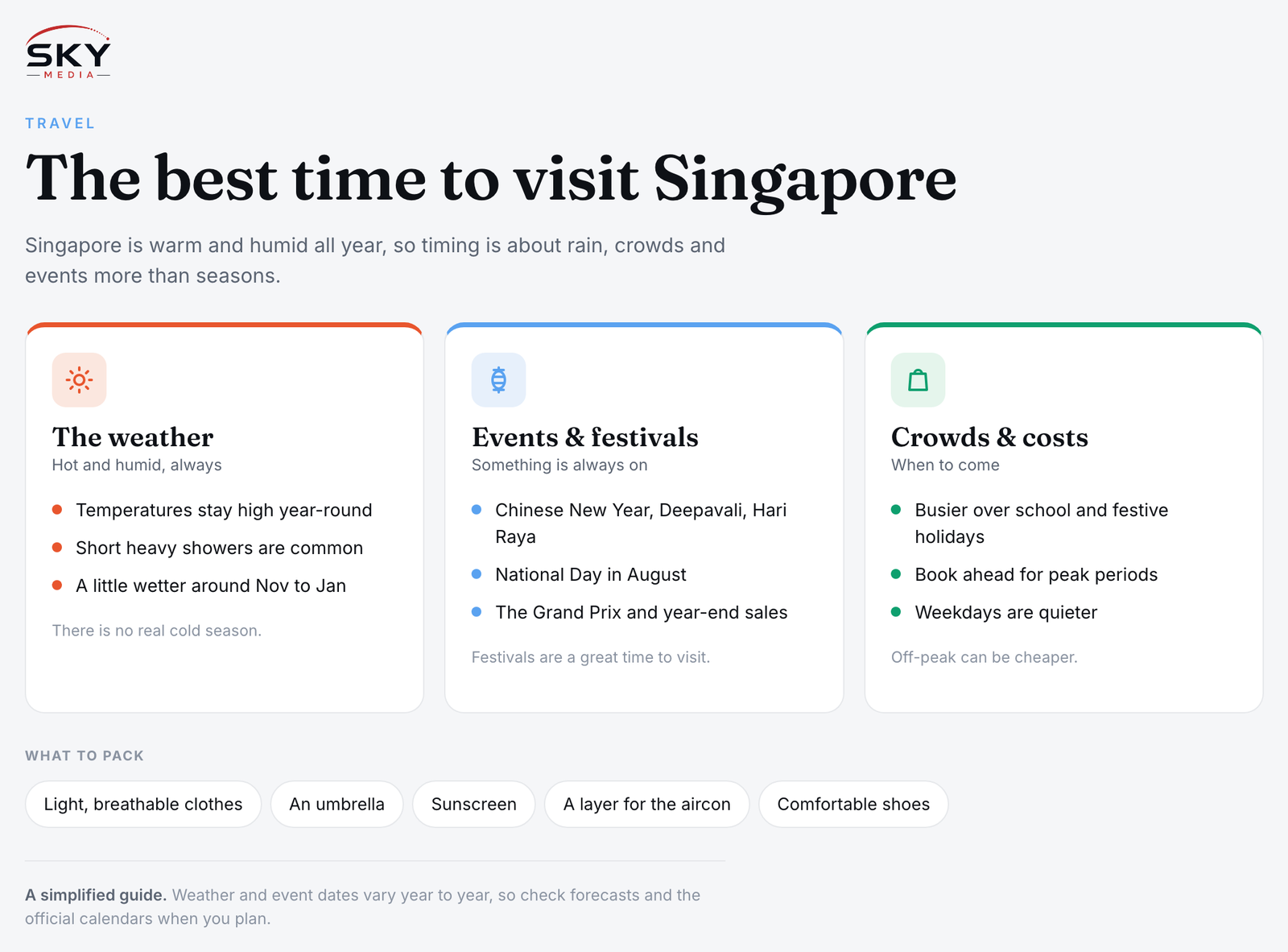
Singapore is hot and humid every single day of the year. Daytime temperatures usually sit in the low thirties Celsius, dropping to the mid twenties at night, and the humidity rarely lets up. There is no cold month and no dry month in the way temperate countries understand them. What changes across the year is not the heat but the rain: how often it falls, how heavy it is, and how long it lingers.
Because of this, packing is refreshingly simple no matter when you come. Think light, breathable clothing, a hat, sunscreen, a refillable water bottle, and a compact umbrella or light rain jacket. Indoor spaces such as malls, museums, restaurants and the MRT are strongly air conditioned, so a thin layer for those cold blasts is genuinely useful.
If the heat is your main worry, it is worth reading our companion guide on coping with the climate, because a few small habits make a big difference to how comfortable your trip feels.
Quick reality check: there is no month in Singapore that is cool, and no month that is completely dry. Plan for warmth and the occasional downpour whenever you travel, and you will rarely be caught out.
The Two Monsoon Seasons
Singapore’s rainfall is loosely organised around two monsoon periods and the calmer stretches between them. Understanding the pattern helps you set expectations, though none of it is a guarantee. Rain here often arrives as a short, dramatic afternoon thunderstorm that clears within an hour or two rather than a grey all day drizzle.
Northeast Monsoon (roughly November to January, wetter)
This is generally the wettest stretch of the year. Skies can be overcast, downpours are more frequent, and some days bring longer spells of rain, occasionally with minor localised flooding on low lying roads. December in particular tends to be damp. The upside is that rain often cools the air a little and the greenery looks lush. If you travel in these months, simply build flexibility into your plans and keep a few indoor options in your back pocket.
Southwest Monsoon (roughly June to September)
This period is typically drier and brighter than the northeast monsoon, though still warm and humid with passing showers. Mornings are often clear, with the classic tropical pattern of building heat and a possible afternoon or evening storm. Many travellers find these months among the more comfortable for sightseeing, weather wise.
The inter monsoon months
The transitions, broadly around April and May and again in October, can be hot, still and sticky, with sudden heavy thunderstorms. These months are sometimes the most humid feeling of all, so pace yourself and take air conditioned breaks.
Singapore Weather Months at a Glance
Here is a very general sense of the singapore weather months. Treat it as a rough guide, not a forecast, because tropical weather is famously changeable.
- January: Tail end of the wetter monsoon, still some heavier rain days, warm throughout.
- February: Usually a little drier, pleasant, and a popular time to visit.
- March: Warm and fairly bright, humidity climbing.
- April: Hot and humid, with sharp afternoon storms.
- May: Often one of the hottest, stickiest months.
- June to September: Southwest monsoon, generally drier and sunnier with passing showers.
- October: Warm, humid, transitional, with heavy thunderstorms possible.
- November to December: Northeast monsoon, the wettest stretch, cooler feeling on rainy days.
The key takeaway is that the differences are matters of degree. You can have a glorious blue sky day in December and a washed out afternoon in July. Flexibility beats forecasting.
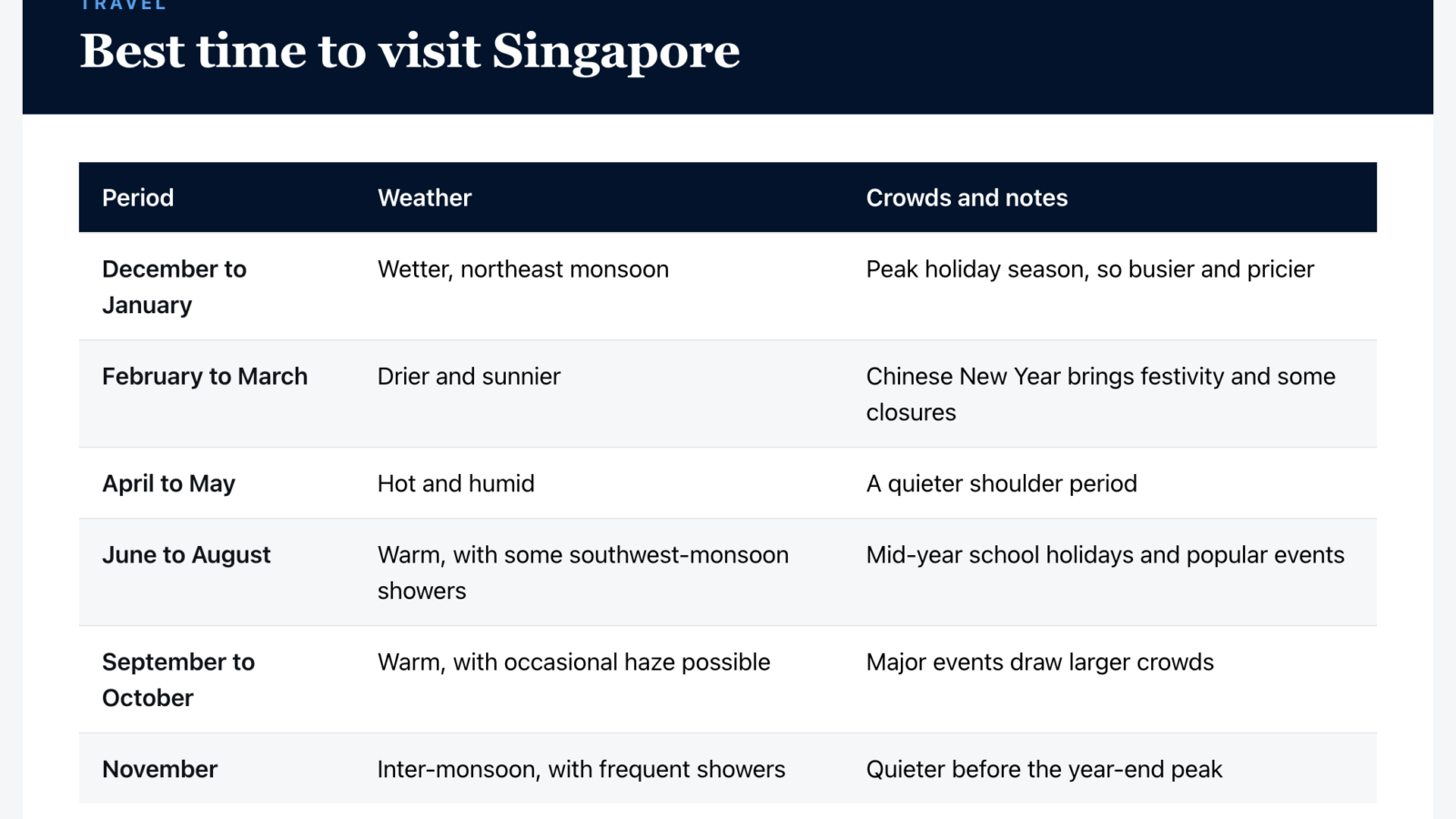
Here is a rough month-by-month guide to help you time your trip:
| Period | Weather | Crowds and notes |
|---|---|---|
| December to January | Wetter, northeast monsoon | Peak holiday season, so busier and pricier |
| February to March | Drier and sunnier | Chinese New Year brings festivity and some closures |
| April to May | Hot and humid | A quieter shoulder period |
| June to August | Warm, with some southwest-monsoon showers | Mid-year school holidays and popular events |
| September to October | Warm, with occasional haze possible | Major events draw larger crowds |
| November | Inter-monsoon, with frequent showers | Quieter before the year-end peak |
The Events Calendar That Shapes Your Timing
For many people, the best time to visit Singapore is decided less by weather and more by what is happening. The city packs a remarkable amount into its calendar, and a few events materially affect crowds, prices and even opening hours.
Chinese New Year (late January or February)
This is the biggest holiday of the year and the one that most affects planning. The mood is festive, with lanterns, light ups in Chinatown, and street bazaars. However, on the first day or two of the celebration, many smaller shops, family run eateries and some attractions close or run reduced hours as people gather with family. It is a wonderful cultural time to be here, but plan around the possibility of closures and book restaurants ahead.
The Formula 1 night race (usually September)
Singapore’s floodlit street circuit is a global draw. Race weekend brings big crowds, headline concerts and a real buzz, but also higher hotel prices and busy roads around the Marina Bay area. If you love the spectacle, book early. If you do not, and you want a quieter, cheaper stay, avoid that specific weekend.
National Day (9 August)
Singapore’s birthday is marked by a spectacular National Day Parade with fireworks and aerial displays. The atmosphere is patriotic and joyful, but central areas near the parade route get busy and some roads close. Even the rehearsals in the preceding weeks bring flypasts and fireworks you can catch for free.
The Great Singapore Sale (traditionally mid year)
If shopping is part of your plan, the annual islandwide sale period, historically held around the middle of the year, brings widespread discounts. Dates and formats shift over time, so check nearer your trip, but it remains a well known reason people time a visit.
Festivals throughout the year
Because Singapore is beautifully multicultural, there is nearly always a festival somewhere: Hari Raya, Deepavali, Thaipusam, the Mid Autumn Festival and more, each with its own food, decorations and neighbourhood atmosphere. These add colour to a trip rather than disrupting it. For a fuller month by month rundown, see our dedicated festivals guide.
Crowds, Prices and Deciding When to Go
Once you accept that the weather is broadly similar year round, the question of when to go comes down to crowds and cost.
- Peak periods. School holidays (notably June, and late November through December), Chinese New Year, the F1 weekend and major long weekends push up flight and hotel prices and fill attractions. Book well ahead.
- Quieter windows. Stretches away from big holidays and events, such as parts of February after Chinese New Year, or the shoulder weeks in spring, can be calmer and slightly kinder on the wallet.
- Weekday advantage. Whatever month you choose, weekdays at popular attractions and hawker centres are almost always less crowded than weekends.
A simple checklist for choosing your dates
- Want the driest odds? Lean towards June to September or February.
- Want a specific event? Let the singapore events calendar lead, then book accommodation early.
- Want lower prices and fewer people? Avoid school holidays, Chinese New Year and F1 weekend.
- Travelling on a fixed schedule anyway? Relax. With light clothing and an umbrella, any month is genuinely fine.
So, When Should You Come?
Here is the reassuring conclusion. There is no bad time to visit Singapore, only different trade offs. The northeast monsoon season is wetter but atmospheric and often cheaper outside the December peak. The southwest monsoon tends to be brighter and comfortable for exploring. Chinese New Year and National Day are unforgettable if you want cultural spectacle, while the F1 weekend is a bucket list thrill that comes at a premium.
Pick the priority that matters most to you, whether it is dry weather, a festival, thin crowds or a good deal, and build the trip around that. Then pack light, stay hydrated, embrace the odd tropical downpour as part of the experience, and enjoy a city that is ready to welcome you in any month of the year.
Explore more: Surviving Singapore’s heat · A guide to Singapore’s festivals