

If you want to understand Singapore quickly, look at its calendar. The list of Singapore public holidays reads like a map of the island’s communities: Chinese, Malay, Indian and Eurasian, plus faiths from Buddhism and Islam to Hinduism and Christianity. Eleven gazetted holidays sit across the year, and most of them are festivals that neighbours of every background end up sharing, whether over an open house, a plate of food or a walk through a precinct lit up for the occasion.
This guide explains what each one celebrates and how it is marked, so both long-time locals and newcomers can join in with confidence. One important note up front: festival dates shift every year because many follow lunar or religious calendars. We deliberately do not print dates here. Always check the official public holiday list published by the Ministry of Manpower (MOM) for the year you are planning around.
Why the calendar looks the way it does
Singapore recognises the major festivals of its main ethnic and religious groups rather than favouring one. That is a deliberate reflection of a multicultural society, and it is why the year feels balanced: a Chinese festival, a Malay-Muslim one, an Indian one, a Buddhist one, and shared civic and Christian dates.
A few practical points worth knowing:
- When a public holiday falls on a Sunday, the following Monday is usually a holiday in lieu.
- Government offices, banks and many schools follow the gazetted list closely.
- Shops, hawker stalls and small businesses set their own hours. Around Chinese New Year in particular, expect some to close for a few days.
The festivals of the communities
Chinese New Year
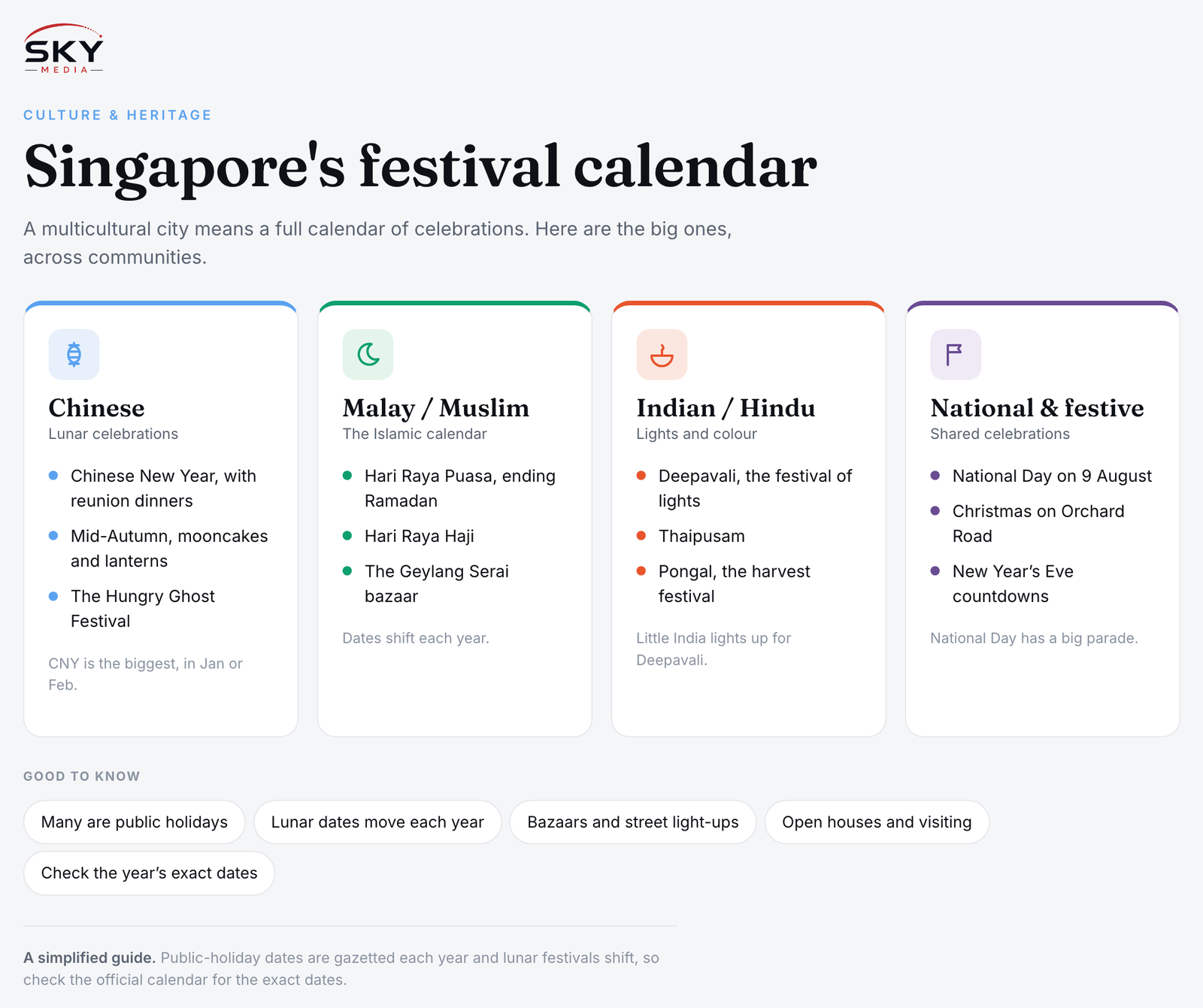
The biggest event on the Chinese calendar, Chinese New Year, marks the start of the lunar new year and usually spans two public holidays. Families reunite for a dinner on the eve, homes are cleaned and decorated in red and gold, and elders and married couples give hongbao (red packets of money) to children and unmarried juniors. You will hear greetings like “Gong Xi Fa Cai,” see lion dances outside malls, and find Chinatown transformed with lanterns, festive markets and stalls selling bak kwa (barbecued pork) and pineapple tarts. This is also the period when some businesses shut for a few days, so stock up and check opening hours before you head out.
Hari Raya Puasa and Hari Raya Haji
The Malay-Muslim community marks two Hari Raya holidays. Hari Raya Puasa (Aidilfitri) celebrates the end of Ramadan, the fasting month. After weeks of fasting from dawn to dusk, families gather for morning prayers, wear new clothes in coordinated colours, seek forgiveness from elders, and hold open houses with dishes such as ketupat, rendang and lemang. In the lead-up, the Geylang Serai area lights up with a bustling bazaar of food and clothing. Hari Raya Haji (Aidiladha) comes later in the year and commemorates the pilgrimage to Mecca and the spirit of sacrifice, marked by prayers and the sharing of meat with the community.
Deepavali
Deepavali, the Hindu festival of lights, celebrates the triumph of light over darkness and good over evil. Homes are cleaned and decorated with oil lamps and colourful rangoli (floor art made from coloured powder or rice), new clothes are worn, and families exchange sweets and visit one another. Little India is the place to feel it: streets strung with lights, a festive bazaar, and shops full of garlands, saris and Indian sweets. Even if you are not celebrating, an evening stroll through the glow is one of the city’s simple pleasures.
Vesak Day
Vesak Day is the most significant date in the Buddhist calendar, commemorating the birth, enlightenment and passing of the Buddha. Devotees visit temples from early morning, offer flowers, light candles and incense, and take part in acts of kindness such as releasing captive animals or giving to those in need. Some temples organise the bathing of a Buddha statue and free vegetarian meals. It is a quieter, more reflective holiday, and temple grounds are peaceful places to observe or simply pay respects.
The shared and civic holidays
Not every public holiday belongs to one community. Several are shared across the whole country.
- New Year’s Day. The first of January, marking the start of the calendar year, often after countdown events by the waterfront the night before.
- Good Friday. A solemn Christian holiday remembering the crucifixion of Jesus, observed with church services.
- Labour Day. The first of May, honouring workers, in common with much of the world.
- National Day. The ninth of August, celebrating Singapore’s independence in 1965. It is the most visibly patriotic day of the year, with the National Day Parade, a flypast, fireworks and flags on HDB blocks across the island.
- Christmas Day. Celebrated well beyond the Christian community, with Orchard Road famous for its dazzling light-up and shopping crowds through December.
A gentle rule of thumb: religious festivals are best experienced with respect and curiosity, while civic days like National Day are for everyone to celebrate together.
How festivals are shared
What makes the calendar special is not just the days off, but the culture of visiting. The open house tradition, strong during Chinese New Year, Hari Raya and Deepavali, means friends, colleagues and neighbours drop by one another’s homes to eat, chat and exchange good wishes. Giving is woven through it all: red packets, sweets, festive goodies and hospitality. If you are invited, bring a small gift, dress modestly for religious occasions, and follow your host’s lead on customs like removing your shoes.
Food is the common language. Pineapple tarts and bak kwa at Chinese New Year, rendang and kueh at Hari Raya, murukku and Indian sweets at Deepavali: each season has its flavours, and much of it is shared generously across communities.
Quick tips for planning around the holidays
- Check MOM’s official list each year. Dates move, especially for the lunar and religious festivals, so confirm before booking anything.
- Expect closures around Chinese New Year. Some hawker stalls and small shops shut for a few days; larger malls and eateries usually stay open.
- Visit the precincts in the lead-up. Chinatown, Geylang Serai and Little India are at their liveliest in the week or two before each festival.
- Watch for holidays in lieu. A Sunday holiday usually shifts the day off to the Monday.
- Be a gracious guest. Dress appropriately, greet elders first, and accept food and hospitality warmly.
Singapore’s festivals are one of the easiest and warmest ways into local life. You do not need to belong to a community to appreciate its celebration, and most people are delighted to share. Turn up with an open mind and an empty stomach, and you will understand the island a little better each season.
Explore more: Singapore’s ethnic enclaves and free things to do in Singapore.