
Every day brings hundreds of small choices. What to eat for lunch, whether to answer that late-night work message, whether to buy the thing in your online cart, whether to say yes to another weekend plan. Most of them are not important on their own, but together they drain energy and time. Life rules are a simple tool for this problem: short personal guidelines that make the decision for you before the moment arrives.
This guide is not about writing a mission statement, listing your values or keeping a decision journal. It is about practical operating rules, the small “if this, then that” guidelines that quietly run your days.
What Life Rules Are, and What They Are Not
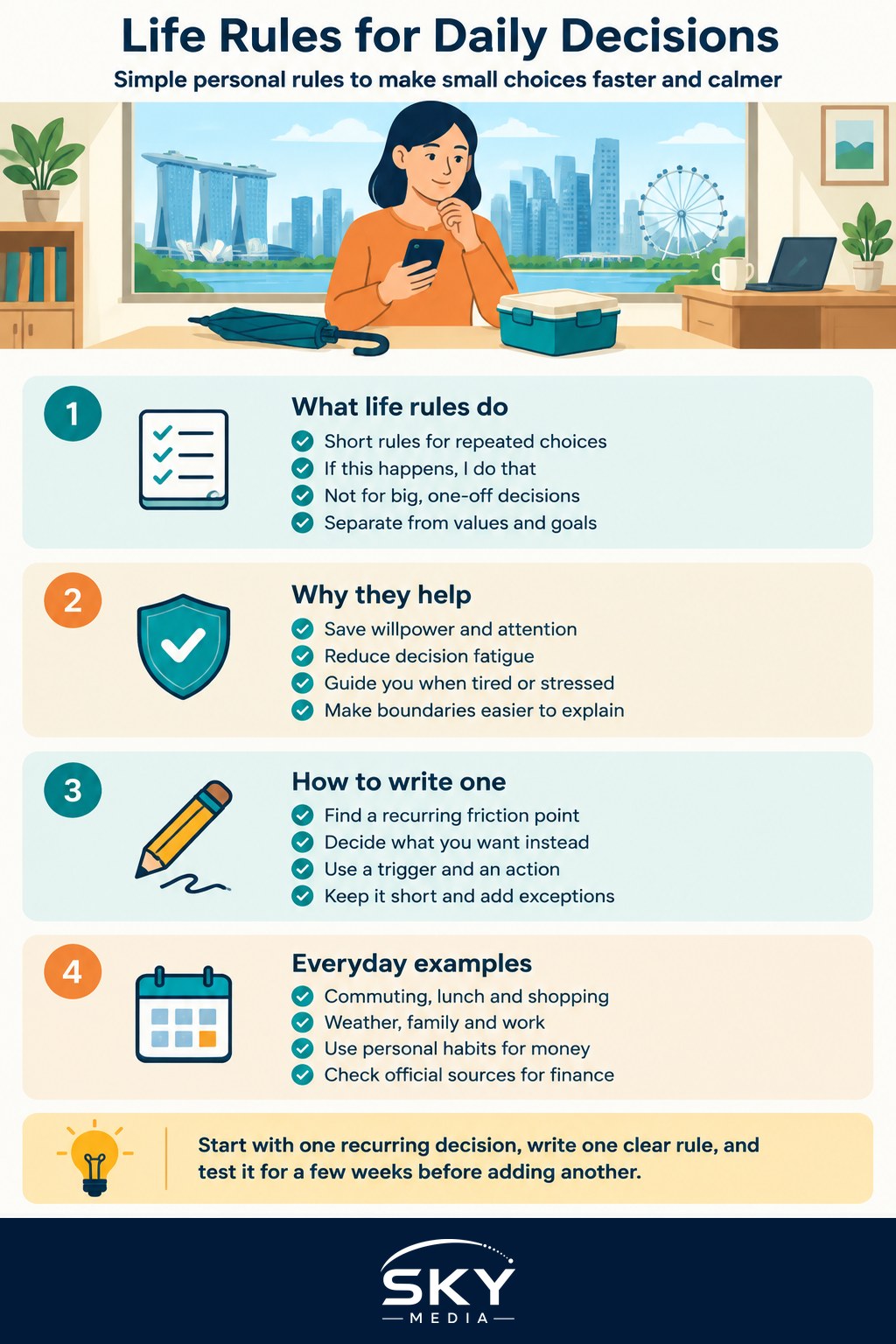
A life rule is a short, specific statement you have decided to follow in a recurring situation. Some examples:
- “If a task takes less than two minutes, I do it now.”
- “I do not reply to non-urgent work messages after 9pm.”
- “If I want something that is not a necessity, I wait one week before buying it.”
- “When a friend invites me out on a weeknight, I check whether I already have two evenings out that week.”
Good life rules differ from other self-improvement tools:
- Values describe what matters to you, such as health or family. Rules turn those values into actions.
- Goals describe outcomes you want. Rules shape the daily behaviour that gets you there.
- Big decisions, such as changing jobs or buying a flat, deserve careful thought each time. Rules are for small, repeated choices.
For larger choices, tools like the 10-10-10 rule or a premortem are better suited. Life rules handle the rest of the week.
Why Personal Rules Work
Rules help because willpower and attention are limited. When you decide something once and then simply follow it, you avoid re-arguing with yourself every time.
They also:
- Reduce decision fatigue. Fewer small choices leave more energy for important ones.
- Protect you from your worst moments. A rule set when calm guides you when you are tired, hungry or stressed.
- Make boundaries easier to explain. “I have a rule that I don’t lend money to colleagues” sounds less personal than an awkward refusal.
- Build identity. Following a rule like “I take the stairs for anything under four floors” slowly shapes how you see yourself.
How to Write a Good Life Rule
A useful rule is short, specific and easy to check. A simple process:
- Notice a recurring friction. Look for choices you keep agonising over or regretting. Late-night food delivery, impulse buys during online sales, saying yes to every request at work, scrolling in bed.
- Decide what you want instead. Be concrete. Not “be healthier” but “eat a home-cooked dinner most weeknights”.
- Write it as a trigger and an action. “When X happens, I do Y.” Triggers make rules automatic.
- Keep it short enough to remember. If you need to look it up, it will not guide you in the moment.
- Add an exception if needed. “Except on public holidays” or “unless it is a genuine emergency” keeps a rule realistic without making it meaningless.
Types of Rules and How They Compare
Different kinds of rules suit different problems. The table below shows common types, an everyday example and where each tends to work best.
| Rule type | Everyday example | Works best for |
|---|---|---|
| Default rule | “My default answer to new weekend commitments is no, unless I’m excited about it.” | Overcommitting and people-pleasing |
| Threshold rule | “Anything over a set amount I’ve chosen waits 48 hours before I buy it.” | Impulse spending |
| Time rule | “Phone goes on the charger outside the bedroom at 11pm.” | Sleep, screen time and evening routines |
| Ratio rule | “For every new item of clothing, one old item leaves the wardrobe.” | Clutter and consumption |
| Batching rule | “I handle personal admin and bills on Sunday afternoon only.” | Scattered small tasks |
| Stop rule | “If I’ve reworked a draft three times, I send it.” | Perfectionism and overthinking |
Pick one type that matches your biggest daily friction and start there.
Everyday Life Rules That Suit Singapore Living
Life in Singapore has its own recurring decisions. Some rules people find useful:
- Commuting. “If I’m on the MRT for more than 20 minutes, I read or listen to something I chose, not whatever the feed gives me.”
- Food. “I decide my lunch before I leave the office, so I don’t wander the hawker centre for 15 minutes.”
- Online shopping. “I don’t buy during flash sales unless the item was already on my list.”
- Weather. “If the forecast shows thunderstorms, I bring an umbrella without debating it.”
- Family. “I call my parents every Sunday, even if just for five minutes.”
- Work. “Meetings without an agenda get a polite request for one before I accept.”
If money rules interest you, keep them as personal habits, not financial strategy. For anything involving savings, CPF or investments, refer to official sources or a licensed adviser.
Testing and Reviewing Your Rules
A rule is a hypothesis about what will help. Treat it like an experiment.
- Start small. Try one to three rules at a time, not twenty.
- Run each rule for a few weeks. Short trials are too noisy; long ones risk following a rule that no longer helps.
- Write them down somewhere visible, such as your phone’s notes or a card on your desk.
- Review regularly. Monthly or quarterly, ask: Did I follow it? Did it help? Did it create new problems?
- Edit or retire freely. A rule that made sense when you were single might not fit after marriage, a new job or children.
Our broader guide on how to make better decisions covers how to judge whether a choice actually worked out, which is useful when reviewing rules.
Avoiding Rigid or Harmful Rules
Rules are meant to free you, not trap you. Watch for these warning signs:
- Rules that cause anxiety. If breaking a rule once makes you feel like a failure, soften it.
- Rules that hurt relationships. “I never change plans” may protect your time but frustrate people you care about.
- Rules based on fear. “I never ask for help” or “I never show weakness” are often old coping patterns, not useful guidelines.
- Too many rules. If your days feel like a checklist, cut back to the few that matter most.
A good rule feels like a relief. You stop thinking about the small stuff and have more room for what matters. If a rule feels heavy, rewrite it or let it go.
Start With One Rule This Week
You do not need a full personal rulebook. Pick one small decision that keeps draining you, write a short rule with a clear trigger, and try it for a few weeks. Review it, adjust it, then add another. Over time, a handful of well-chosen life rules can make everyday decisions faster, calmer and more aligned with the person you want to be.