

Some decisions are easy. Others leave you stuck, weighing a short-term feeling against a longer-term consequence, going back and forth until you are exhausted. The 10-10-10 rule for decisions is a simple thinking tool for these moments. Before you decide, you ask three questions: How will I feel about this in 10 minutes? In 10 months? In 10 years? The three time horizons pull you out of the pressure of the present and help you see the choice more clearly. It will not make hard decisions painless, but it can stop you from being ruled by whatever you happen to feel right now.
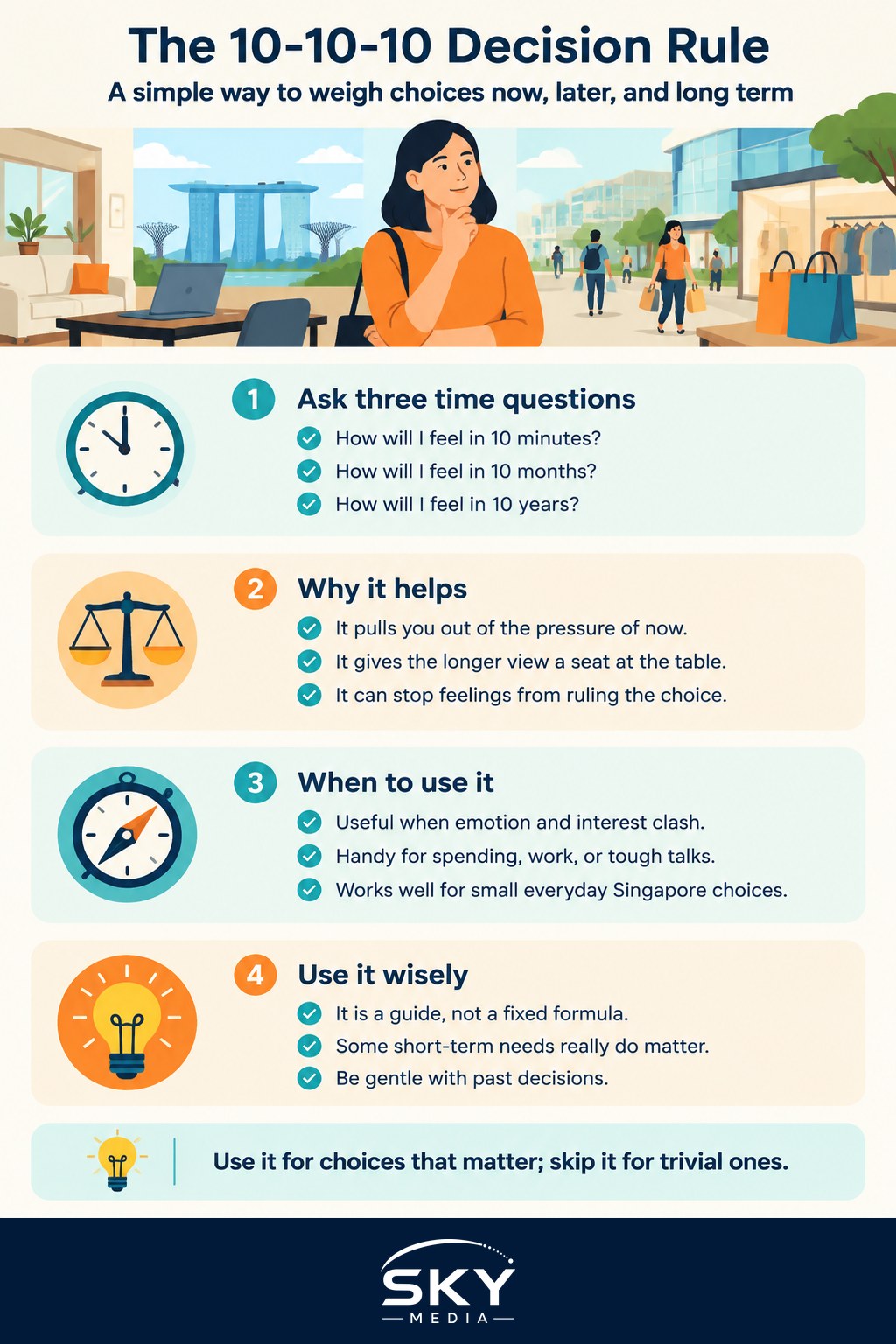
What the 10-10-10 rule is
The 10-10-10 rule is a decision making framework popularised by writer Suzy Welch, who described using three time frames to weigh choices. The specific numbers are not meant to be literal. They are stand-ins for the immediate, the medium term, and the long term. You could just as easily think in terms of later today, next year, and the rest of your life. The value is in deliberately looking at a decision from more than one distance.
Why does this help? Because in the moment, our feelings are loud. The urge to avoid an awkward conversation, the temptation of an easy purchase, the fear of speaking up, all of these shout at us in the present tense. Left unchecked, they push us toward choices that feel good now but cost us later. The 10-10-10 rule for decisions gives the quieter, longer view a seat at the table, so the loudest feeling does not automatically win.
How to use the three time horizons
Using the rule takes only a few minutes, but it is best done honestly rather than as a formality.
- In 10 minutes: How will you feel right after the decision? This captures the immediate emotion, the relief, the discomfort, the excitement, or the fear.
- In 10 months: How will this look once the immediate feeling has faded? This is where medium-term consequences show up: your finances, your health, your relationships, your progress on a goal.
- In 10 years: Will this even matter? Sometimes this horizon reveals that a decision you are agonising over is genuinely small. Other times it shows that a choice you are tempted to make lightly is actually significant.
Take a real example. You are offered a tempting but expensive gadget on an online sale. In 10 minutes, buying it feels great. In 10 months, you might feel the dent in your savings and realise you barely use it. In 10 years, it is forgotten entirely. Laid out like this, the honest choice becomes clearer. The same three questions work for whether to speak up in a meeting, whether to take on extra commitments, or whether to have a difficult but necessary conversation.
Where the 10-10-10 rule fits best
This tool is most useful for decisions where short-term emotion and long-term interest pull in different directions. Impulse spending, avoiding hard tasks, reacting in anger, or saying yes when you should say no. In all of these, the present feeling is a poor guide, and stretching your view across the three horizons helps you act more in line with what you actually value.
It works well with other clear-thinking habits. Slowing down to run the three questions naturally reduces the pull of impulse, which supports how to stop overthinking by giving your mind a structure to follow instead of endless looping. It also complements broader skills in how to make better decisions, and it can quietly reinforce your sense of finding your personal values, because the 10 year horizon often reveals what truly matters to you.
For everyday Singapore life, the rule is handy precisely because so many of our decisions are small and fast. A quick shopping cart, a supper invite, an extra project at work, an emotional reply to a message. Running even a rough version of the three questions in your head takes seconds and can save you a lot of later regret.
Using it wisely, not rigidly
A few honest caveats keep this tool useful rather than misleading. First, the 10-10-10 rule is a guide, not a formula that spits out the “correct” answer. It organises your thinking, but you still have to weigh the horizons yourself, and different people will reasonably weigh them differently. Sometimes the short-term matters most, for instance choosing rest when you are genuinely worn out.
Second, not every decision deserves this much analysis. For trivial choices, running the full framework is overkill and can even feed indecision. Save it for the choices that actually carry some weight. If you find yourself over-analysing everything, that is a sign to lighten up, and learning how to avoid analysis paralysis becomes just as important as thinking things through.
Finally, be gentle with yourself about past decisions. The point of the 10-10-10 rule is to help you choose more thoughtfully going forward, not to fuel regret over choices you already made with the information you had at the time. Everyone makes calls they would revisit with hindsight.
Used with that balance, the 10-10-10 rule for decisions is a calm, practical companion for the many small and large choices of daily life. Ask how you will feel in 10 minutes, 10 months, and 10 years, listen honestly to all three answers, and let that wider view guide you toward decisions you can be at peace with.
Further reading: The Regret Minimisation Framework for Big Life Decisions · The Warren Buffett Priority Rule · The 5 Second Rule Explained