

Supporting a parent in their later years is something many Singapore families take on with love, but it can strain household finances if the money side is left vague. Learning to budget for ageing parents means turning good intentions into numbers: what your parents already have, what they spend, what may change as their health changes, and who in the family pays for what. This guide focuses on building that budget, both month to month and for the longer term.
This is general information, not financial advice. Government schemes, payouts and eligibility rules change, so confirm current details with CPF Board, the Ministry of Health (MOH), the Agency for Integrated Care (AIC) and IRAS.
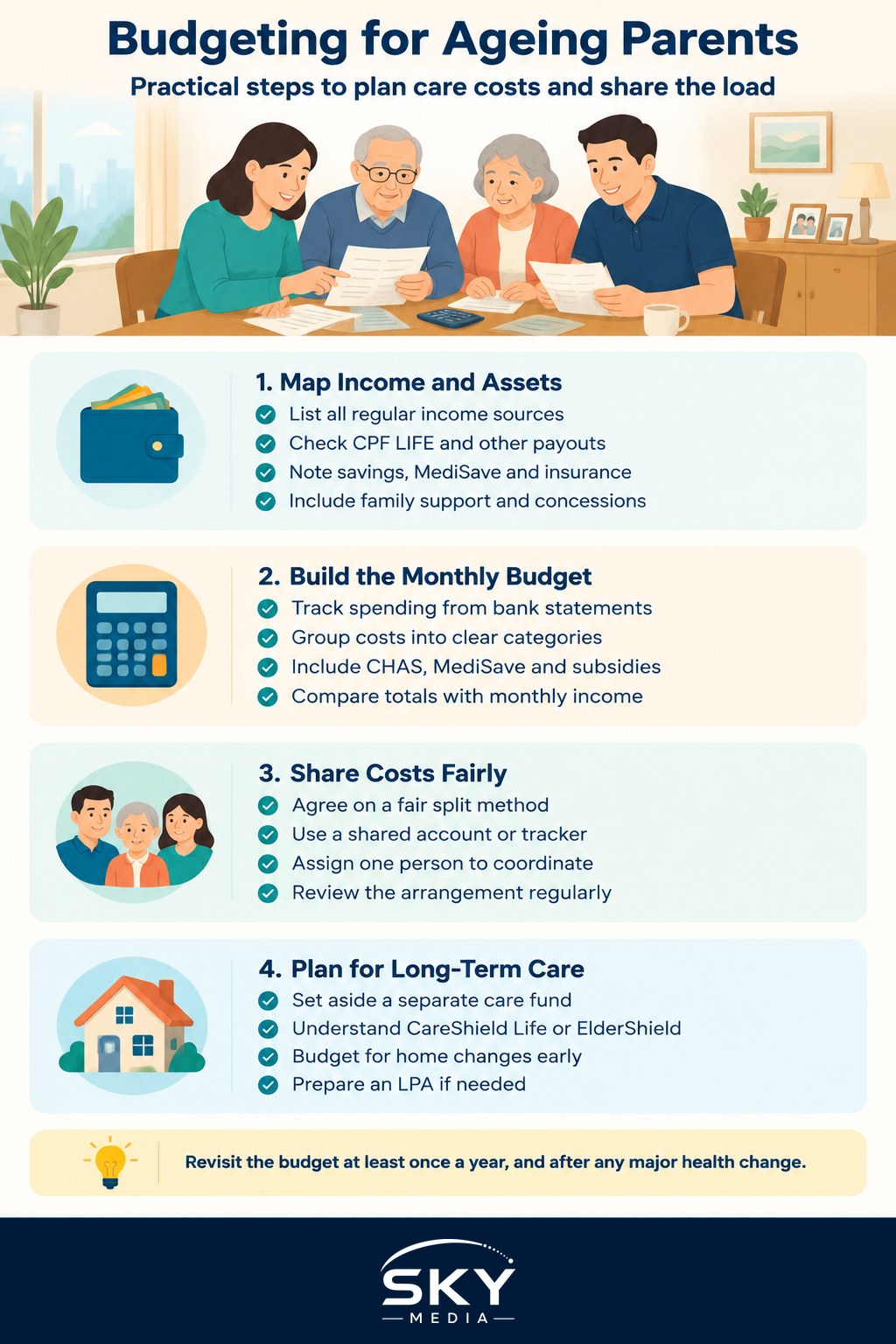
Step One: Map What Your Parents Already Have
A budget starts with income and assets, not just costs. Sit down with your parents, gently and respectfully, and build a picture together. Our guide on talking to your family about ageing has tips for starting this conversation.
List their regular income sources, which may include:
- CPF LIFE or other CPF retirement payouts. Your parents can check their payout details through the CPF Board website or app.
- Government support schemes they may qualify for, such as Silver Support Scheme payouts or other assistance. Check eligibility on official sites rather than assuming.
- Pensions, rental income, annuities or part-time work.
- Regular money from children, including how much each sibling currently gives.
Then list their assets and protections:
- Savings and fixed deposits.
- MediSave balances, which can be used for approved medical expenses.
- Health insurance, including MediShield Life and any Integrated Shield Plan.
- Long-term care insurance such as CareShield Life or ElderShield, depending on their age and coverage.
- Any concessions tied to their generation, such as Pioneer Generation or Merdeka Generation benefits.
Knowing these figures lets you see the real gap you need to fill, rather than guessing.
Step Two: Build the Monthly Budget
Next, track what your parents actually spend in a typical month. If possible, look at two or three months of bank statements and receipts, because one month can be unusual.
Group expenses into clear categories:
| Budget category | What to include | Where help may come from |
|---|---|---|
| Daily living | Food, groceries, utilities, phone, transport, household items | Parents’ own income, children’s contributions |
| Routine healthcare | GP and polyclinic visits, chronic medicine, dental, spectacles | CHAS subsidies, MediSave for approved treatments, generation packages |
| Home and safety | Grab bars, non-slip mats, minor repairs, cleaning help | Subsidy schemes for senior-friendly fittings, family |
| Caregiving support | Day care, home care visits, a domestic helper, respite care | AIC-listed subsidies and grants, family pool |
| Social and wellbeing | Activities, outings, hobbies, religious contributions | Parents’ own budget, community programmes |
| Irregular and one-off costs | Hospital stays, mobility aids, festive expenses, travel | Insurance, MediSave, emergency fund |
CHAS (Community Health Assist Scheme) gives subsidies at participating GP and dental clinics for eligible Singaporeans, so check whether your parents hold a CHAS card and which tier applies.
Once you have the totals, compare them with their monthly income. The difference is the monthly gap the family needs to cover. Write it down as a single number everyone can see.
Step Three: Agree How the Family Shares Costs
Money is one of the most common causes of friction between siblings caring for parents. A clear, written arrangement can prevent misunderstandings. Our guide on caring for ageing parents as a family covers the wider roles, but for the budget itself:
- Choose a fair method. Some families split costs equally. Others split by income, or recognise that one sibling contributes time as the main caregiver instead of money.
- Use a shared account or tracker. A joint account or a simple shared spreadsheet makes contributions and spending visible.
- Assign a coordinator. One person tracks bills and reports back regularly, so nothing slips.
- Review every few months. Costs change as health changes, and so do siblings’ circumstances.
- Include your parents. Older adults usually want a say in how their money and care are managed. Respect their preferences where possible.
Also check tax matters. IRAS offers reliefs related to supporting parents, and CPF top-ups to a parent’s retirement account may qualify for tax relief under certain conditions. Check IRAS and CPF Board for current rules and limits before planning around them.
Step Four: Plan for Long-Term Care Costs
Monthly budgets cover today. Long-term planning covers the years when your parents may need more help, such as after a fall, a stroke or a gradual decline in mobility or memory.
Practical steps:
- Build a care fund. Set aside a monthly amount in a separate account for future care needs, distinct from the family’s general savings.
- Understand insurance payouts. Find out what CareShield Life or ElderShield would pay if your parent became severely disabled, and how claims work. Read the policy wording or check with CPF Board and the insurer.
- Know the care options and their cost drivers. Home care, day care centres, a live-in helper and nursing homes have very different cost structures. AIC lists options and the subsidies available, which are often means-tested based on household income.
- Consider where your parents will live. Many families prefer ageing in place, which may need home modifications and regular support. Budget for these early.
- Prepare legal documents. A Lasting Power of Attorney (LPA), registered with the Office of the Public Guardian, lets a trusted person make financial and personal welfare decisions if your parent loses mental capacity. Without it, families may face a longer court process to manage a parent’s finances.
Step Five: Protect Your Own Finances
It is natural to put parents first, but supporting them should not wipe out your own retirement or your children’s needs.
- Keep your own emergency fund separate from the parent care fund.
- Continue contributing to your own retirement savings where you can.
- Avoid taking on high-interest debt to pay for care. Explore subsidies, grants and family sharing first.
- If you are the main caregiver and reduce your working hours, discuss with siblings how that loss of income will be recognised.
- Check whether you qualify for caregiver support, such as the Home Caregiving Grant, through AIC.
Keeping the Budget Working Over Time
A budget for ageing parents is a living document. Revisit it at least once a year, and immediately after any major health event, hospital stay or change in living arrangements. Keep a folder, physical or digital, with your parents’ key documents: NRIC copies, CPF and insurance details, medical records, LPA, and a list of contacts.
Most importantly, keep the conversation open. Financial planning works best when your parents feel respected and involved, and when siblings trust the numbers. For help understanding the medical side of care costs, read our guide on navigating the healthcare system for an ageing parent.
Official sources: Agency for Integrated Care