
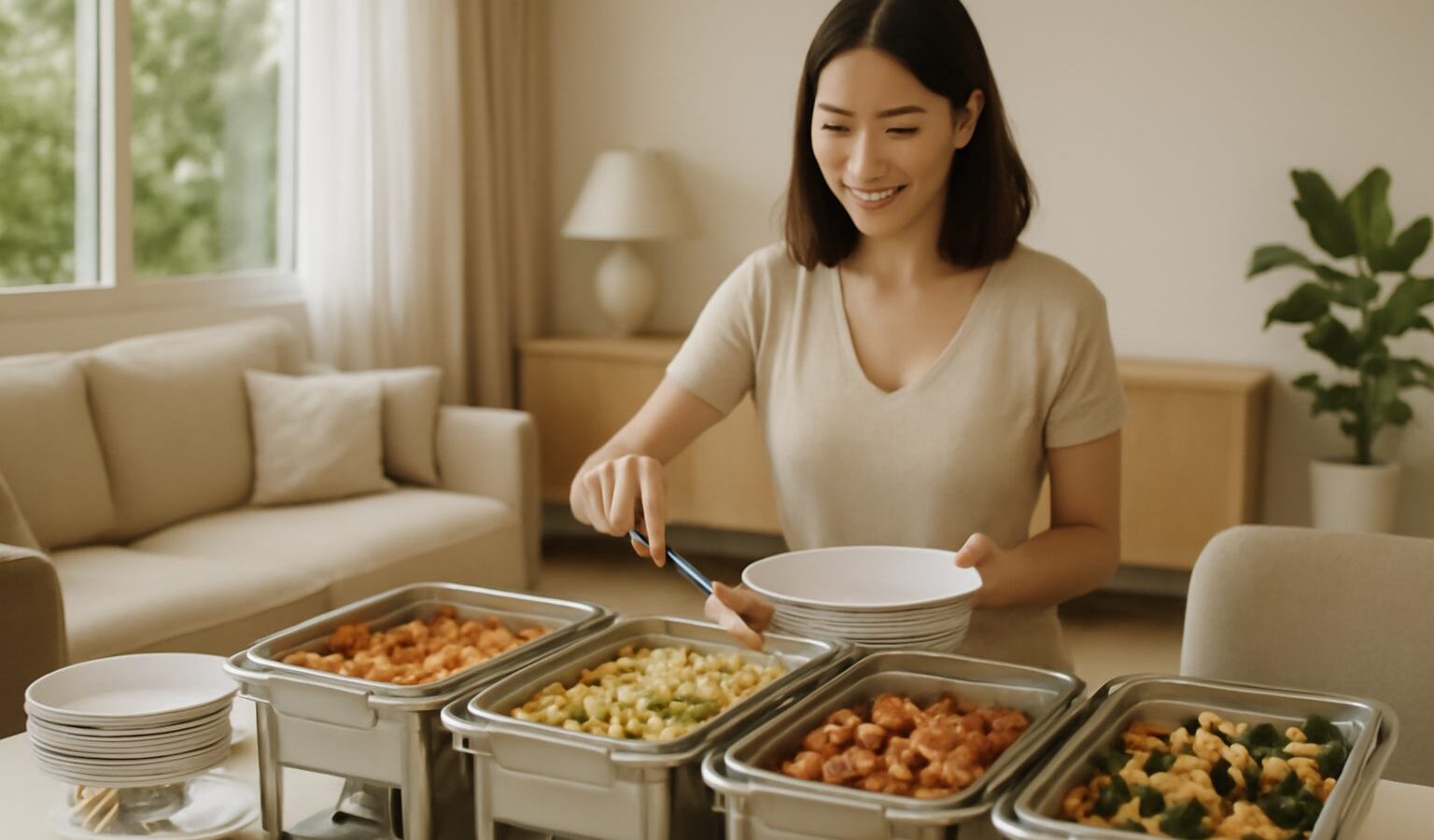
When the guest list grows beyond what your kitchen can handle, buffet catering in Singapore is the usual answer. Birthdays, full-month celebrations, housewarmings, festive gatherings and post-funeral meals are all commonly catered at home, and the market is crowded with options from small home-based cooks to large commercial caterers.
That choice is also what makes it confusing. Menus look similar, prices are quoted per person with different minimums, and the details that matter most for a home party, such as setup space, delivery access and halal status, are often buried in the fine print. This guide walks through how to choose a caterer and plan the logistics for an HDB flat or condo.
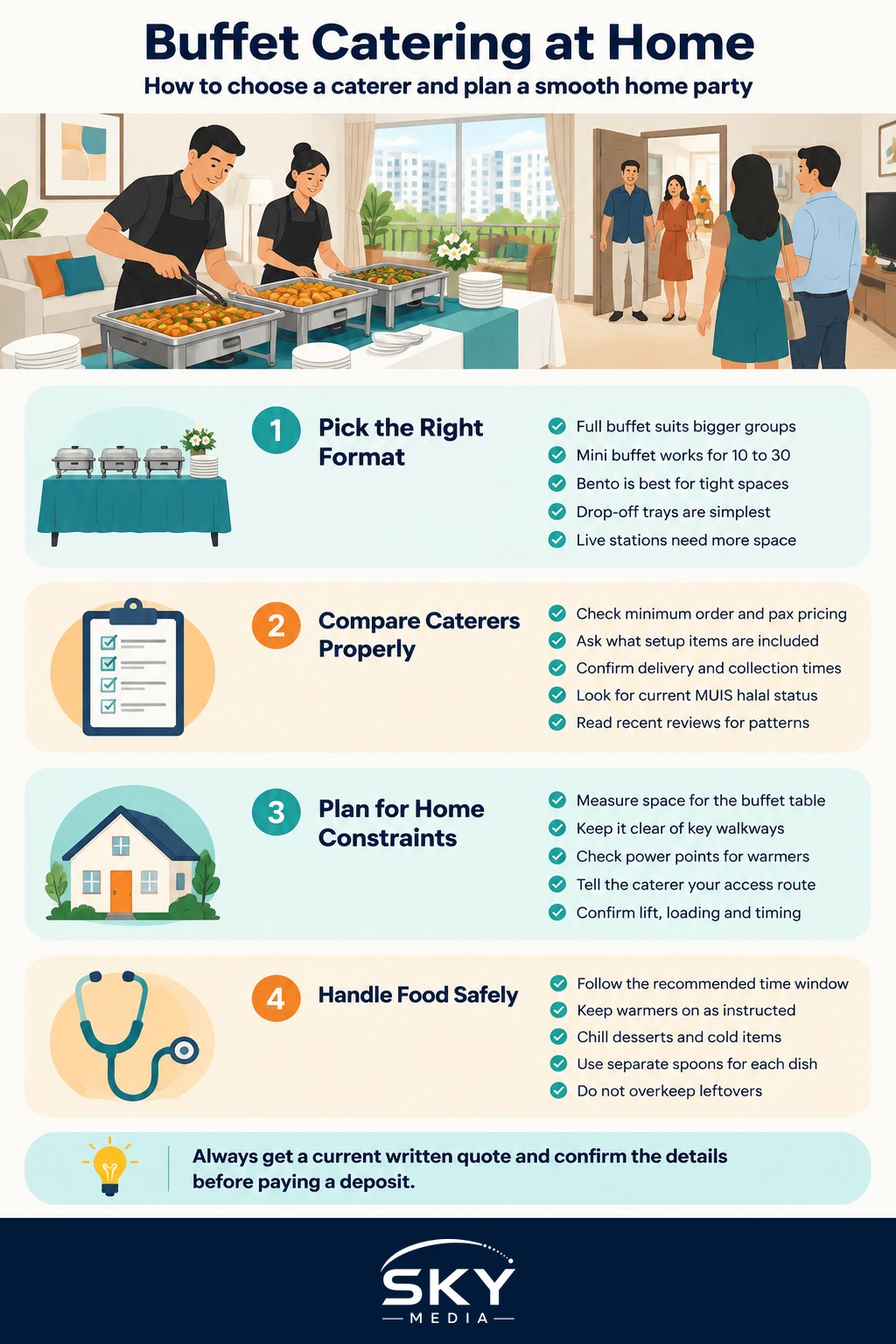
Decide What Kind of Buffet You Actually Need
Caterers usually offer a few formats. Choosing the right one first narrows your search a lot.
- Full buffet with setup. The caterer delivers food in chafing dishes or warmers, sets up a skirted table, and returns later to collect equipment. Best for larger groups and longer events.
- Mini buffet. Smaller menus for smaller headcounts, often with simpler setup. Good for 10 to 30 people at home.
- Bento or packed meals. Individual boxes rather than a shared spread. Useful for very tight spaces or when guests arrive in waves.
- Drop-off trays. Food in disposable trays with no warmers or staff. Cheapest and simplest, but you handle the serving and keeping things warm.
- Live stations or service staff. Some caterers offer a chef or attendant for items like carving, pasta or satay. These need more space and usually cost more.
For most home parties, a mini buffet or full buffet with setup is the sweet spot.
How to Compare Caterers
Once you know the format, shortlist a few caterers and compare them on the same points. Ask for written quotes so you can line them up side by side.
| What to compare | What to ask or check | Why it matters at home |
|---|---|---|
| Minimum order and pax pricing | Minimum number of guests, price per person, whether GST and delivery are included | Small home parties can fall below a minimum, pushing your cost up |
| Setup and equipment | Whether warmers, table, skirting, utensils and plates are provided and collected | You may not own enough serving ware for 20 or more people |
| Delivery window and collection | Delivery time range, how early setup happens, when collection takes place | Affects lift access, neighbours and when you can clean up |
| Halal certification | Whether the caterer and its kitchen hold current MUIS halal certification | Essential if Muslim guests are attending |
| Menu flexibility | Ability to swap dishes, add vegetarian options, adjust spice levels, cater for allergies | Mixed-age and mixed-diet guest lists are the norm |
| Food safety and licensing | Whether the business is licensed by the Singapore Food Agency (SFA) | Shows the kitchen meets regulatory standards |
| Cancellation and change terms | Deadline to change headcount, deposit rules, refund policy | Guest numbers often shift in the final week |
Read recent reviews for patterns rather than single complaints. Repeated comments about late delivery, cold food or small portions are worth taking seriously.
Halal and Dietary Considerations
Singapore’s guest lists are often diverse, so dietary planning is part of choosing a caterer, not an afterthought.
- Halal. In Singapore, halal certification is issued by MUIS (the Islamic Religious Council of Singapore). A caterer labelling a menu as “no pork, no lard” is not the same as holding halal certification. If you have Muslim guests, look for a current MUIS certificate and verify it using the halal directory on the MUIS website. Some caterers have separate certified kitchens or brands for their halal range.
- Vegetarian and vegan. Ask whether vegetarian dishes are cooked separately and whether they use egg, dairy, onion or garlic, which matters for some guests.
- Allergies. Ask about nuts, shellfish, gluten and dairy, and whether the caterer can label dishes.
- Spice levels and kids. Ask for a few mild dishes if young children or elderly relatives are coming.
If your guests have mixed needs, a fully halal-certified buffet is often the simplest way to make sure everyone can eat from the same table. For guidance on halal planning for large events, see our guide to wedding catering and menus in Singapore, which covers similar questions at a bigger scale.
Plan for HDB and Condo Constraints
Home buffets bring practical challenges that restaurants never face. Sort these out before the delivery van arrives.
Space
– Measure where the buffet table will go. A standard caterer table can be longer than you expect. Allow room for guests to queue on one side without blocking the main walkway.
– Keep the buffet away from your main door, the kitchen entrance and the toilet path.
– Make sure there is a power point nearby if any warmers or equipment are electric. Most chafing dishes use small fuel cans, so keep them away from curtains and children.
Access and delivery
– Tell the caterer your block, unit number, and which lift or loading point to use. In condos, check whether deliveries must go through the guardhouse or a service lift, and whether the MCST (the condo’s management body) requires prior notice.
– Confirm whether there is somewhere for the delivery vehicle to stop briefly. Some HDB blocks and condos have limited loading bays.
– Clear shoes and items from the corridor so staff can carry equipment in safely.
Timing
– Ask for delivery shortly before guests arrive, so food is not sitting out too long.
– Agree on a collection time that does not cut your party short or keep equipment overnight unless that is your plan.
Food Safety for Catered Buffets
Catered food is prepared in licensed kitchens, but once it is on your table, handling is up to you. Most caterers print a recommended consumption window on their packaging or invoice, so follow it.
- Keep warmers lit and topped up as instructed, and do not leave food sitting out well beyond the recommended time.
- Avoid packing leftovers after food has been sitting out for a long time.
- Keep desserts and cold items chilled until needed.
- Use separate serving spoons for each dish, especially for halal or vegetarian food.
SFA publishes general food safety advice for consumers, which is worth a read if you host often.
Common Booking Mistakes to Avoid
- Booking too late. Popular dates around festive seasons, weekends and public holidays fill up early. Book as soon as your date is fixed.
- Ordering for the full RSVP count. Not every guest eats a full portion, especially at afternoon events. Ask the caterer for advice on portion planning.
- Forgetting drinks and ice. Many buffets do not include them by default.
- Not checking what is collected. Know whether trays, warmers and table skirting will be picked up, or if anything is disposable.
- Skipping the confirmation call. Confirm address, time, headcount and dietary notes a few days before.
Making the Most of Your Home Buffet
A caterer takes the cooking off your plate, but a little planning still makes the difference between a smooth party and a stressful one. Set up a drinks table separately, plan where guests will sit or stand, and prepare containers for leftovers. If you are hosting a child’s celebration, our guide to children’s birthday parties in Singapore has ideas for keeping young guests entertained, and if you want to cut waste from disposables, sustainable parties and gatherings offers practical swaps.
Prices, minimums and terms vary between caterers and change over time, so always get a current written quote and confirm the details directly before paying a deposit.
Frequently Asked Questions
Is a home-based cook or a commercial caterer better for a home party? It depends on size and needs. Home-based cooks can suit small parties, while larger caterers tend to offer equipment, setup and clearer licensing. Compare written quotes, minimum orders and what is collected afterwards.
How can I check that a caterer is really halal? Halal means current MUIS certification, which is not the same as a menu saying no pork, no lard. Verify the certificate in the halal directory on the MUIS website, and note some caterers run separate certified kitchens or brands.
How much buffet food should I order for a small home party? Do not order for the full RSVP count by default, since not every guest eats a full portion, especially at afternoon events. Ask the caterer for portion advice, and remember drinks and ice often are not included.
What is a drop-off tray set versus a full buffet with setup? Drop-off trays come in disposable containers with no warmers or staff, so they are cheapest but you handle serving and keeping food warm. A full buffet includes chafing dishes, a skirted table and later collection of equipment.
Can a caterer deliver to my condo or HDB block without problems? Tell them your block, unit and which lift or loading point to use. In condos, check whether deliveries go through the guardhouse or a service lift and whether the MCST needs prior notice. Confirm where the vehicle can stop.
Further reading: Finger Food Ideas for Home Parties in Singapore · Ordering Deepavali Catering for a Home Gathering in Singapore