

Many of us end the day the way we spend it: in a rush. You reach home late from the office, wolf down dinner, half-watch a show while clearing messages, then scroll in bed until your eyes give up. The next morning you feel like you never really switched off, because you did not. A good evening routine fixes this by giving your mind and body a clear signal that the working day is over and rest can begin.
An evening routine is not a rigid checklist that steals your one relaxing hour. It is a short, calming sequence that helps you close the loop on today and set up tomorrow, so you sleep better and wake less frazzled. This guide covers why the wind-down matters, what to include, and how to keep it realistic when your evenings are already short.
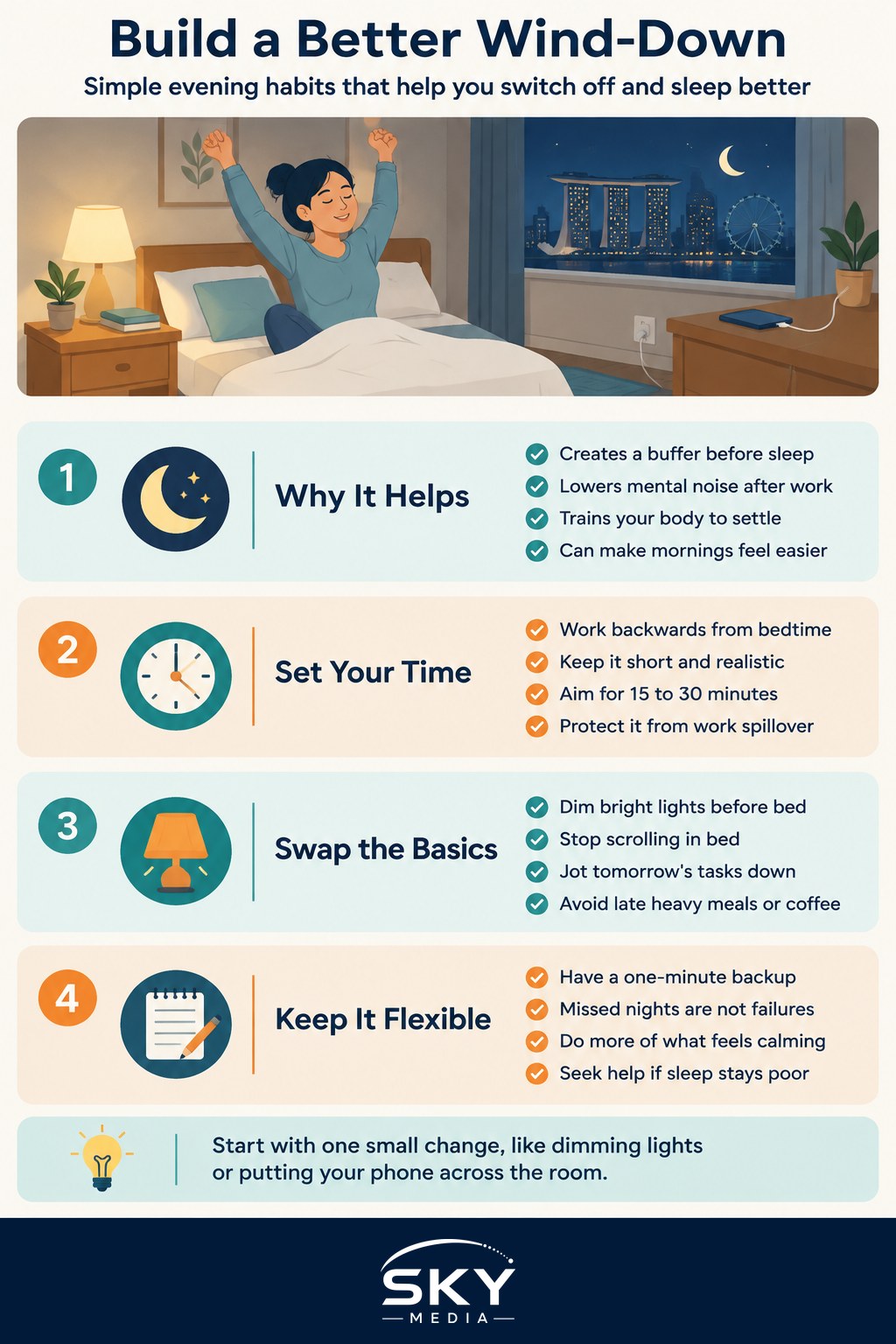
Why the Wind-Down Matters More Than You Think
Your body does not have a switch that flips from busy to sleepy on command. It needs cues, and it needs a little time. When you go straight from a stressful video call or a doom-scroll into bed, your mind is still racing through tasks and worries, and sleep comes slowly or shallowly.
A wind-down routine creates a buffer between doing and resting. That buffer lowers the mental noise, so when your head hits the pillow you are actually ready. Over time, doing the same calming steps in the same order trains your body to associate them with sleep, the way a bedtime story once did as a child.
There is a knock-on effect too. A calmer night makes a calmer morning far easier. If you keep struggling to wake, the fix often lies in the evening before, not the alarm.
Set a Realistic Wind-Down Time
The first step is deciding when the wind-down begins, working backwards from when you want to be asleep. If you hope to sleep by 11pm, your wind-down might start around 10:15pm. That is your signal to stop working, stop chores, and begin slowing down.
Be honest about your evenings. If you only get home at 9pm, a ninety-minute ritual is a fantasy that you will resent and skip. Aim for fifteen to thirty minutes of genuine wind-down rather than an elaborate routine you cannot sustain. Short and consistent beats long and occasional every time.
It also helps to protect the wind-down from spillover work. Singapore’s always-on work culture means messages can arrive at any hour. Decide on a soft cut-off after which you stop replying unless it is a true emergency, and let colleagues learn that pattern.
What to Include, and What to Cut
A wind-down works best when it moves you from stimulation towards calm. The two biggest levers are light and screens. Bright light and glowing phones tell your brain it is still daytime, so dimming both is the single most effective change most people can make.
Here is how common evening habits compare, so you can swap the draining ones for restful ones.
| Habit | Effect on sleep | Better alternative |
|---|---|---|
| Scrolling in bed | Keeps the mind alert and delays sleep | Read a book or the NLB app in the living room |
| Working right up to bedtime | Leaves the brain in problem-solving mode | Set a soft cut-off and jot tomorrow’s tasks down |
| Bright overhead lights | Signals daytime to the body | Switch to a dim lamp an hour before bed |
| Late heavy meals or coffee | Disrupts falling and staying asleep | Finish dinner earlier; switch to water or tea |
You do not need to adopt all of these at once. Pick the one that bothers your sleep the most and start there. Small, steady swaps are easier to keep than a full overhaul.
A Sample Evening Routine
Every home is different, so treat this as a starting point rather than a rule. Someone winding down towards an 11pm bedtime might follow a sequence like this.
- Around 9:45pm, tidy for five minutes and lay out tomorrow’s clothes and bag.
- Jot down anything on your mind: unfinished tasks, worries, or your top three jobs for tomorrow. Getting them onto paper stops them looping in your head.
- Dim the lights and put the phone on charge across the room, not on the nightstand.
- Do something calming for ten to fifteen minutes: read, stretch gently, shower, or simply sit quietly.
- Get into bed at a consistent time, even on nights you do not feel sleepy, so your body learns the pattern.
The writing-things-down step is quietly powerful. Much of the racing mind at night is the brain trying not to forget things. Once they are captured somewhere you trust, it can let go.
Keep It Going, and Be Kind to Yourself
Evenings are unpredictable. There will be dinners out, late-night deadlines, dramas you cannot stop watching, and children who refuse to settle. A routine that only works on perfect nights is not much use, so build in flexibility.
- Have a one-minute version for exhausted nights: phone across the room, lights dim, into bed. That alone protects your sleep.
- Do not chase perfection. A missed night is not a failure; just return to the routine the next evening rather than giving up.
- Watch the caffeine and the doom-scrolling, the two habits that quietly undo everyone’s best intentions.
- Notice what actually helps you feel calm and do more of that, whether it is a warm shower, quiet music, or a few pages of a novel.
If you are persistently unable to sleep, or you often feel low, anxious, or overwhelmed at night, that is worth taking seriously. General wind-down tips are not a substitute for proper help. Speak to your doctor, or reach out to the Samaritans of Singapore (SOS) on 1767 or mindline.sg if you need someone to talk to.
Give any new routine a few weeks before you judge it. Sleep habits shift slowly, and the point is not a flawless ritual but a gentler, more consistent close to your day.
Explore more
A good night and a good morning are two halves of the same habit. Pair this with building a morning routine that works, and use how to build habits that actually stick plus how to stay consistent when life gets busy to keep your evening routine going once the novelty fades.