

As Teachers’ Day approaches each September, many parents pause before buying anything and wonder: can teachers accept gifts at all? It is a fair question, especially for families new to Singapore who may come from school systems with very different customs. The short answer is that teachers in Singapore’s government and government-aided schools can usually accept small tokens of appreciation, but they work under public service rules that discourage anything of real value.
This guide explains how those rules work in general terms, why they exist, and how to thank a teacher in ways that never cause them trouble. It is general information, not legal advice. Rules and internal guidance can change, so always follow what your child’s school tells you.
Why Teachers Have Gift Rules at All
Teachers in Ministry of Education (MOE) schools are public officers. Singapore’s public service places a strong emphasis on integrity and on avoiding anything that could look like favouritism or influence. Public officers are expected not to accept gifts or benefits that could create, or appear to create, an obligation to the giver.
For teachers, the concern is easy to understand. A teacher marks work, writes reports, recommends students for programmes and manages class placements. Even a well-meant expensive gift could make other parents wonder whether a child is being treated differently. The rules protect the teacher, your child and the fairness of the whole class.
Independent schools, international schools, private enrichment centres and tuition agencies are not run the same way as MOE schools. They usually set their own policies for staff, so if your child attends one of these, ask the school directly.
How Gift Rules Generally Work for Public School Teachers
The detailed rules sit in the public service’s internal guidance and MOE’s own instructions to staff, which are not all published for parents. Broadly, the approach looks like this:
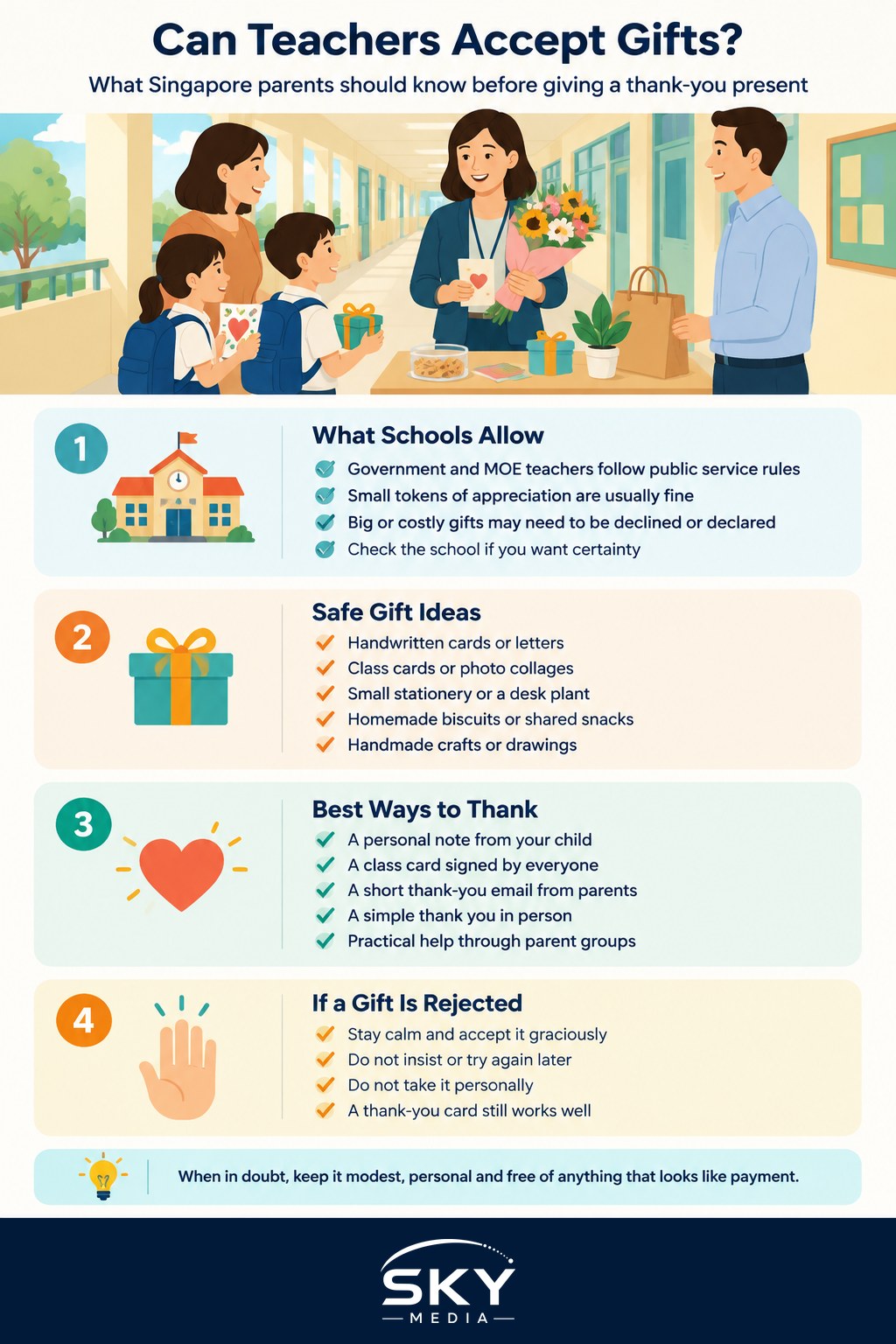
- Token gifts are generally fine. A card, a handmade item, flowers, snacks to share or inexpensive stationery are the kind of gifts teachers commonly receive and keep.
- Valuable gifts must be handled formally. Where a gift is of more than nominal value, a public officer typically has to decline it or declare it to their organisation, which then decides what happens to it. In some cases the officer may be allowed to keep it only by paying for it.
- Cash and cash equivalents are a no. Money, ang bao, vouchers and gift cards are treated very cautiously because they look like payment.
- Timing and context matter. A gift linked to a decision, such as around results, placement or a disciplinary matter, is inappropriate whatever its value.
You may see specific dollar figures mentioned in parent forums. Treat these with caution: limits and procedures are set internally and can be updated. The safest approach is to keep gifts clearly modest so the question never arises. If you need certainty, ask the school’s general office or check guidance shared in a school circular.
What Counts as a Token Gift
“Token” means the gift’s value is in the thought, not the price. A useful test is to ask: would the teacher feel comfortable if every colleague and parent saw this gift? If yes, you are on safe ground.
| Usually fine | Better to avoid |
|---|---|
| Handwritten card or letter from your child | Cash, ang bao or vouchers |
| Class card or photo collage | Branded bags, jewellery or watches |
| Small stationery or desk plant | Electronics or gadgets |
| Homemade biscuits or shared snacks | Alcohol |
| Handmade craft or drawing | Gifts given while asking for a favour |
Pooled class gifts deserve a note. When a class group collects money, the combined value can quietly creep up. Keep the total modest, or split it into small thank-you items for several teachers rather than one bigger present for the form teacher.
What Happens If a Teacher Declines
Occasionally a teacher may politely return a gift or say they cannot keep it. This is not rudeness and it is not a judgement on you. They are following rules that apply to them as public officers.
If this happens:
- Accept it graciously. A simple “No problem, thank you for everything” keeps the relationship warm.
- Do not insist or try again later. Pressing a teacher to accept puts them in a difficult position.
- Do not take it personally. Many teachers would rather receive a note than any object.
- Redirect the gesture. Your child can still give a card or say thank you in person.
Teachers may also share gifts like snacks with the whole staff room. That is a common and welcome practice.
Safer Ways to Say Thank You
Ask almost any teacher what they treasure, and the answer is usually the same: words. Notes from students are often kept for years and reread on difficult days.
- A personal card from your child. Specific memories, such as a lesson they enjoyed or how the teacher helped them, matter most.
- A class card. Every student signs or draws something. It costs almost nothing and is truly shared.
- A short message from the parent. A thank-you note or an email describing how the teacher helped your child is meaningful and fully appropriate. Some parents also send a compliment to the school leadership, which can support the teacher professionally.
- Practical help. Volunteering through the school’s parent support group, if your school has one, is another way to give back.
- Saying it out loud. Encouraging your child to thank the teacher in person builds confidence and gratitude.
A Note for Newcomer Families
Parents arriving from places where teacher gifts are more elaborate, or where gift-giving is linked to relationships with the school, may find Singapore’s approach unusually strict. It helps to know that this is not about distrust of parents. Singapore’s public institutions keep a clear line between appreciation and influence, and teachers are trained to stay on the right side of it.
You do not need a gift to build a good relationship with your child’s teacher. Turning up to parent-teacher meetings, reading school messages promptly and communicating respectfully count for far more. If you are curious about what the job involves, our guide to becoming a school teacher in Singapore explains the profession from the inside, and our home tuition guide covers how private tutors differ.
Quick Checklist Before You Give
- Is it clearly modest in value?
- Is it free of cash, vouchers or anything that resembles payment?
- Is the timing unconnected to any decision about your child?
- Would the teacher be comfortable if everyone saw it?
- Does it include a personal message?
If you can answer yes to all five, your gift will be received the way you intended: as a simple thank you.
Official sources: Ministry of Education (MOE)