

Sharing a ride with a colleague who lives nearby, or with a neighbour who drives past your MRT station every morning, makes a lot of sense in Singapore. Cars are expensive to own and run, roads are busy at peak hours, and fewer cars on the road is better for everyone. Many people, though, are unsure where friendly cost-sharing ends and illegal hire begins.
This guide explains how carpooling in Singapore is generally treated, how it differs from running an unlicensed taxi or private hire service, and fair, practical ways for colleagues and neighbours to split costs. It is general information, not legal advice. The Land Transport Authority (LTA) sets the rules, and they can change, so check LTA’s website for the current position before you start a regular arrangement.
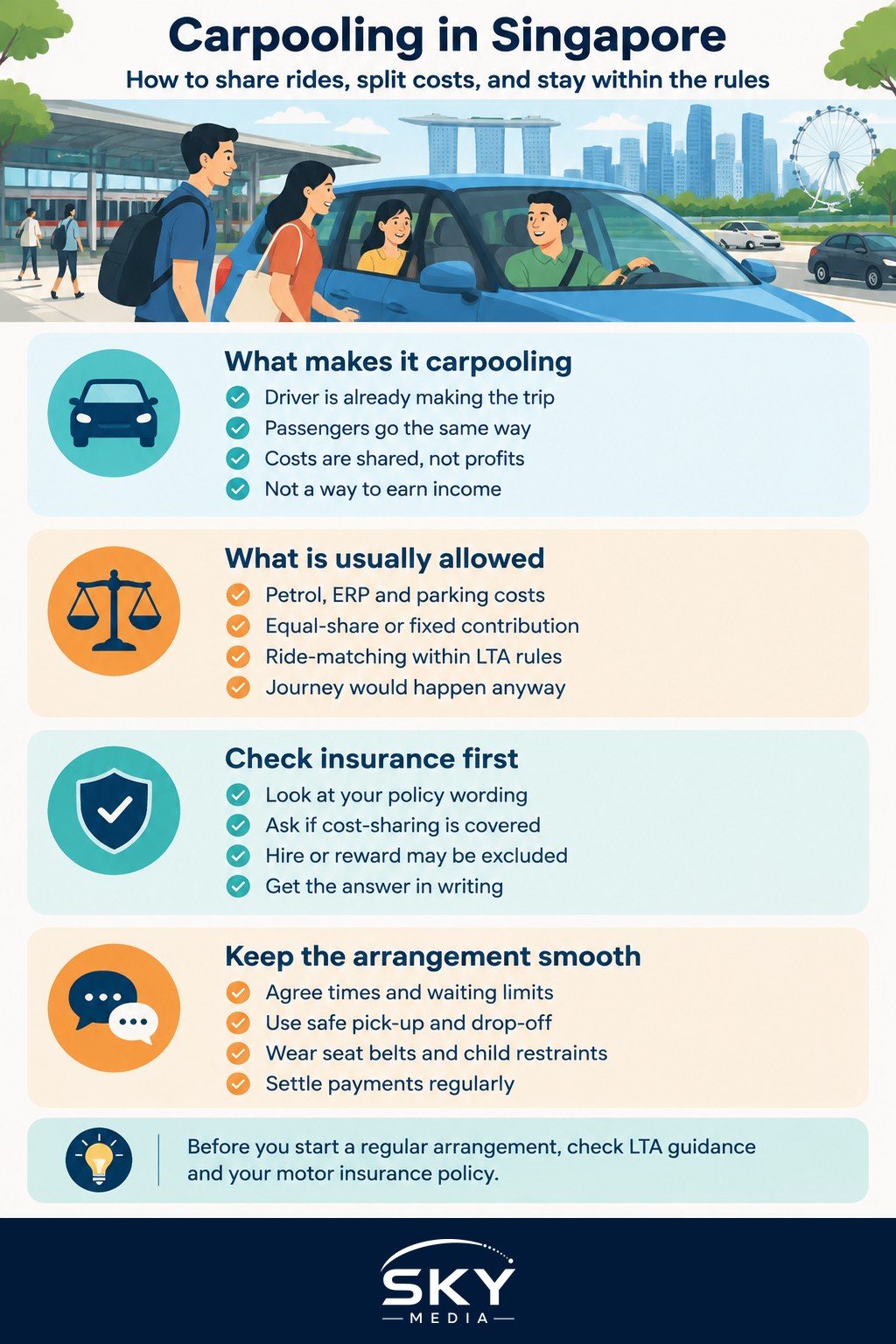
Carpooling Versus Illegal Hire: The Key Difference
Singapore regulates vehicles that carry passengers for payment. Taxis and private hire cars must be properly licensed, the vehicles must be registered for that use, and drivers need the right vocational licence. Using an ordinary private car to carry paying passengers as a business, without these licences, is treated as illegal hire and can lead to penalties for the driver.
Carpooling is different in purpose. The idea is that a driver who is already making a journey shares it with others going the same way, and the passengers help cover the cost of the trip. The driver is not making a living from it.
In broad terms, the factors that usually separate permitted carpooling from illegal hire are:
- Profit. Payment should cover the cost of the journey, such as petrol, ERP charges and parking, rather than earn the driver an income.
- Purpose of the trip. The driver would be travelling anyway, for example between home and work.
- Frequency. LTA has set limits on how many paid carpool trips a driver may make, which helps separate genuine carpooling from a hire service.
- How passengers find the ride. Ride-matching platforms that offer carpooling must work within LTA’s framework, and taking random paying passengers off the street is not carpooling.
Because the detailed conditions are set by LTA and may be updated, read the latest guidance on the LTA website, and if your situation is unusual, consider getting proper legal advice. Our explainer on getting legal help and legal aid in Singapore lists where to start.
A Quick Comparison
| Situation | Usually treated as | What to watch out for |
|---|---|---|
| Colleagues sharing petrol and ERP on the daily commute | Carpooling | Payment should not exceed the cost of the trip |
| Neighbour gives you a lift and you buy them coffee | Informal goodwill | Generally no issue |
| Driver takes paying strangers on many trips a day for income | Illegal hire, unless properly licensed | Licensing, vocational licence and vehicle requirements |
| Carpool arranged through a ride-matching app’s carpool service | Carpooling within LTA’s rules | Platform terms and LTA’s trip and fare conditions |
Check Your Car Insurance First
Before you agree to a regular paid carpool, check your motor insurance. Private car policies are usually written for social, domestic and pleasure use, and often commuting. Many policies exclude using the car for “hire or reward”, which means carrying passengers for payment.
Whether a cost-sharing carpool counts as hire or reward depends on the policy wording, not on what feels fair. If an accident happens and the insurer decides the car was being used outside the policy’s terms, a claim could be affected. To avoid surprises:
- Read the “limitations as to use” section of your policy.
- Ask your insurer directly whether regular cost-sharing carpools with colleagues or neighbours are covered.
- Get the answer in writing if possible.
- If you join a carpooling platform, check whether it provides any cover and what it applies to.
Passengers should also know that they are travelling in a private car and that the driver’s insurance is what applies.
Fair Ways to Split Carpool Costs
Once you are confident the arrangement is permitted and insured, the next question is money. The aim is to cover the real cost of each trip so nobody feels short-changed, without the driver coming out ahead.
What counts as a trip cost. Most carpool groups include:
- Petrol, based on distance and the car’s typical fuel consumption
- ERP charges on the route at the time you travel
- Parking at the destination, if the driver would not otherwise pay
- Occasionally toll or checkpoint charges for cross-border trips
Wider costs like car loan instalments, COE, road tax and servicing are part of owning the car, not of the trip. Including them can push a carpool towards profit, so many groups leave them out.
Common splitting methods:
- Equal share per trip. Add up the trip costs and divide by everyone in the car, including the driver. Simple and fair for a fixed route.
- Per-person fixed amount. Agree a flat figure each passenger contributes per trip, worked out from the average cost. Easy to manage with a monthly transfer.
- Rotation. If several people in the group own cars, take turns driving so costs even out over time without money changing hands.
- Distance-based. If passengers get dropped at different points, split costs by how far each person travels.
Keep it simple and transparent:
- Agree the method up front and write it down in a group chat.
- Settle up regularly, such as weekly or monthly, by PayNow or bank transfer.
- Review the amount if petrol prices or ERP rates change noticeably.
- Do not charge more than the trip actually costs.
Ground Rules That Keep a Carpool Working
Money is only part of a good carpool. A few clear rules prevent friction:
- Agree pick-up times and a waiting limit. Decide how long the driver will wait before leaving.
- Plan for changes. Tell the group early if you will not need a ride, and agree what happens if the driver is on leave or working late.
- Respect the car. No eating messy food, and keep the volume down if someone wants to rest.
- Safety first. Everyone wears a seat belt, and children need the correct child restraint for their size.
- Pick-up and drop-off. Choose safe, legal spots, not bus stops, double yellow lines or junctions.
- Be considerate about route changes. Detours add time and cost for everyone.
Alternatives If Carpooling Does Not Fit
If carpooling feels too complicated, consider other ways to cut costs. Public transport covers most of Singapore, many companies offer flexible start times to avoid peak hours, and for one-off trips a licensed taxi or private hire car avoids any question of legality or insurance.
Carpooling in Singapore works best when it stays what it was meant to be: neighbours and colleagues sharing a journey they were making anyway, splitting the real costs fairly. Keep payments to cost, check your insurance, and follow LTA’s current rules, and a carpool can save money and make the daily commute more pleasant. For a broader view of how rules like these are made and enforced, see Singapore’s legal system explained.
Frequently Asked Questions
Can parents carpool to take children to school? School-run sharing follows the same principle: split real costs, do not make money, and check your insurance. Children need the correct child restraint for their size, and everyone should wear a seat belt. Agree pick-up points that are safe and legal, and check LTA’s current guidance before a regular arrangement.
How can I find carpool partners safely? Start with colleagues, neighbours and people you already know, such as through your company or estate notice boards. If you use a ride-matching platform, make sure it operates within LTA’s framework. Share trip details with someone you trust, agree rules in writing and avoid taking paying strangers off the street.
Do I have to declare carpool payments as income? If payments only cover the real cost of the trip, such as petrol, ERP and parking, they are generally not profit. If you earn more than the costs, that is a different matter and could also raise legal issues. Check IRAS’s guidance or speak to a tax professional.
What if a carpool member does not pay their share? Agree the method and timing in the group chat at the start so everyone knows what is expected. Send a polite reminder, then discuss it privately if it continues. If it is not resolved, the group can stop the arrangement. Settling up by PayNow gives a clear record.
Official sources: Land Transport Authority (LTA)