

Most people refinance a home loan to get a lower interest rate. Cash-out refinancing is different. Instead of simply swapping one loan for another, you borrow against the value your property has built up, and receive part of that value as cash. If you are researching cash out refinancing in Singapore, you will usually see it described as an equity term loan or equity loan, and the rules here are stricter than in some other countries.
This guide explains how it works locally, what limits the amount you can take out, and how to judge whether it is a sensible move or an expensive mistake. It is general information, not financial advice. Rules set by the Monetary Authority of Singapore (MAS), CPF Board and banks can change, so always confirm current details with them before deciding.
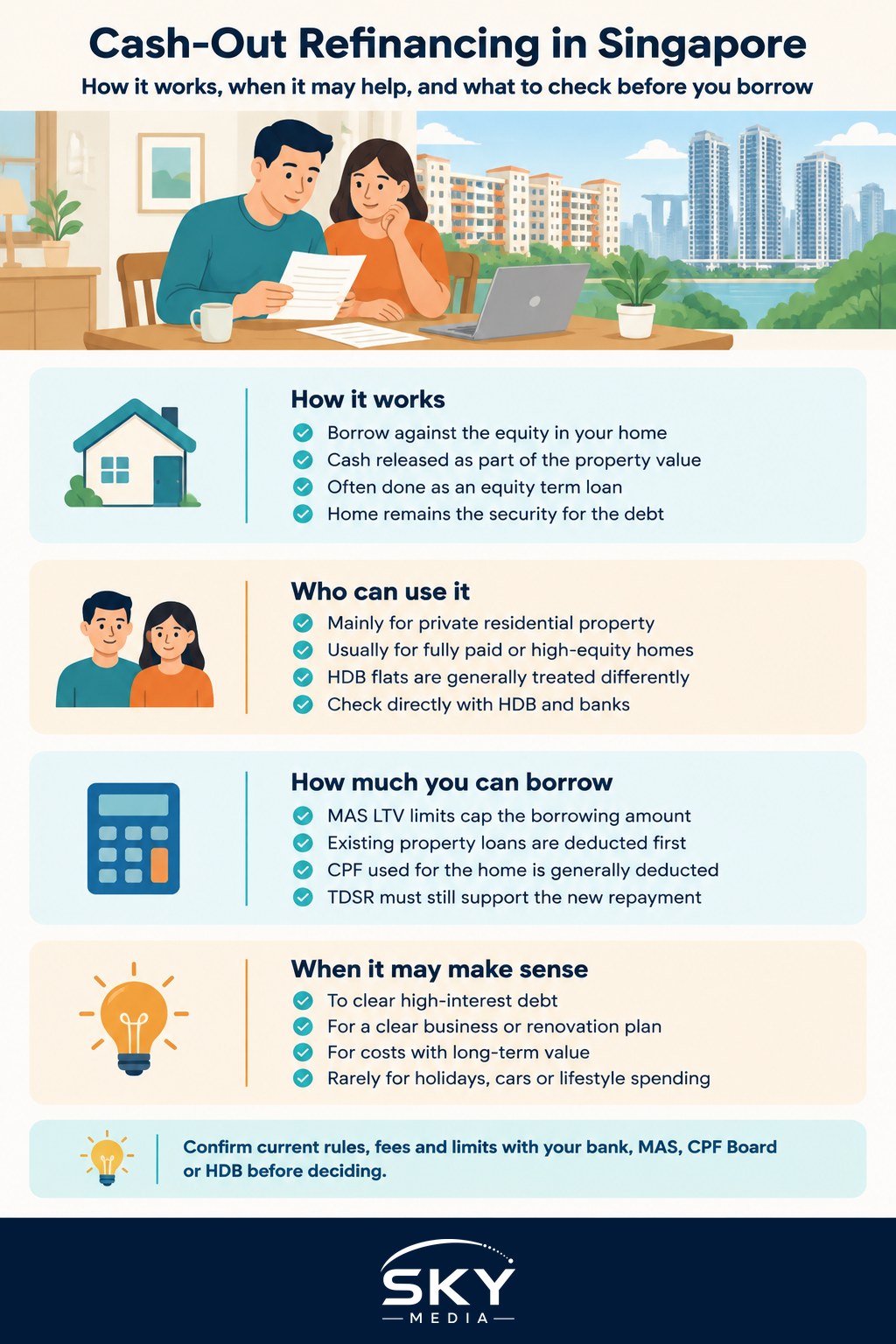
How Cash-Out Refinancing Works in Singapore
Your home equity is roughly the current value of your property minus what you still owe on it. If property values have risen or you have paid down a large part of your loan, you may have substantial equity locked in your home.
A cash-out arrangement lets you unlock part of that equity as a loan. In Singapore, this usually takes one of two forms:
- Equity term loan. A separate loan secured on your property, on top of or alongside your existing mortgage. You receive cash, and repay it over an agreed tenure.
- Refinancing with a larger loan. Moving your mortgage to a new loan for more than your outstanding balance, with the difference released to you. Whether this is offered, and how, depends on the bank and the property.
In both cases, your home is the security. If you cannot repay, the bank can eventually take action against the property.
This is not the same as standard refinancing or repricing, where the aim is a better rate on the same balance. For that, see Refinancing Your Home Loan, which covers switching banks and packages.
Who Can Use It and What Limits the Amount
Cash-out options in Singapore are mainly available for private residential property, such as condominiums and landed homes, that is fully paid or has meaningful equity. HDB flats are generally treated differently, and equity loans on them are typically not available. If you own an HDB flat, check directly with HDB and the banks rather than assuming the option exists.
Several rules work together to cap how much you can borrow:
- Loan-to-value (LTV) limits. MAS sets the maximum share of a property’s value that can be lent. The bank applies this to a fresh valuation of your home.
- Outstanding loans. Anything you still owe on the property is deducted first.
- CPF used for the property. If you used CPF savings to buy or pay for the home, the amount withdrawn, typically together with accrued interest, is generally deducted from the amount you can borrow. This protects your CPF retirement savings.
- Total Debt Servicing Ratio (TDSR). TDSR is the MAS framework that limits how much of your gross monthly income can go towards all your debt repayments, including car loans, credit facilities and the new equity loan. If your income cannot support the extra repayment, the loan will be smaller or declined.
- Age and tenure. Your age and the remaining property lease can shorten the maximum loan tenure, which raises monthly repayments and affects TDSR.
The exact percentages and thresholds are set by MAS and may change, so ask your bank or a mortgage adviser for the current figures that apply to you. For homeowners who are permanent residents, Mortgage Refinancing and Repricing Explained covers related points worth knowing.
When Cash-Out Refinancing Can Make Sense
Borrowing against your home is serious. It can still be a reasonable tool in specific situations, usually where the money replaces more expensive debt or funds something with clear long-term value.
The table below compares common reasons people consider it.
| Purpose of the cash | Can it make sense? | Key question to ask |
|---|---|---|
| Paying off high-interest debt such as credit cards or personal loans | Often, if spending habits have changed | Will the old debt stay paid off, or build up again? |
| Funding a business | Sometimes, with a clear plan | Can you cope if the business fails and you still owe the bank? |
| Major home renovation or adding value to the property | Sometimes | Will the works add real value or just cost? |
| Children’s education | Sometimes | Have cheaper options, such as savings or education loans, been considered? |
| Investing in shares or another property | Higher risk | What happens if investments fall while repayments continue? |
| Holidays, cars or lifestyle spending | Rarely | Are you turning short-term spending into a long-term debt on your home? |
A useful test: if the cash is being used for something that will be long gone while you are still repaying, think twice.
When It Usually Does Not Make Sense
Some warning signs suggest cash-out refinancing is the wrong answer:
- Unstable income. If your job, commission or business income is uncertain, adding a loan secured on your home raises the stakes.
- Using it to cover regular monthly shortfalls. If you are borrowing to pay ordinary bills, the underlying budget problem will continue. Envelope-style budgeting, as described in Cash Stuffing and Envelope Budgeting, may help you see where money is going first.
- Rising rates. Equity loans are often priced differently from standard home loans and may carry higher or floating rates. Model how repayments would look if rates rise.
- Plans to sell soon. If you may sell within a few years, borrowing now reduces your sale proceeds and may trigger penalties.
- Retirement close at hand. A new debt late in your working life can eat into the funds you need later, and banks may restrict the tenure.
Costs and Fine Print to Check
The interest rate is only part of the cost. Before committing, ask the bank for a full breakdown and read the letter of offer carefully.
Common items to check:
- Legal fees for the mortgage documents, sometimes subsidised by the bank in exchange for a lock-in period.
- Valuation fees for assessing your property.
- Lock-in periods during which paying off or switching the loan triggers a penalty.
- Clawback clauses where the bank recovers any legal subsidy if you redeem early.
- Penalties on your existing loan if refinancing breaks a current lock-in.
- Rate structure, whether fixed or floating, and what benchmark a floating rate follows.
- Fees for partial prepayment if you want to clear the loan early.
Compare at least a few banks. Packages differ, and a slightly lower headline rate may come with stricter terms.
Steps to Take Before You Apply
If cash-out refinancing still looks right, approach it methodically:
- Write down the purpose and amount. Borrow only what you need, not the maximum offered.
- Check your CPF usage through your CPF account so you know how much will be deducted.
- List all current debts to estimate how TDSR will affect you.
- Get indicative valuations from banks, which often provide them free of charge.
- Stress test repayments at a higher interest rate to see whether your budget still holds.
- Compare packages across banks, including all fees and lock-in terms.
- Consider professional advice from a licensed financial adviser or mortgage broker if the amount is large or your situation is complex.
- Discuss with your household. If the property is jointly owned, all owners will usually need to agree and sign.
If the cash is for a business, plan how the business will service the debt rather than relying on your salary. Managing Business Cash Flow explains how to forecast whether a business can carry new obligations.
Used carefully, cash-out refinancing can turn idle home equity into cheaper funding for a genuine need. Used carelessly, it puts your home behind short-term spending. The difference lies in being clear about the purpose, realistic about repayments, and thorough with the fine print.
Frequently Asked Questions
Is an equity loan cheaper than a personal loan? It can carry a lower interest rate because your home is the security, but that is not the whole story. Equity loans may come with legal and valuation fees, lock-in terms and the risk of losing your home if you cannot repay. Compare total cost and risk, not just the rate.
What happens if my property value falls after I take an equity loan? You still owe the full loan, whatever the property is worth. A fall in value can make it harder to refinance or sell without a shortfall, and some lenders may revalue the property for later applications. Borrow conservatively and stress test your repayments before you commit.
Can permanent residents or foreigners take a cash-out loan on a home? It depends on the bank’s policies and your overall profile. Lenders look at income, existing debts, the property type and the rules set by MAS. Foreigners and PRs may face additional conditions, so ask several banks for their requirements and get the figures in writing.
Will an equity loan affect my ability to buy another property? It can. The extra repayments count towards your total debt obligations under TDSR, which may reduce how much you can borrow later. Other rules for buying further property also apply. If a second purchase is in your plans, speak to a bank or mortgage adviser before taking the loan.
How long does a cash-out refinancing application usually take? It varies by bank and how quickly documents and valuation are completed. Expect steps such as submitting income and loan documents, a valuation, credit assessment, a letter of offer and legal paperwork. Ask your bank for an estimated timeline, and avoid relying on the funds for a deadline you cannot move.
Official sources: MoneySense
Further reading: Home Loan Legal Subsidies and Cash Rebates Explained