

Singapore has many inter-ethnic couples, and for a Chinese, Malay, Eurasian or foreign partner, the first Deepavali with Indian in-laws can feel like a big moment. You are not a guest dropping by an open house for an hour. You are family, or becoming family, and you may be invited into the quieter, more personal parts of the day.
This guide is for non-Indian partners spending Deepavali with Indian in-laws, whether you are dating, engaged or married. It covers the rituals you may be invited to join, what to wear, gifts, food and the unspoken expectations that tend to cause the most nerves. Every family celebrates differently, shaped by region, language, religious practice and personal habits, so treat this as a starting point and let your partner be your guide.
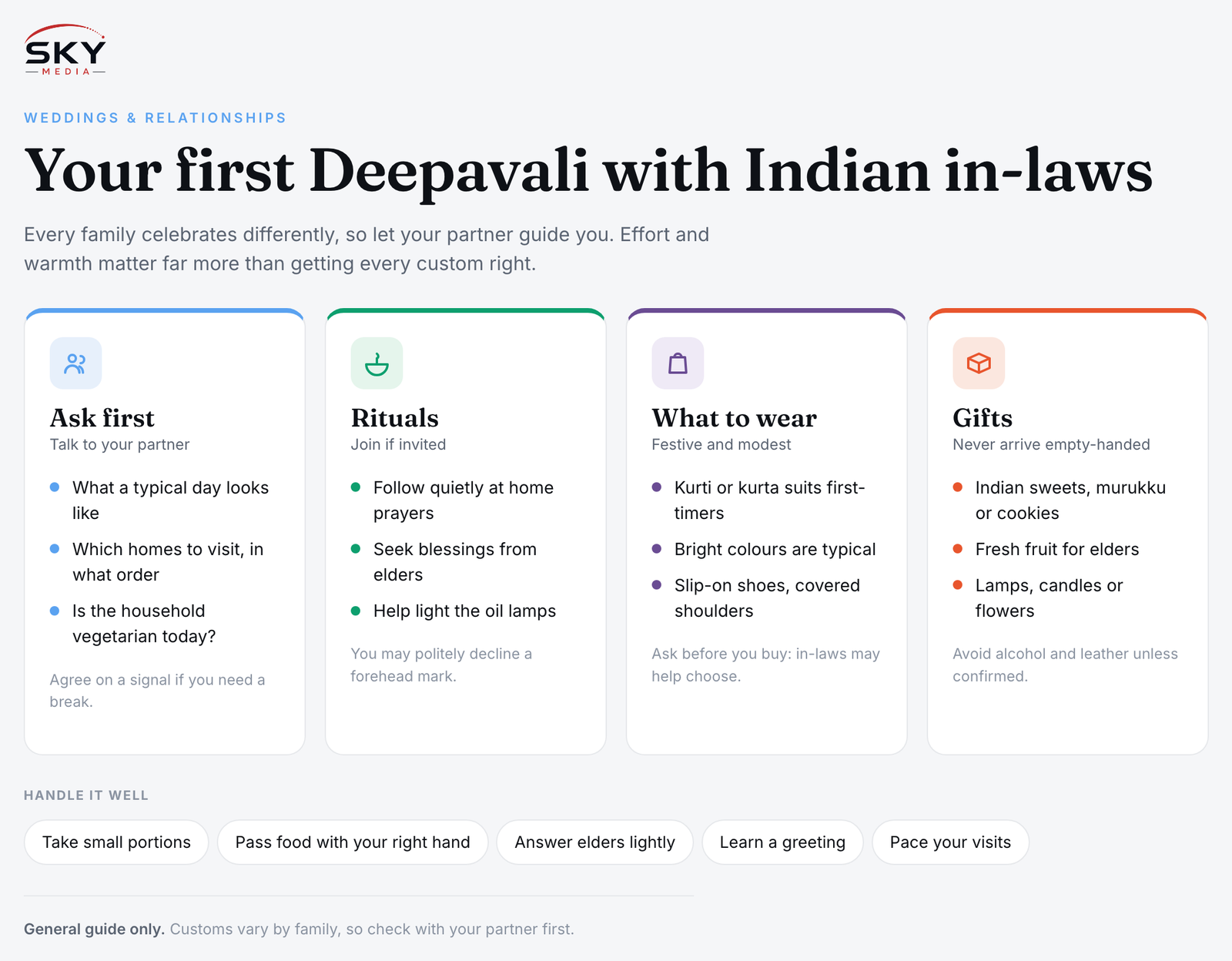
Start With a Conversation With Your Partner
Your partner is your best source of information, but people often forget to explain things they grew up with. Ask specific questions a week or two before:
- What does a typical Deepavali day look like in your family? Some families begin very early, others start around mid-morning.
- Which house do we go to, and in what order? Many couples visit the eldest relatives first.
- Are there prayers at home or a temple visit? Should I join, watch or wait?
- Is the household vegetarian on the day? Some families avoid meat, and possibly alcohol, around the festival.
- What do relatives call me, and what should I call them? Learning the right terms for aunties, uncles and grandparents in the family’s language is a thoughtful touch.
- Is there anything I should avoid? For example, wearing shoes indoors, or touching food before it has been offered at prayers.
Agree on a signal you can use if you feel lost or need a break. It helps you both.
Rituals You May Be Invited to Join
Deepavali, the Festival of Lights, is celebrated by many Hindus in Singapore, and many Indian families of other faiths also mark the season socially. Customs vary widely, but these are commonly seen practices:
- The early oil bath. In many South Indian households, family members take an oil bath before dawn on Deepavali morning. As a partner, you may simply be told to get ready early. You are unlikely to be expected to take part unless you stay over and the family invites you.
- Prayers at home. Families may pray at the home altar, offering flowers, sweets and lit lamps. If invited to stand with the family, follow quietly. You may be offered holy ash or a red or yellow mark on the forehead. You can accept it respectfully, or politely decline if it conflicts with your own faith. Most families understand either choice if it is done kindly.
- A temple visit. Some families visit a temple on the morning of Deepavali. Remove your shoes where indicated, dress modestly and follow the family’s lead on where to stand.
- Seeking blessings from elders. In some families, younger members touch the feet of elders or bow to receive blessings, and elders may give blessings or money in return. Watch what your partner does. If you are invited to do the same, it is usually received warmly.
- Lighting oil lamps (diyas or kuthu vilakku). Lamps are lit at home in the evening. Being asked to help light them is a sign of welcome.
- Kolam or rangoli. Some families create colourful patterns at the entrance before the day. Offering to help is a lovely way to spend time with relatives.
What to Wear
Many Indian families wear new clothes on Deepavali, and in-laws are often delighted when a non-Indian partner wears traditional dress. You do not have to, but it is usually appreciated.
Practical points:
- Ask before you buy. Your partner or a sibling-in-law may want to help choose, or the family may gift you an outfit. Shopping together in Little India in the weeks before is often part of the fun.
- Women commonly wear a saree, salwar kameez, kurti with leggings, or a lehenga. A kurti is easiest for first-timers.
- Men commonly wear a kurta with pants, or a veshti (a wrapped white cloth) with a shirt in some South Indian families.
- Colours. Bright colours are typical and festive. In many families, all-black or all-white outfits are avoided on auspicious days, but practices vary, so ask.
- Modesty and comfort. Covered shoulders and knees are sensible for prayers and temple visits. Choose slip-on shoes, since you will remove them often.
Gifts, Sweets and Money
Arriving empty-handed at your in-laws’ home on Deepavali can feel awkward, so plan ahead.
- Sweets and snacks. A box of Indian sweets or murukku from a reputable shop, or homemade cookies, is a common, safe gift. Check whether the household is vegetarian and avoid anything containing egg or meat if so.
- Fruit. A basket of fresh fruit is a classic offering for elders.
- Something for the home. Decorative lamps, candles or flowers suit the festival.
- Money. In some families, married couples give money in small packets to children or younger unmarried relatives, a little like ang bao at Chinese New Year. Packet colours, amounts and who gives to whom differ by family, so let your partner decide.
- Avoid alcohol and leather items unless your partner confirms they are welcome.
Expectations That Often Surprise Partners
| Situation | What often happens | How to handle it well |
|---|---|---|
| Food is offered repeatedly | Hosts keep serving, and an empty plate may be refilled | Take small portions, accept a little of each dish, and leave a small amount when you are full |
| Eating with your hands | Some relatives eat rice meals with the right hand | Use cutlery if you prefer, or try your right hand. Avoid using the left hand to pass food |
| Questions about marriage or children | Elders may ask direct, personal questions | Smile, give a light answer and let your partner steer the topic |
| Language switches | Relatives may chat in Tamil, Malayalam, Hindi or another language | Learn a festive greeting, ask simple questions, and do not take it personally |
| Long day of visiting | Several homes in one day, lots of food at each | Pace yourself, wear comfortable footwear and agree on breaks with your partner |
Remember that your partner may also feel pressure, caught between wanting you to feel comfortable and wanting their family to see you at your best. Be a team. If you want broader tips on navigating these dynamics, our guides on spending holidays with your partner’s family and managing in-law and extended-family boundaries go further.
Building Your Own Traditions as a Couple
As your relationship grows, Deepavali can become something you share rather than something you attend. Ideas that many inter-ethnic couples enjoy:
- Walking through the Little India light-up and bazaars together in the weeks before the festival.
- Learning to make one festive sweet or snack from a relative, and bringing it the following year.
- Inviting your own family to join part of the celebration, or to an open house, so both sides meet.
- Blending festivals. Many couples celebrate Chinese New Year, Hari Raya or Christmas with one side and Deepavali with the other, and talk openly about how to balance time.
If you have children, deciding together how to pass on both cultures is worth an early, honest conversation. Our piece on celebrating festivals as a family has practical ideas.
A Simple Greeting Goes a Long Way
You do not need to know everything. Saying “Happy Deepavali” or “Happy Diwali”, or learning the greeting the family uses in their own language, offering to help in the kitchen, and thanking your hosts sincerely before you leave will matter more than getting every custom right. Most in-laws remember the effort and warmth far more than any small slip.
Further reading: Celebrating Deepavali in Kuala Lumpur’s Brickfields: A Trip From Singapore