

A good family doctor becomes more valuable as you get older. The same GP who once saw you for the odd cold may now be helping you manage blood pressure, diabetes, joint pain or several medicines at once. But needs change, and sometimes the clinic that suited you at 50 no longer fits at 70. If you are wondering whether and how to change GP Singapore seniors have several practical options, and the switch can be smooth with a little planning.
This guide focuses on when it makes sense to switch family doctors, how to choose a new one, and how to keep your care going smoothly. It is general information, not medical advice. Always discuss your health decisions with your doctor.
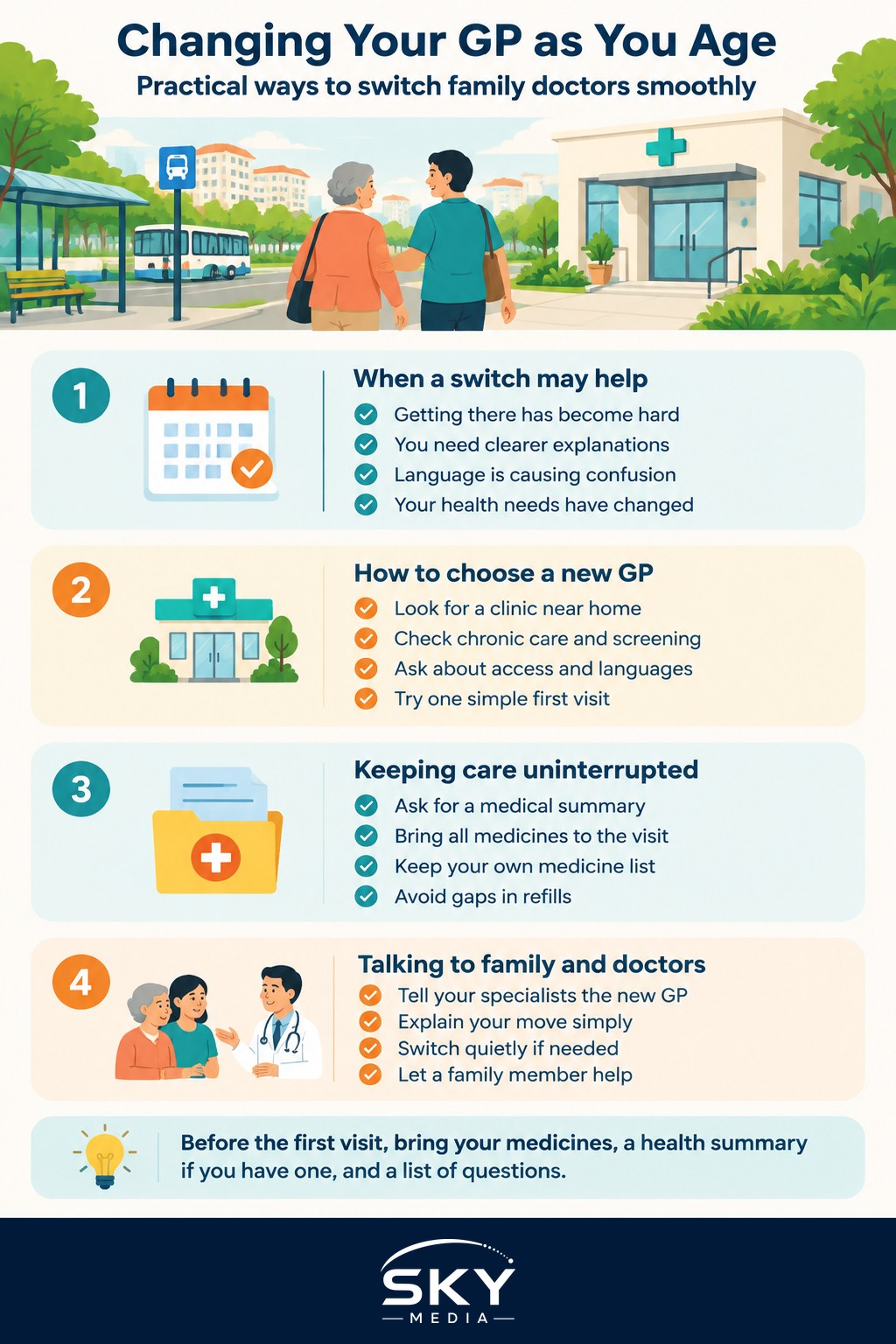
Signs It May Be Time to Change Your GP
Changing doctors is a personal decision, and loyalty to a long-time GP is understandable. Still, these are common reasons seniors decide to switch:
- Getting there has become hard. The clinic may be far from home, up stairs, or a long bus ride away. A clinic within walking distance, or one that is wheelchair-friendly, can make regular visits much easier.
- You need more time or clearer explanations. If you often leave appointments confused about your medicines or test results, a doctor who explains things in a way you understand matters.
- Language is a barrier. Many seniors are more comfortable in Mandarin, a dialect, Malay or Tamil. A GP or clinic team who can speak your preferred language reduces misunderstandings.
- Your health needs have changed. Managing chronic conditions often benefits from a clinic that offers regular reviews, health screening and coordination with specialists.
- Opening hours no longer fit. If you rely on a family member to accompany you, a clinic with evening or weekend hours may help.
- You have moved home. Downsizing or moving closer to children often means a new neighbourhood and a new clinic.
- Your GP has retired or the clinic has closed. This is a natural moment to choose deliberately rather than going to whichever clinic is nearest.
Healthier SG and Your Enrolled Clinic
Under Healthier SG, a national programme by the Ministry of Health (MOH), Singapore residents are encouraged to enrol with one family doctor who helps them stay healthy over time. If you have enrolled, your chosen clinic is the one that draws up your health plan and follows up with you.
If you decide to switch, you will usually need to change your enrolled clinic as well. This can generally be done through the HealthHub app or website, which is the official health portal for Singapore residents. The rules on how and when you can change clinics are set by the programme and can be updated, so check HealthHub or ask the clinic staff for the current process.
If you are not sure whether you are enrolled, HealthHub can show you, or a family member can help you check.
How to Choose a New Family Doctor
Before switching, take time to find a clinic that genuinely meets your needs.
- Shortlist clinics near home. HealthHub lets you search for clinics, including those taking part in Healthier SG and the Community Health Assist Scheme (CHAS), which provides subsidies for eligible Singapore Citizens at participating GP and dental clinics.
- Check what support each clinic offers. Ask whether they manage chronic conditions, provide vaccinations recommended for seniors, and do regular health screening.
- Check accessibility. Look for step-free access, seating while waiting, and a location near your bus stop or MRT station.
- Ask about languages spoken. Many clinics list this, or you can call to ask.
- Pay a first visit for something simple. A routine review or vaccination is a good way to see how the doctor communicates before you fully commit.
- Bring someone along if helpful. A family member or caregiver can help you ask questions and remember the answers.
Seniors who are unsure which type of care to use for different situations may find our explainer on GP vs polyclinic vs A&E in Singapore helpful.
Staying With Your GP Versus Switching
It is not always a clear choice. This comparison may help you weigh it up.
| Situation | Staying may suit you if | Switching may suit you if |
|---|---|---|
| Long relationship | Your GP knows your history and you trust them | You no longer feel heard or understood |
| Travel and access | The clinic is still easy to reach | Getting there has become tiring or unsafe |
| Chronic conditions | Your conditions are well managed and reviewed | You need more regular follow-up or coordination |
| Language and communication | You understand your treatment clearly | Language differences cause confusion |
| Life changes | Nothing major has changed | You have moved, or your GP has retired |
Transferring Your Records and Medicines Safely
Continuity of care is the biggest concern when changing doctors. A few steps help ensure nothing is missed.
- Ask for a summary from your current GP. A short medical summary or referral letter listing your conditions, allergies and current medicines helps your new doctor. Clinics may have their own process and may charge for this, so ask.
- Understand the National Electronic Health Record (NEHR). NEHR is a national system that allows authorised healthcare providers to view key health information such as hospital discharge summaries and some test results. It helps, but it may not contain everything, so a summary from your GP is still useful.
- Bring all your medicines to the first visit. Put every tablet, inhaler, eye drop and supplement in a bag and show your new doctor. This helps them check for duplication or interactions.
- Keep your own list. A simple written list of conditions, medicines and allergies, kept in your wallet or on your phone, is helpful in any clinic or emergency.
- Avoid gaps in medicine refills. Make sure you have enough medicine to last until your first appointment with the new doctor. Do not stop or change any medicine without medical advice.
- Tell your specialists. If you see specialists at a hospital, let them know who your new GP is so letters and updates reach the right clinic.
Talking to Your Current Doctor About the Change
Many seniors feel awkward about leaving a long-time doctor. There is no need to feel guilty. Doctors understand that patients move, needs change and access matters. A simple explanation such as “I have moved and need a clinic closer to home” is enough, and most GPs will help with a summary.
If your reason is that you did not feel comfortable with the care you received, you can still switch quietly. If you have a serious concern about your care, you may raise it through the clinic’s feedback channel.
Helping an Older Parent Change Their GP
Adult children often help with this decision. Involve your parent in every step, respect their preferences, and go with them to the first visit if they would like. Newcomers to Singapore supporting elderly parents may also find our guide to seeing a GP in Singapore a useful starting point.
A well-chosen family doctor who knows you, is easy to reach and speaks your language can make ageing well in Singapore much easier.
Frequently Asked Questions
How do I change my enrolled Healthier SG clinic? This can generally be done through the HealthHub app or website. The rules on how and when you can change clinics are set by the programme and can be updated, so check HealthHub or ask the clinic staff for the current process.
What should I bring to my first visit with a new GP? Bring every tablet, inhaler, eye drop and supplement in a bag, plus a medical summary or referral letter from your current GP if you have one. Your own written list of conditions, medicines and allergies also helps. This lets the new doctor check for duplication or interactions.
Will my new GP be able to see my records through NEHR? Authorised healthcare providers can view key information through the National Electronic Health Record, such as hospital discharge summaries and some test results. It may not hold everything, so a summary from your current GP is still useful.
How do I tell my long-time doctor I am leaving? A simple explanation such as that you have moved and need a clinic closer to home is enough. Doctors understand that needs change, and most will help with a summary. Serious concerns about your care can go through the clinic’s feedback channel.
How can I help my elderly parent switch GP? Involve your parent in every step and respect their preferences. Shortlist clinics near home, check access and languages spoken, and go with them to the first visit if they would like. A routine review or vaccination is a gentle way to test the fit.
Official sources: HealthHub