

When your child says school is boring, it is tempting to reply with “Everyone finds school boring sometimes” and move on. Sometimes that is fair. But “boring” is a catch-all word children use for many different feelings, from finding the work too easy to finding it too hard, missing a friend or simply being tired. If the complaint keeps coming back, it is worth a closer look.
This guide is about everyday disengagement: a child who goes to school, does the minimum and feels flat about it. It is general information for parents, not a replacement for advice from your child’s teachers, school counsellor or a doctor.
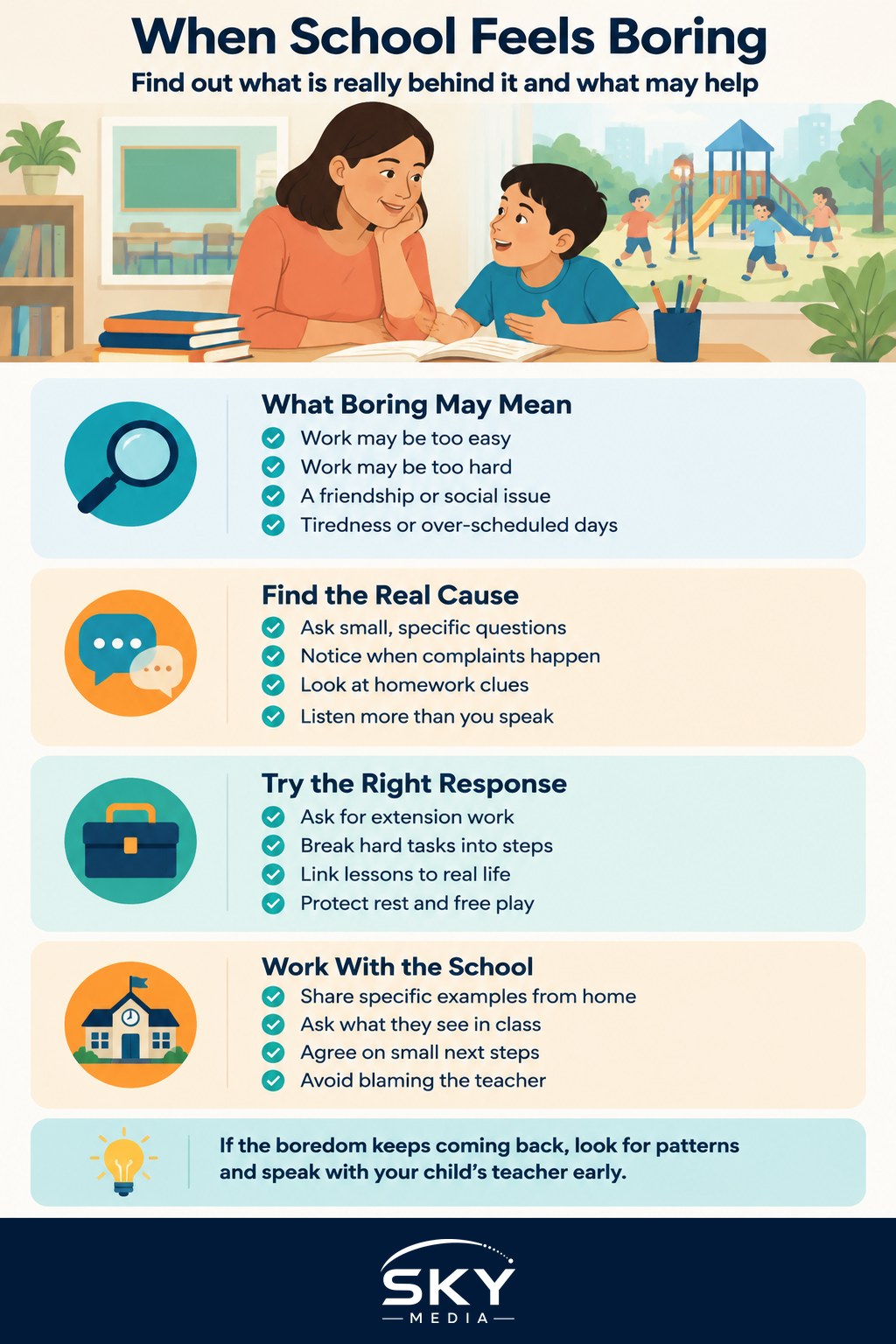
What “Boring” Often Really Means
Before trying to fix anything, work out what sits behind the word. Common meanings include:
- The work is too easy. Your child finishes quickly and then waits, which feels tedious.
- The work is too hard. Not understanding feels uncomfortable, and “boring” is a less embarrassing word than “confusing”.
- A social problem. A friendship has changed, they feel left out, or there is teasing.
- A poor fit with the teaching style. Some children learn best by doing and struggle with long stretches of listening.
- Tiredness. Late nights, long days of enrichment classes and screen time can make anything feel dull.
- Something else going on. Worry, low mood, or difficulties with attention, hearing or vision can show up as lack of interest.
The response that helps depends heavily on which of these is true, which is why the next step matters more than any quick fix.
How to Find Out What Is Going On
Children rarely explain their feelings when asked “Why is school boring?” Try smaller, more specific questions at relaxed moments, such as in the car, during a walk or at bedtime.
- “Which lesson felt longest today?”
- “When did the time go fast?”
- “If you could change one thing about your class, what would it be?”
- “Who did you sit with at recess?”
- “Was there anything you did not understand today?”
Listen more than you speak, and avoid jumping to defend the school or criticise the teacher. Over a week or two, you will often notice patterns, such as complaints only on certain days, about certain subjects or after certain events.
It can also help to look at schoolwork that comes home. Very neat, fast work with full marks may hint at a child who is not being stretched. Unfinished or messy work, or work your child avoids discussing, may hint at difficulty.
Matching the Response to the Cause
Once you have a sense of what “boring” means for your child, you can respond in a targeted way.
| What you notice | What may be behind it | What you can try |
|---|---|---|
| Finishes quickly, says lessons are slow | Work may be too easy | Ask the teacher about extension work, and explore the topic deeper at home through books or projects |
| Avoids talking about a subject, homework takes very long | Work may be too hard | Break tasks into smaller steps, ask the teacher where your child is struggling, consider short regular revision rather than long sessions |
| Complaints focus on recess, groups or certain classmates | Social difficulty | Talk gently about friendships, arrange play dates, let the form teacher know |
| Fine on active days, flat on lecture-heavy days | Teaching style mismatch | Link lessons to hands-on activities at home, praise effort in school-based projects and co-curricular activities |
| Tired, irritable, flat about everything | Too little rest or too much scheduled | Review sleep, screen time and enrichment load, protect some free time |
If your child seems persistently sad, anxious or withdrawn, or the change is sudden and affects life beyond school, speak to the school counsellor or your family doctor. Our guide to supporting a child’s wellbeing during school covers the signs to watch and the support available.
Rebuilding Interest at Home
You cannot change the curriculum, but you can change how your child relates to learning.
Connect School to Real Life
Children engage more when they see why something matters. Fractions come alive while baking. Science makes more sense on a visit to a nature reserve or a museum. Mother Tongue practice feels more natural when chatting with grandparents or ordering food at a hawker centre. Ask what topic they are covering this term and find one real-world link a week.
Follow Their Interests
If your child loves football, dinosaurs, drawing or a particular video game, use that interest as a doorway. Reading about it, writing about it or calculating scores builds the same skills in a context they care about. Over time, confidence in these skills often carries over into class.
Give Them Some Control
Disengagement often grows when children feel they have no say. Let them choose the order of homework tasks, where they study or which library book to borrow. Small choices build ownership.
Praise Effort and Curiosity
Comments like “You kept trying even when it was tricky” or “That was a great question” encourage the habits that make school feel more interesting. Focusing only on marks can make learning feel like a chore to get through.
Protect Rest and Free Play
In Singapore, many children balance school, tuition and enrichment classes. If the schedule has no slack, everything starts to feel like work. Unstructured time to play, read for fun or simply be bored at home can actually help children recharge for school.
Working With the Teacher
Teachers usually want to know when a child is disengaged, and they see sides of your child you do not. Reach out calmly through the school’s usual channels, such as the form teacher, a message via the school’s parent communication app or a parent-teacher meeting.
When you speak to the teacher:
- Describe what you have noticed at home, with specific examples.
- Ask what they see in class, including participation, friendships and focus.
- Ask whether extension work, a different seating arrangement or a role in class could help.
- Agree on one or two small steps and a time to check in again.
Avoid framing the conversation as a complaint about the lessons. Approaching it as a shared problem makes it easier for the teacher to help.
If your child is shy and tends to hide in class, our guide on helping a shy child thrive in school has ideas that also help with engagement.
What Not to Do
- Do not dismiss the complaint entirely. Even if it seems minor, brushing it off teaches children not to share.
- Do not add more classes as the first fix. More structured learning can deepen fatigue if tiredness is the issue.
- Do not criticise the teacher in front of your child. It can make your child less willing to engage in that class.
- Do not compare with siblings or friends. Comparison usually lowers motivation further.
- Do not expect overnight change. Engagement usually builds slowly over weeks.
When It Is More Than Boredom
Occasional boredom is normal. Seek further support if you notice:
- Refusal to go to school, or frequent stomach aches or headaches on school mornings.
- A clear drop in results or a sudden change in behaviour.
- Signs of bullying, such as lost belongings, unexplained injuries or reluctance to talk about classmates.
- Ongoing difficulty concentrating, reading or following instructions.
In these cases, talk to the form teacher and school counsellor, and consider a check with your family doctor or a polyclinic. They can advise whether any assessment would be useful. Getting help early usually makes things easier for everyone.
With patience, curiosity and a good working relationship with the school, most children move past a “school is boring” phase and find parts of school they genuinely enjoy.