

Cheaper flights, a family wedding overseas or a grandparent’s milestone birthday can all make term-time travel tempting. If you are thinking about taking your child out of school for a holiday, it helps to know how Singapore schools view absence, who you should tell, and how to keep your child from falling behind. This guide covers the practical side for parents with children in MOE (Ministry of Education) primary and secondary schools.
Every school sets out its own attendance procedures, so treat this as general guidance and always check your child’s school handbook, the Parents Gateway app, or ask the form teacher directly.
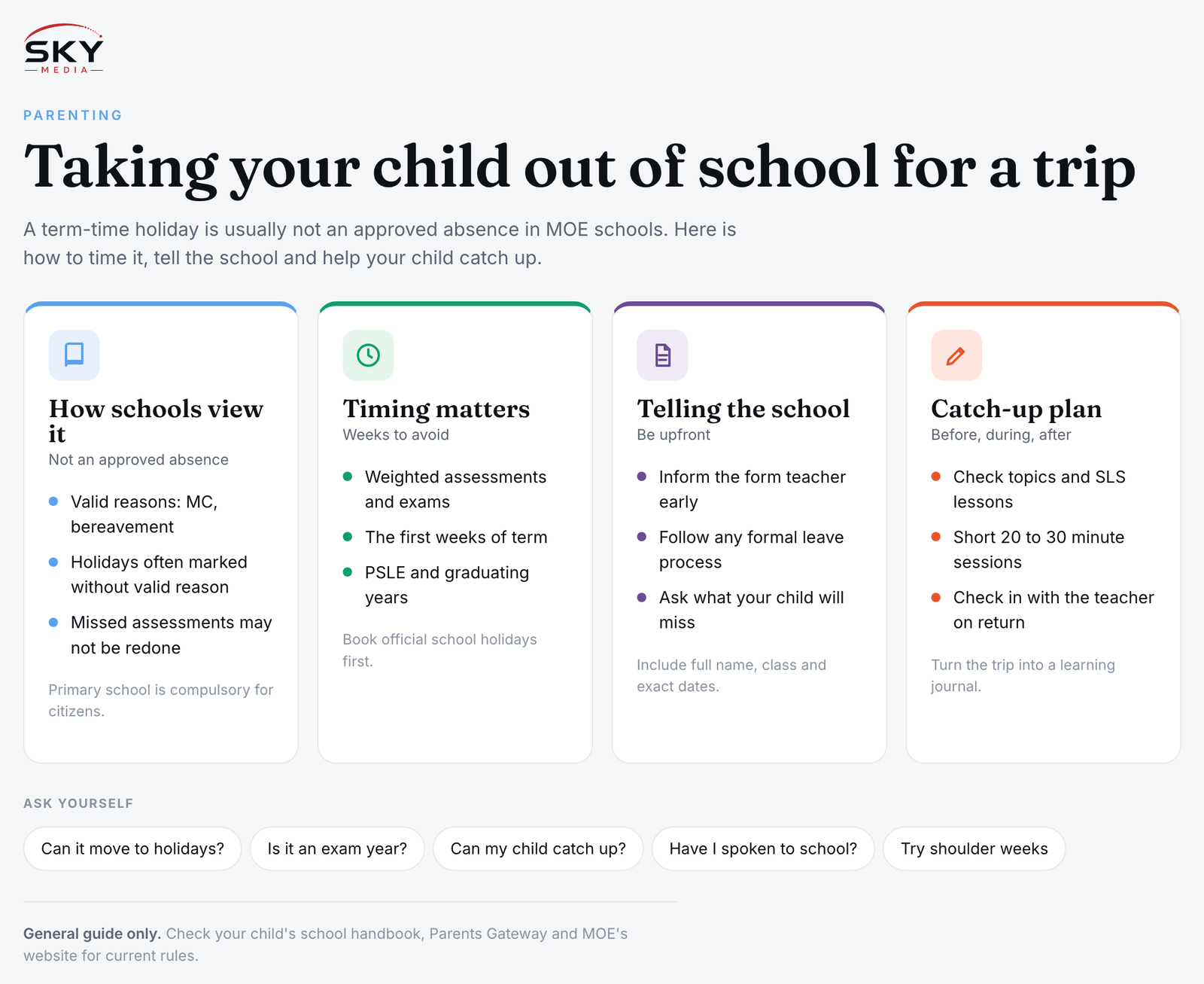
How MOE Schools View Term-Time Absence
Singapore schools place real weight on attendance. Lessons build week by week, class tests and assignments run on fixed schedules, and teachers track attendance daily. For Singapore citizen children of primary school age, primary education is compulsory under the Compulsory Education Act, so regular attendance is not just a school preference.
In practice, schools generally sort absences into two broad groups:
- Absences with a valid reason, such as illness supported by a medical certificate (MC), a family bereavement, or approved school or national representation.
- Absences without a valid reason, which is where a family holiday usually falls.
A holiday during term is typically not treated as an approved absence, even if you inform the school in advance. The school may record the days as absent without a valid reason, and your child may miss assessments that cannot always be rescheduled. Policies on missed assessments vary by school and by level, so ask before you book anything non-refundable.
Timing Matters More Than You Think
Not all school weeks carry the same weight. Some periods are far riskier to miss than others:
- Weighted assessment and exam weeks. Missing these can affect your child’s results for the term or year. Many schools only allow make-ups for valid reasons such as an MC.
- The start of a term. The first weeks set routines, introduce new topics and sometimes include class placement or CCA (co-curricular activity) sign-ups.
- Upper primary and graduating secondary years. Primary 6 children sit the PSLE, and graduating secondary students prepare for national exams. From the 2027 cohort, secondary students sit the Singapore-Cambridge Secondary Education Certificate (SEC), which replaces the O-Level and N-Level. Check exam calendars with MOE and SEAB (Singapore Examinations and Assessment Board) before planning anything in these years.
The table below compares common timing choices.
| Timing of the trip | Likely impact on your child | What to do |
|---|---|---|
| Official school holidays | No lessons missed | Book these first wherever possible |
| One or two days next to a public holiday or long weekend | Small amount of missed work, usually manageable | Inform the form teacher early and arrange catch-up |
| A full week in the middle of term | Missed topics, homework and possibly class tests | Discuss with the school first, plan structured catch-up |
| During weighted assessments or exams | Possible missed marks that may not be rescheduled | Avoid unless there is an unavoidable family reason |
For official term and holiday dates, see our guide to school holidays and term dates in Singapore, which helps you line travel up with the calendar instead of against it.
Telling the School: Who, When and How
Being upfront is the most respectful approach and helps teachers plan. Most schools prefer that you:
- Inform the form teacher as early as possible, ideally a few weeks before travel. Many schools use Parents Gateway, email or the student handbook for this.
- Follow any formal leave process the school has. Some schools ask for a written letter addressed to the principal or form teacher; others simply want a message on record.
- Be honest about the reason. Teachers can tell when a sudden “family matter” coincides with a school holiday elsewhere. Honesty builds trust for future conversations.
- Ask about anything your child will miss, including assessments, project deadlines, CCA commitments and school events.
A Simple Absence Letter Template
You can adapt this short message:
Dear Mrs Tan,
I am writing to inform you that my son, Ethan Lim of Class 4B, will be absent from school from Monday to Thursday next week as our family will be travelling overseas for a family occasion. We understand this is not an approved absence and that he may miss some lessons. Could you let us know of any assessments, homework or materials he should cover, so he can catch up on his return?
Thank you for your understanding.
Regards,
Lim Wei Ming (father)
Keep it brief and include your child’s full name, class and the exact dates.
Planning Catch-Up Work Before and After the Trip
Teachers are busy, and they are not obliged to prepare a special pack for every holiday. A considerate approach makes things easier for everyone and protects your child’s learning.
Before you go:
- Ask which topics will be covered while your child is away, and whether there are worksheets, textbook pages or online lessons on the Singapore Student Learning Space (SLS) they can access.
- Check due dates for projects, journals and spelling or ting xie (Chinese dictation) lists.
During the trip:
- Aim for short sessions of 20 to 30 minutes on a few mornings rather than trying to cover everything.
- Turn the trip into learning: a travel journal for English composition, currency conversion for maths, or reading signs in another language.
When you return:
- Check in with the form teacher in the first day or two.
- Watch your child’s mood and energy. Jet lag and catching up at the same time can be tiring for younger children.
If you want ideas on balancing revision and rest, our March holiday study plan has a light routine you can adapt for the days after a trip.
Special Situations Parents Ask About
Family emergencies overseas. A bereavement or a seriously ill relative is a very different matter from a leisure trip. Tell the school as soon as you can. Schools are generally understanding in these situations and can advise on how the absence will be handled.
Extended trips of several weeks. Longer absences raise bigger questions about learning continuity and, for compulsory-age citizen children, about school attendance obligations. Speak to the school leaders before committing. If you are relocating temporarily, ask about the implications for your child’s place in the school.
Students in international or private schools. These schools set their own attendance policies, often in the enrolment contract, so read it carefully.
Newcomer families. If you have moved from a country where term-time trips are common, note that Singapore schools tend to be more structured, with frequent assessments. Speaking to the form teacher early is the best way to understand expectations at your child’s school.
Weighing Up Whether It Is Worth It
There is no single right answer. A few days away for a meaningful family event can matter far more than a week of worksheets, but regular term-time trips can leave gaps and unsettle a child’s routine.
Before deciding, ask yourself:
- Can this trip move into the school holidays, even at a higher cost?
- Is my child in a key exam year?
- How confident is my child at catching up independently?
- Have I spoken to the school and understood what will be missed?
If the answer to most of these points towards waiting, look at shoulder weeks just before or after official breaks. Our guide on travelling during school holidays from Singapore has tips on keeping costs down when you do travel in peak season.
Rules and procedures can differ from school to school and may change over time, so confirm the current approach with your child’s school and refer to MOE’s official website for general information on school attendance.
Official sources: Ministry of Education (MOE)
Further reading: Helping Your Child Recover From the Holiday Learning Slide