

Many families who moved from mainland China to Singapore keep one door open: the chance for their child to study at a top university back in China. For students who hold Chinese citizenship and have settled in Singapore, the main route is the overseas Chinese joint entrance exam, known in Chinese as 华侨港澳台联考 (often just 联考). It is a separate exam from the national gaokao, set specifically for overseas Chinese (华侨, Huaqiao) students and students from Hong Kong, Macau and Taiwan.
This guide focuses on the exam itself: who can sit it, what it covers and how a student in Singapore can prepare. Eligibility rules and exam arrangements are set by the Chinese authorities and can change from year to year, so always confirm the current year’s admissions brochure (招生简章) on the official joint admissions website and with the Chinese Embassy in Singapore.
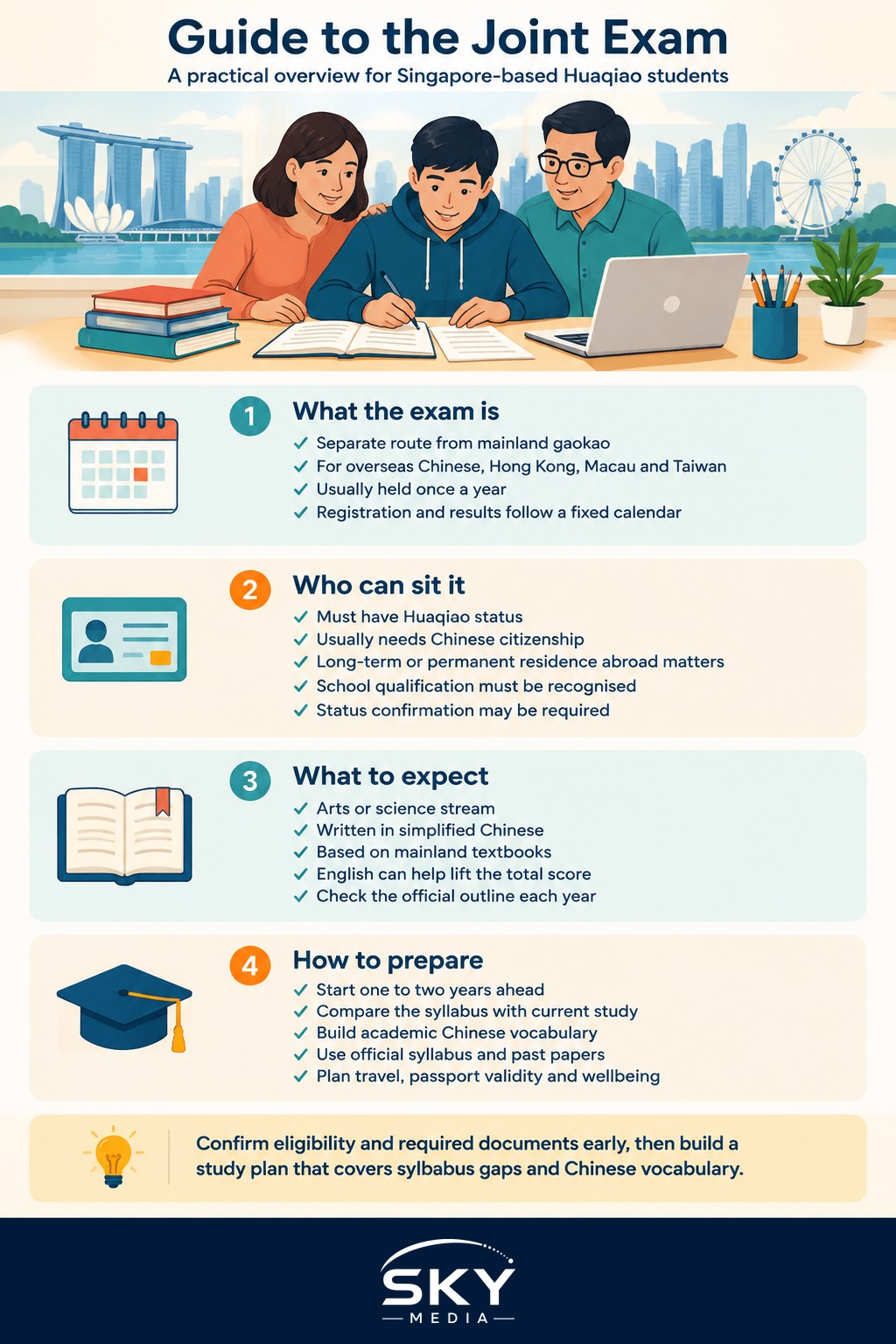
What the Joint Entrance Exam Is
The joint entrance exam is the unified undergraduate admissions test that Chinese universities use for applicants in the overseas Chinese, Hong Kong, Macau and Taiwan categories. Many well-known universities admit students through it, and places are allocated separately from mainland gaokao candidates. Because the applicant pool is smaller and the syllabus is set for this group, many families see it as a more realistic route than competing in the gaokao.
The exam is usually held once a year, with registration opening several months earlier. Registration, document checks and score release follow a fixed calendar that is published each year, so mark the dates early.
There are also postgraduate versions of the joint exam, and some universities run their own separate admissions for overseas Chinese students. This guide covers the undergraduate exam.
Who Counts as a Huaqiao Student
The key requirement is Huaqiao status. In Chinese rules, Huaqiao generally refers to Chinese citizens who have settled abroad. For families in Singapore, this typically means:
- The student holds a valid People’s Republic of China passport and has not given up Chinese nationality.
- The student (and, depending on the rules, a parent) has obtained long-term or permanent residence abroad, such as Singapore Permanent Residence.
- The student has actually lived in Singapore for a minimum period, rather than holding PR on paper only.
The rules set specific conditions about the type of residence status, how long it has been held and how much time was actually spent overseas. These details matter, and they have been tightened in the past. Do not assume eligibility; check the current definition in the official brochure.
Students also generally need to have completed, or be about to complete, senior high school or an equivalent qualification. In Singapore, this could mean finishing JC with A-Levels, an IB Diploma, or a recognised equivalent. Confirm how your child’s qualification is treated.
Many students must also go through Huaqiao status confirmation (华侨身份确认) with the relevant overseas Chinese affairs office in China before or during registration. Start this early, because it requires supporting documents and can take time. Our separate guide on Huaqiao status explains this process in more detail.
Exam Subjects and Format
The undergraduate exam is split into streams, broadly matching the arts and science tracks of Chinese schools. The structure has commonly looked like this:
| Stream | Common subjects | Notes for Singapore students |
|---|---|---|
| Arts (文科) | Chinese, mathematics, English, plus combined history and geography | Chinese essay writing and history content can feel unfamiliar |
| Science (理科) | Chinese, mathematics, English, plus combined physics, chemistry and biology | Maths and science are taught in Chinese terms, so learn the vocabulary |
| Specialised tracks | Some programmes such as Chinese medicine or arts may have extra requirements | Check the specific university and programme |
Points worth knowing:
- The exam is written in simplified Chinese (apart from the English paper). Students educated mainly in English in Singapore often find the language demand, not the content, is the real challenge.
- The syllabus is based on mainland textbooks. Topics may be ordered differently from the Singapore curriculum, and some may not be covered in Singapore at all.
- English is often a strength for Singapore students, and can help balance the total score.
Subject combinations, paper formats and exam centres can change, so check the official outline (考试大纲) for your year.
Preparing From Singapore
Most candidates in Singapore prepare alongside their JC or IB studies, which takes planning.
- Start one to two years ahead. Begin with a gap analysis: compare the official syllabus with what your child has already learned, subject by subject.
- Strengthen academic Chinese. Reading Chinese newspapers, writing timed essays and learning maths and science terms in Chinese make a large difference.
- Get the right materials. Use the official syllabus and past papers where available. Specialised prep courses for this exam exist, both online and in China; check the teachers’ track record and refund terms before paying.
- Plan the travel. Exam centres have historically been located in China and a few other places. Check where you can sit the exam, then plan flights, accommodation and documents early. Make sure the student’s Chinese passport has enough validity left.
- Keep wellbeing in view. Balancing two curricula is demanding. Our guides on exam preparation tips and managing exam day nerves have practical routines that help.
Applications, Scores and Keeping Options Open
After the exam, results are released and universities set admission lines for this exam, often by stream and programme. Students submit preferences according to the official process, and some universities consider interviews or additional requirements.
Many families keep a parallel plan in Singapore. A student with strong A-Level or IB results may also apply to local universities, and the timelines can overlap. Our guide to applying to NUS and NTU as a student from China covers that route.
A short checklist:
- Confirm Huaqiao eligibility against the current year’s brochure
- Start Huaqiao status confirmation early, if required
- Note registration, exam and results dates
- Check passport validity and exam centre location
- Build a study plan that covers syllabus gaps and Chinese vocabulary
- Keep a backup plan with Singapore or other overseas universities
With early planning, the joint exam can be a realistic way for Singapore-based Huaqiao students to study in China while keeping their life in Singapore.