

Many mainland Chinese who settle in Singapore hear the word “huaqiao” (华侨) from relatives or other newcomers, often with confusing advice. In Chinese law and policy, a huaqiao is a Chinese citizen who has settled abroad. If you hold Singapore permanent residence (PR) or a long-term pass but keep your Chinese nationality, you may be able to have huaqiao status recognised in China. This guide explains what huaqiao status in Singapore means for you, how recognition generally works, and what it can affect back home.
This is general information, not legal advice. The rules are set by Chinese authorities and can differ by province and city. Check the current requirements with the Embassy of the People’s Republic of China in Singapore and the overseas Chinese affairs office in your home area.
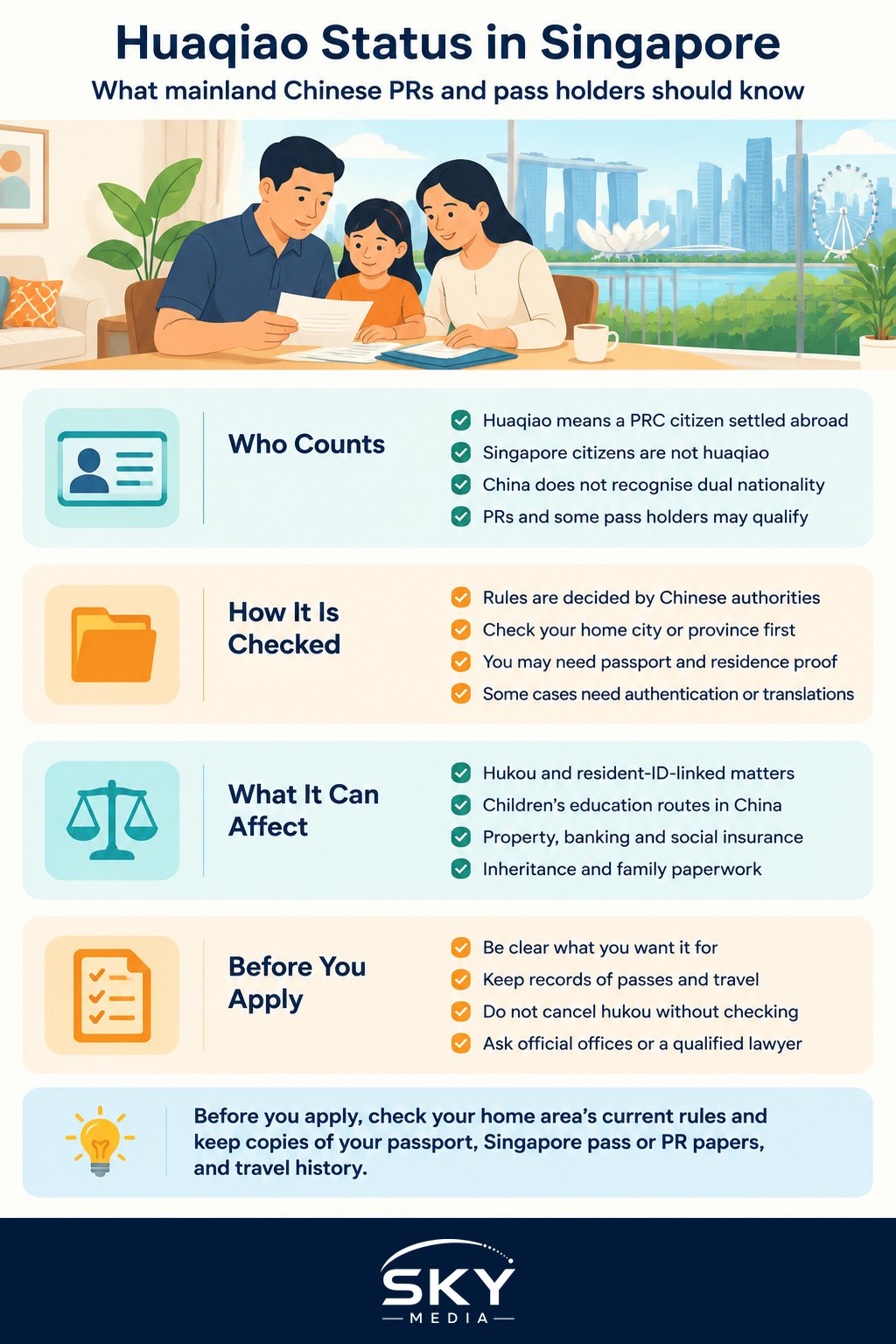
Huaqiao vs Huaren: Who Counts as Overseas Chinese
Two terms are often mixed up:
- Huaqiao (华侨): a citizen of the People’s Republic of China (PRC) who lives abroad and has settled there. You still hold a Chinese passport.
- Huaren (华人) or foreign nationals of Chinese descent: people of Chinese heritage who hold another country’s citizenship, such as Singapore citizens. China does not recognise dual nationality, so once you take up Singapore citizenship, you are no longer a PRC citizen and cannot be a huaqiao.
So huaqiao status is relevant to PRC citizens holding Singapore PR, and in some cases to holders of long-term passes. Chinese policy generally looks at whether you have obtained long-term or permanent residence rights abroad and have actually lived there for a meaningful period. The precise definition and minimum residence period are set by Chinese authorities, so check the current wording rather than relying on what a friend was told years ago.
Which Singapore Passes May Qualify
Singapore PR is the clearest case, because it is permanent residence. Long-term passes are less straightforward. Whether an Employment Pass, S Pass, Dependant’s Pass or Long-Term Visit Pass counts as “long-term residence” for huaqiao purposes is decided by the Chinese side, and practice can vary by locality.
In general, be ready to show:
- Your valid Chinese passport.
- Your Singapore pass or PR documents (such as the re-entry permit for PRs).
- Evidence of how long you have actually lived in Singapore, such as entry and exit records.
Your Singapore status itself is governed by Singapore’s Immigration and Checkpoints Authority (ICA) and, for work passes, the Ministry of Manpower (MOM). Getting huaqiao recognition in China does not change anything about your Singapore pass.
How Registration Generally Works
There is no single national online form that covers every case. Recognition is typically handled by the overseas Chinese affairs office (侨务部门) at the local government level where your household registration (hukou, 户口) is or was held. In broad terms, the process often looks like this:
- Check your home area’s rules. Contact the overseas Chinese affairs office in your city or province, or look up its official website, to confirm whether and how it issues huaqiao status confirmation.
- Prepare documents. Usually your passport, Singapore residence documents, and proof of time spent living abroad. Some offices ask for translations or certified copies.
- Get documents authenticated if required. Some documents issued in Singapore may need authentication. The Chinese Embassy in Singapore can advise on what is needed.
- Submit and follow up. Applications may be made in person, by a relative with authorisation, or online, depending on the locality.
Processing and documents vary, so ask the office directly before you travel back or book appointments.
What Huaqiao Status Can Affect Back Home
Huaqiao recognition matters mainly when you deal with Chinese systems. Areas to think about:
| Area | What huaqiao status may affect | What to check |
|---|---|---|
| Hukou | Settling abroad can affect your household registration, and in some cases hukou is expected to be cancelled | Your local public security bureau and current rules |
| Children’s education | Huaqiao children may have access to certain admission routes or arrangements for study in China | The education authority and target university |
| Property and banking | Using your passport rather than a resident ID can change how you buy, sell or bank | Local housing policy and your bank |
| Social insurance (shebao) | Your contributions and benefits may be affected by settling abroad | The local social insurance bureau |
| Inheritance and family matters | Your status may affect paperwork and procedures | A lawyer qualified in China |
Hukou is the big one. If your hukou is cancelled, things that rely on a resident ID, such as some banking, local benefits or property arrangements, may need to be handled with your passport instead. Think through the knock-on effects before you act, and do not cancel anything simply because someone told you it is necessary.
For related issues, see our guides on China Social Insurance (Shebao) While Living Abroad and Inheriting China Assets While Living in Singapore.
Thinking About Your Children
Huaqiao status is often discussed because of children. Families sometimes consider it to keep options open for a child to study in China, for example at universities that run admission routes for overseas Chinese students. Rules on eligibility, including how long the family must have lived abroad, are set by Chinese education authorities and individual universities, and they change.
In Singapore, your child’s own status matters just as much. If your child is a Singapore PR, there are important decisions to make as they grow older, including National Service for male PRs. Our guides on What Happens to Your Child’s PR Status at 21 and National Service: What China-Newcomer Families Should Know explain the Singapore side.
Practical Tips Before You Apply
- Write down why you want it. Huaqiao status can open some doors and close others. Be clear what you are trying to achieve.
- Keep your records. Save copies of passes, PR documents and travel history. They are useful for many applications.
- Check before cancelling hukou. Understand how it affects property, pensions, social insurance and family matters in your home city.
- Use official sources. The Chinese Embassy in Singapore and your local overseas Chinese affairs office are the authorities. Online groups can be helpful, but rules differ by city and change over time.
- Get professional advice for complex cases, especially where property, inheritance or business interests are involved.
Huaqiao status is a Chinese matter, not a Singapore one, but for many mainland families settling here it shapes how they handle life back home. Taking time to understand it, and confirming the current rules with the right offices, will save a lot of trouble later.