

If you have moved to Singapore from mainland China, your China mobile number is probably still the key to many accounts: banks, Alipay, WeChat, shopping apps, government services and more. The problem comes when one of them sends a one-time password (OTP, 验证码) and it never arrives. Solving china number OTP overseas problems is mostly about keeping the number active, making sure SMS can reach you while roaming, and reducing how often you need SMS at all.
This guide focuses on the practical fixes. For keeping bank apps themselves working, see our broader guide to keeping China bank apps and OTP working from Singapore.
Why China OTP Messages Fail Overseas
Before fixing anything, it helps to understand the usual causes:
- The number is suspended or inactive. If your plan expired or the balance ran out, incoming SMS may stop.
- International roaming is not turned on. Many China plans need roaming activated before you can receive anything abroad.
- The SIM is not in a phone that is switched on. An old China SIM sitting in a drawer cannot receive messages.
- Short code messages are filtered. Many verification SMS in China come from service numbers, often starting with 106. Some of these may not be delivered reliably to numbers roaming overseas, depending on the sender and carrier.
- The local network cannot connect. Your China SIM must be able to register on a Singapore network through a roaming partner.
- The phone blocks or hides messages. Spam filters or SMS blocking settings may hide the code.
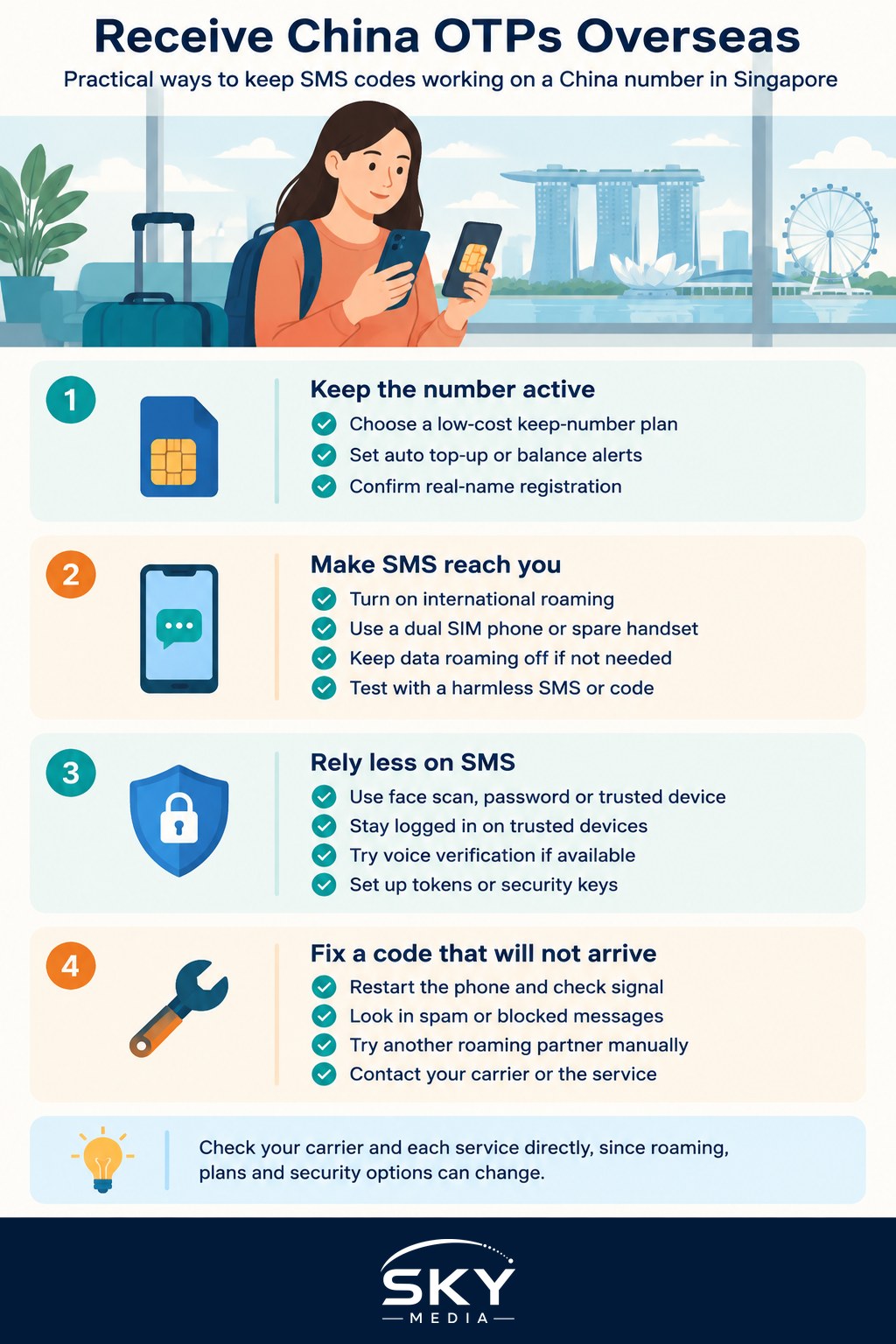
Step 1: Keep the Number Alive
The foundation is a China number that stays active. Check with your carrier, whether China Mobile, China Unicom or China Telecom, about:
- A low-cost plan suitable for keeping the number (often called a 保号套餐). Plans and conditions vary, so ask the carrier directly through its app or customer service.
- Auto top-up or balance alerts, so the number is not suspended for non-payment.
- Real-name registration status. Make sure the number is registered to you, because some services check this.
Our guide on keeping a China phone number in Singapore covers this in more depth.
Step 2: Make Sure SMS Can Reach You
Once the number is active, set it up to receive messages in Singapore:
- Activate international roaming before leaving China if possible. If you are already in Singapore, check whether your carrier’s app lets you turn it on remotely.
- Use a dual SIM phone or keep a second handset. A dual SIM phone lets you keep your Singapore SIM for daily use and the China SIM for receiving SMS. Our guide to using a dual SIM for your China and Singapore numbers explains the setup.
- Turn off data roaming on the China SIM unless you need it. Receiving SMS usually does not require mobile data, and leaving data roaming off helps avoid unexpected charges.
- Check roaming charges. Ask your carrier how incoming SMS and calls are charged when roaming, as this differs by plan.
- Test it. Ask a friend in China to send you an SMS, or trigger a harmless code from an app, to confirm messages arrive.
Comparing Your Options
| Option | How it works | Pros | Cons |
|---|---|---|---|
| Dual SIM phone | China SIM and Singapore SIM in one phone | One device, codes arrive where you are | Needs a compatible phone, roaming must be on |
| Spare phone with China SIM | Old phone kept on and charged at home | Keeps your main phone simple | Easy to forget to charge, not with you when out |
| Switch to app-based verification | Use in-app confirmation, face scan or a token instead of SMS | Works without SMS delivery | Not every service offers it |
| Change the bound number | Link the account to your Singapore number where allowed | No roaming needed | Many China services require a China number |
Step 3: Reduce Your Reliance on SMS
The most reliable fix is needing fewer SMS codes in the first place:
- Check each app’s security settings. WeChat, Alipay and many banking apps offer other ways to confirm your identity, such as face recognition, a payment password or confirmation from a trusted device. Turn these on where available.
- Keep trusted devices logged in. Logging out and back in often triggers an SMS. Staying logged in on a trusted phone reduces this.
- Ask about voice verification. Some services can deliver codes by voice call when SMS fails. Look for an option like “receive by voice” (语音验证码).
- Update bound numbers where allowed. Some international or cross-border services let you bind a Singapore number. Many China-only services do not, so check before trying.
- Set up bank tokens or security keys if your bank offers them, so large transactions do not depend on SMS alone.
Troubleshooting When a Code Does Not Arrive
If you are stuck waiting for a code, try these in order:
- Restart the phone and make sure the China SIM shows network signal.
- Check the SMS blocking or spam folder on your phone.
- Switch networks manually. In your phone’s mobile network settings, try selecting a different Singapore roaming partner.
- Wait before retrying. Repeated requests may trigger a temporary block from the service.
- Try the voice option if the app offers one.
- Contact the service’s customer support through the app or website. Explain you are overseas and ask about other verification methods.
- Contact your carrier to confirm roaming is active and the number is not suspended.
Stay Safe With OTPs
OTPs protect your money and identity, so treat them carefully:
- Never share an OTP with anyone, even someone claiming to be from your bank, a courier or a government office.
- Be cautious of third-party “virtual number” or SMS forwarding services. Using them to receive codes for your bank or payment accounts can expose your accounts to risk.
- Watch for scam messages pretending to be verification requests. Our guide on how to recognise phishing emails and SMS shows common warning signs.
Carrier plans, roaming arrangements and app security options change over time. Check the latest details with your carrier and each service before you travel or change settings. With an active number, working roaming and fewer SMS-dependent logins, China number OTP problems overseas become much easier to manage.
Frequently Asked Questions
Can I use a virtual number service to receive my China bank OTP? It is risky. Third-party virtual number or SMS forwarding services can expose your bank and payment accounts to danger, since someone else may see your codes. Safer routes are keeping your own China SIM active with roaming, a dual SIM phone or app-based verification.
Why do some China verification messages not reach me while roaming? Many come from service numbers, often starting with 106, and these may not be delivered reliably to numbers roaming overseas, depending on the sender and carrier. Make sure roaming is on, then try the voice code option if the app offers one.
Will receiving SMS on my China SIM use mobile data or cost money? Receiving SMS usually does not need mobile data, so you can keep data roaming off to avoid unexpected charges. Incoming SMS and calls may still be charged when roaming, and this differs by plan, so ask your carrier how yours works.
What should I do if I keep requesting codes and none arrive? Stop repeating requests, because repeated attempts may trigger a temporary block from the service. Restart the phone, check the spam folder, try switching to a different Singapore roaming network, then contact the app’s support and your carrier to confirm the number is not suspended.
Is it safe to share an OTP with someone helping me with my account? No. Never share an OTP with anyone, even someone claiming to be from your bank, a courier or a government office. Genuine organisations do not ask for it. Treat any message asking for your code as a possible scam.