

Looking for a rehab centre? Singapore families often face this decision suddenly. When an elderly parent comes home from hospital after a fall, stroke or surgery, or simply starts losing mobility, families often have to decide quickly where rehabilitation should happen. Choosing a rehab centre in Singapore is not just about picking the nearest building. The right setting depends on how much help your parent needs, how often they can travel, and what the family can manage at home.
This guide gives you a comparison framework to weigh the options. If you are new to the topic, our introductions to senior rehab services after a hospital stay and what a day rehabilitation centre does explain the basics. This article is general information, not medical advice. The doctors and therapists treating your parent should guide the final decision.
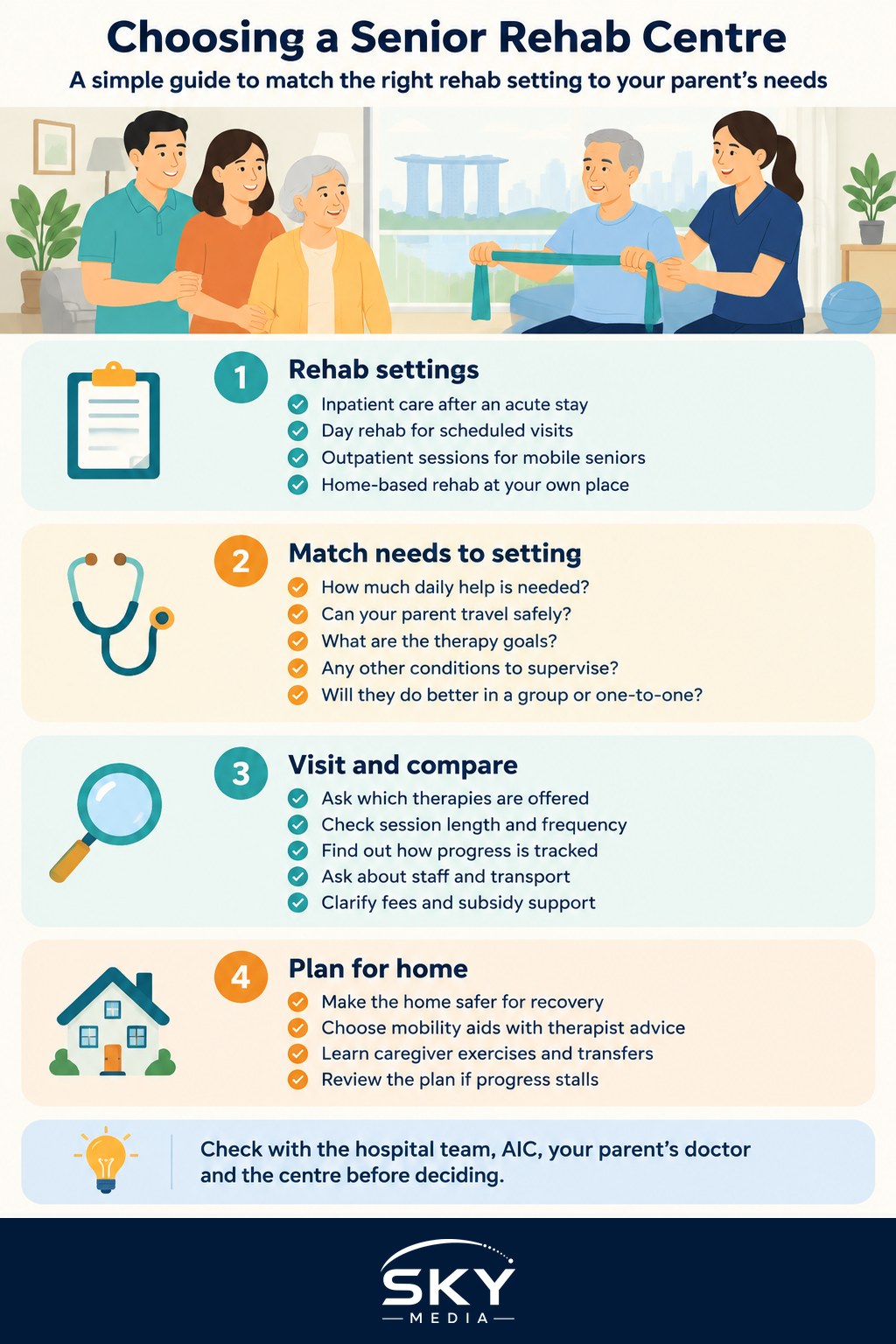
The Main Types of Rehab Settings
Rehabilitation for seniors in Singapore is commonly delivered in four broad settings:
- Inpatient rehab in a community hospital. For patients who still need nursing care and daily therapy after an acute hospital stay. Referrals are usually made by the hospital team.
- Day rehabilitation centres. Seniors live at home and attend a centre on certain days for physiotherapy, occupational therapy and sometimes speech therapy. Transport may be arranged.
- Outpatient rehab at hospitals, polyclinics or private clinics. Scheduled therapy sessions for seniors who can travel and need focused treatment.
- Home-based rehab. Therapists visit the home to work on mobility, daily tasks and home safety in the actual living environment.
The Agency for Integrated Care (AIC), which coordinates eldercare and community care services in Singapore, lists many of these services and can help families understand options and referrals.
Comparing Rehab Options Side by Side
Use the table below as a starting point when discussing choices with the care team.
| Setting | Best suited for | Main advantages | Things to consider |
|---|---|---|---|
| Community hospital (inpatient) | Seniors who need daily nursing and intensive therapy after an acute stay | Round-the-clock care, coordinated team | Time away from home, ward routines, referral needed |
| Day rehabilitation centre | Seniors who can live at home but need regular structured therapy | Social contact, group exercise, family can work during the day | Travel each session, fixed schedule |
| Outpatient clinic | Seniors who are fairly mobile and need targeted sessions | Flexible scheduling, specialised therapists | Travel and waiting time, less supervision between sessions |
| Home-based rehab | Seniors who are housebound or need help adapting their home | Therapy in the real environment, no travel | Fewer sessions, family or helper must practise exercises between visits |
Match the Setting to Your Parent’s Needs
Start by being honest about your parent’s current situation. Questions to discuss with the doctor or medical social worker:
- How much help do they need with daily activities such as walking, toileting, bathing and eating? Heavy needs usually point toward inpatient care first.
- Can they travel safely? Consider stairs, wheelchair access, the distance to the centre and whether transport is available.
- What are the goals? Returning to walking independently, getting in and out of bed safely, regaining hand function or speaking clearly each need different therapy.
- Are there other conditions such as dementia, heart problems or diabetes that need supervision during exercise?
- What is their mood and motivation? Some seniors thrive in group settings, while others respond better to one-to-one sessions at home.
Questions to Ask When Visiting a Rehab Centre
Once you have a shortlist, visit if you can, or speak to the centre by phone. Useful questions include:
- Which therapies are offered? Physiotherapy, occupational therapy and speech therapy are different. Check that the centre provides what your parent needs.
- How often are sessions, and how long is each one? Ask how this is decided and reviewed.
- How are goals set and progress tracked? Good centres set measurable goals and share updates with families.
- Who are the staff? Ask about therapist qualifications and the ratio of staff to participants in group sessions.
- Is transport provided? If so, how are pick-up times arranged, and is there assistance for wheelchair users?
- What happens if your parent feels unwell during a session?
- How are families involved? Many centres teach caregivers and helpers exercises to practise at home.
- What are the fees and what subsidies apply? Ask the centre to explain current charges and how subsidies are assessed.
Understanding Costs and Subsidies
Rehab costs vary by setting and provider, and subsidies can depend on factors such as household income and citizenship or residency status. Government-subsidised services may be means-tested, and some costs may be payable through MediSave or covered by schemes for eligible seniors, depending on the service.
Because rules change, confirm current details with:
- The medical social worker at the discharging hospital.
- The Agency for Integrated Care (AIC), through its website or service centres.
- The rehab centre’s own admin team, who can explain charges and the subsidy application process.
- The Ministry of Health (MOH) website for official information on schemes.
If your parent has private insurance, check the policy wording or speak to the insurer to see whether any rehab costs are covered.
Planning the Transition Home
Rehab is most effective when the home is ready. As your parent progresses, think about:
- Home safety changes such as grab bars, non-slip mats, better lighting and removing loose rugs. Therapists can often advise, and some home-based rehab programmes include a home assessment.
- Mobility aids like walking sticks, walking frames or wheelchairs, chosen with the therapist’s advice.
- Caregiver training. If a family member or helper will support daily care, ask for practical training in transfers and exercises. Our guide on when a senior care centre is better than a helper can help you think through longer-term care arrangements.
- Follow-up therapy. Many seniors move from inpatient care to day rehab or outpatient sessions, then to a maintenance exercise routine.
Signs the Current Rehab Arrangement Needs Reviewing
Check in regularly with the therapists. Consider asking for a review if:
- Progress has stalled for several weeks.
- Your parent is regularly too tired, anxious or in pain to participate.
- Travel is becoming difficult or stressful.
- The family can no longer manage the current schedule.
- New health problems appear.
Changing settings is not a failure. Rehab needs often shift, and a good care team will help you adjust.
Making a Confident Choice
The best rehab centre in Singapore for your parent is the one that matches their medical needs, their goals and your family’s practical situation. Use the comparison above, ask the right questions, and lean on the hospital team, AIC and your parent’s doctor for advice. Involving your parent in the decision, as far as possible, also helps them stay motivated through recovery.
Official sources: Agency for Integrated Care