

Choosing a rental lease term in Singapore is one of the first real commitments a newcomer makes, often before they know which neighbourhood suits them or how secure their job really is. The length you sign for affects your monthly rent, how much flexibility you keep, how much you pay upfront and what happens if your plans change. This guide looks only at that one decision: when a 6, 12 or 24 month lease makes sense, and how to match the term to your situation.
The Lease Lengths You Will Actually See
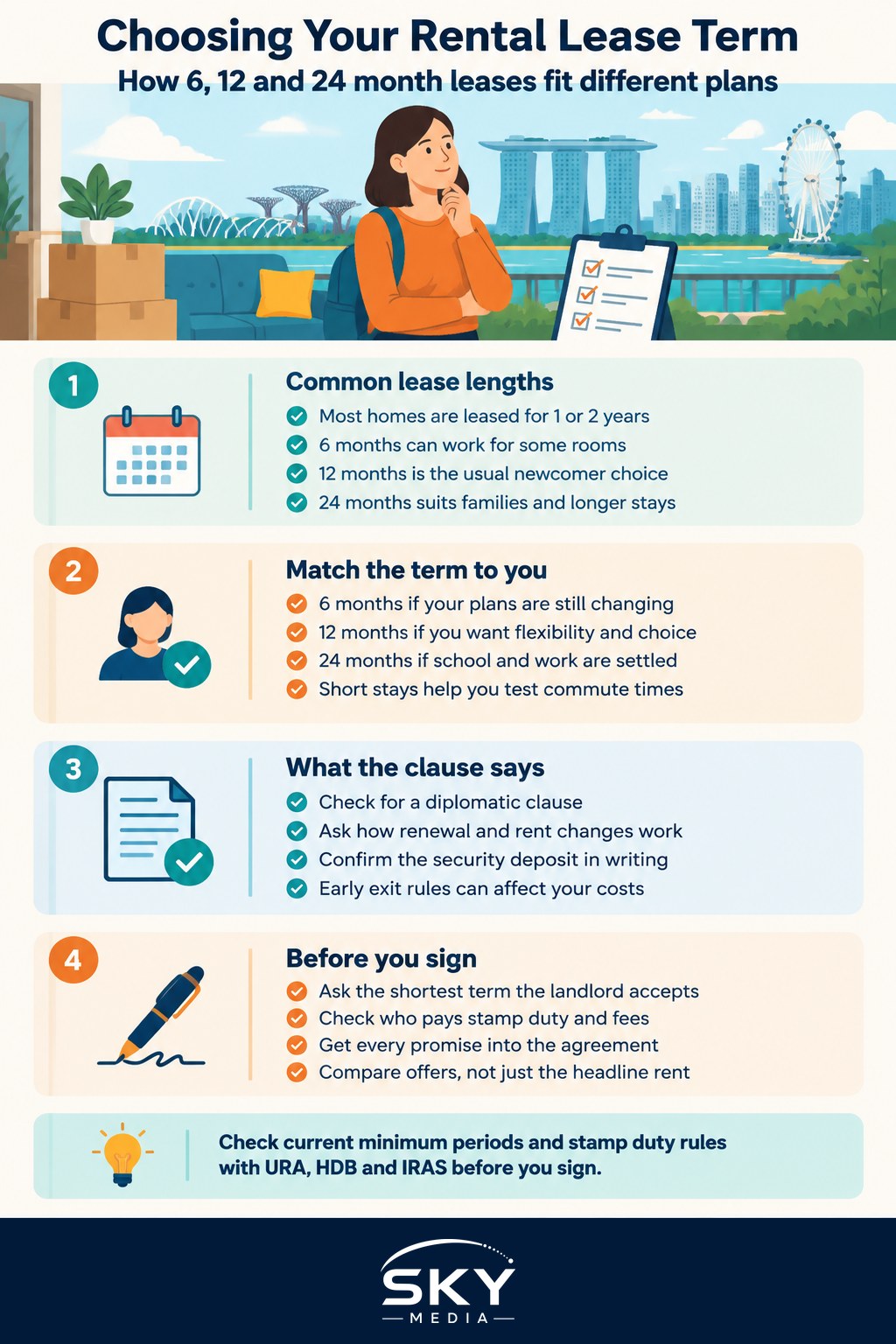
When you compare rental lease term Singapore options, you will find that most residential tenancies are written for one year or two years. These are the terms landlords and agents are used to, and they are what most listings assume unless they say otherwise.
Shorter terms exist but come with rules. The government sets a minimum rental period for residential property, and it differs between private homes and HDB flats. Private residential property is subject to a minimum stay set by URA (the Urban Redevelopment Authority), and HDB sets its own minimum period for renting out a flat or a room. These minimums have changed before, so check the current figures on the URA and HDB websites before you agree to anything unusually short.
In practice, this means:
- Under the minimum period: not legally offered as ordinary residential rental. Short stays below the minimum are usually serviced apartments or hotels, which operate under different rules.
- Around 6 months: possible with some landlords, especially for rooms, but less common for whole units.
- 12 months: the standard choice for many newcomers and the easiest to find.
- 24 months: common for families and for anyone who expects to stay, often with better rent terms.
Note that a rental lease is different from the 99-year lease on an HDB flat itself. If you see “remaining lease” in a listing, that refers to the flat’s ownership lease, which is explained in our guide to HDB lease and remaining lease. It does not limit how long you can rent.
Comparing 6, 12 and 24 Month Leases
Each length shifts risk between you and the landlord. A longer lease gives the landlord certainty, so they may be more willing to negotiate. A shorter lease gives you freedom, but you usually pay for it somewhere.
| Lease term | Best suited to | Typical advantages | Typical drawbacks |
|---|---|---|---|
| 6 months | Trial period in a new job, waiting for family to arrive, still choosing an area | Low commitment, easier to move once you know the city | Fewer listings, landlords may ask higher rent, mostly rooms or serviced options |
| 12 months | Most newcomers on a new employment pass, singles, couples | Widest choice of homes, standard paperwork, reasonable flexibility | Renewal talks each year, rent may be revised at renewal |
| 24 months | Families with children in school, people on longer contracts | Rent locked for longer, fewer moves, stronger position to negotiate | Harder to leave early without penalty, larger deposit is common |
Treat the table as a starting point. Every tenancy agreement is negotiated, and what one landlord accepts another may refuse.
Matching the Term to Your Situation
When a shorter lease makes sense
A 6 month lease, or a short stay in a serviced apartment before signing anything, is worth considering if:
- Your employment pass has only just been approved and you are still in probation.
- You do not yet know where your office, your partner’s office or your children’s school will be.
- You are arriving ahead of your family and want to choose the long-term home together.
Many newcomers use a short first stay to learn the MRT network, test commute times and visit neighbourhoods at different times of day. Then they sign a longer lease with far more confidence.
When a one-year lease is the sensible default
For most people moving to Singapore for work, 12 months balances flexibility and choice. You get access to the bulk of the rental market, the agreement follows familiar templates, and you can reassess after a year. If you are unsure, this is usually the safest option.
When a two-year lease pays off
A 24 month lease suits you if your job contract runs for two years or more, your children are settled in a school nearby, or you simply hate moving. Moving house in Singapore costs money and time, from agent fees to movers to setting up utilities again, so avoiding a second move can easily outweigh slightly less flexibility.
The Clauses That Matter More Than the Number
The headline length is only half of the decision. The clauses inside the agreement decide how locked in you really are.
The diplomatic clause
Many longer leases include a diplomatic clause, which lets a tenant end the lease early if they are transferred out of Singapore or lose their job, usually after a minimum period and with written notice and proof. This clause is the main reason a 24 month lease can be less risky than it looks. Read our explainer on the diplomatic clause and lease terms before you sign, and check exactly when it can be used and what documents are needed.
Renewal and rent revision
Ask whether the agreement includes an option to renew, and on what terms. Some agreements state that rent at renewal will be agreed by both parties, which gives you little protection. Others set out how renewal works. A 12 month lease with a clear renewal option can give you much of the security of a 24 month lease.
Security deposit and early termination
Deposits in Singapore are often linked to the lease length, with longer leases commonly asking for a larger deposit. Practice varies, so confirm the amount in writing. Also check what happens if you leave early without a qualifying reason. Many agreements say the tenant must pay rent until the landlord finds a new tenant, or forfeit the deposit, or both.
Stamp duty
Tenancy agreements in Singapore attract stamp duty, which is paid to IRAS (the Inland Revenue Authority of Singapore). The amount depends on the rent and the lease length, and the tenant usually pays it. Use the calculator on the IRAS website to check the current amount for your lease before you sign.
Questions to Ask Before You Commit
Before you settle on a rental lease term in Singapore, run through these questions with your agent or landlord:
- What is the shortest lease the landlord will accept, and does the rent change for a longer one?
- Is there a diplomatic clause, and after how many months does it apply?
- Is there an option to renew, and how is rent at renewal decided?
- How much is the security deposit, and when will it be returned?
- What happens if I need to leave early for a reason the diplomatic clause does not cover?
- Can I sublet or bring in a replacement tenant if my plans change?
- Who pays stamp duty and agent fees, and how much?
Get every answer reflected in the written agreement. A verbal promise from an agent is hard to rely on if a dispute comes up later.
A Simple Way to Decide
If you are still unsure, follow this order of thought. First, ask how certain your job and visa situation are. If uncertain, keep the commitment short or make sure a good diplomatic clause is in place. Second, ask how settled your household is, especially around schools. The more settled, the more a longer lease saves you. Third, compare the actual offers. A landlord willing to give a lower rent for two years, with a fair diplomatic clause, may give you the best of both worlds.
The right lease term is the one that fits how sure you are about the next one to two years, not the one that looks cheapest on day one. Take your time, read every clause and confirm current rules with URA, HDB and IRAS before you sign.
Frequently Asked Questions
Can I break my rental lease early if I lose my job in Singapore? Only if your agreement allows it. A diplomatic clause may let a tenant end the lease early if transferred out of Singapore or if they lose their job, usually after a minimum period with written notice and proof. Without one, you may owe rent until a new tenant is found or lose your deposit.
Is a longer lease cheaper per month than a shorter one? Often, but not always, since a longer lease gives the landlord certainty and may make them readier to negotiate. A shorter term can mean higher rent and fewer listings. Each tenancy is negotiated separately, so ask the landlord whether the rent changes for a 12 or 24 month term.
How much is stamp duty on a tenancy agreement, and who pays? The amount depends on the rent and the lease length, and the tenant usually pays it. IRAS has a calculator on its website, so use it to check the current amount for your lease before you sign. Confirm in writing who pays stamp duty and agent fees.
What happens to my rent when I renew the lease? That depends on the agreement. Some state that renewal rent will be agreed by both parties, which gives you little protection, while others set out how renewal works. Ask for a clear renewal option in writing, as a 12 month lease with one can give much of the security of a 24 month lease.
Can I sublet my room or find a replacement tenant if my plans change? Only if the agreement and the landlord allow it, so ask before you sign. Subletting rules can also be restricted by URA or HDB minimum rental periods, so check those. Get any permission to sublet or bring in a replacement tenant written into the tenancy agreement.
Further reading: How to Furnish a Rental Flat in Singapore Without Overspending