

You wake up with a fever, see a GP, pay at the counter and go home with an MC. A week later you wonder whether the company will pay you back. For many newcomers, the first outpatient claim in Singapore is confusing because the rules sit inside an HR portal, an insurer’s app and a benefits booklet nobody reads on day one. This guide walks through how routine outpatient claims usually work in practice, so you can use the benefits you already have.
This is general information, not insurance or medical advice. Your own policy wording and your HR team always have the final say.
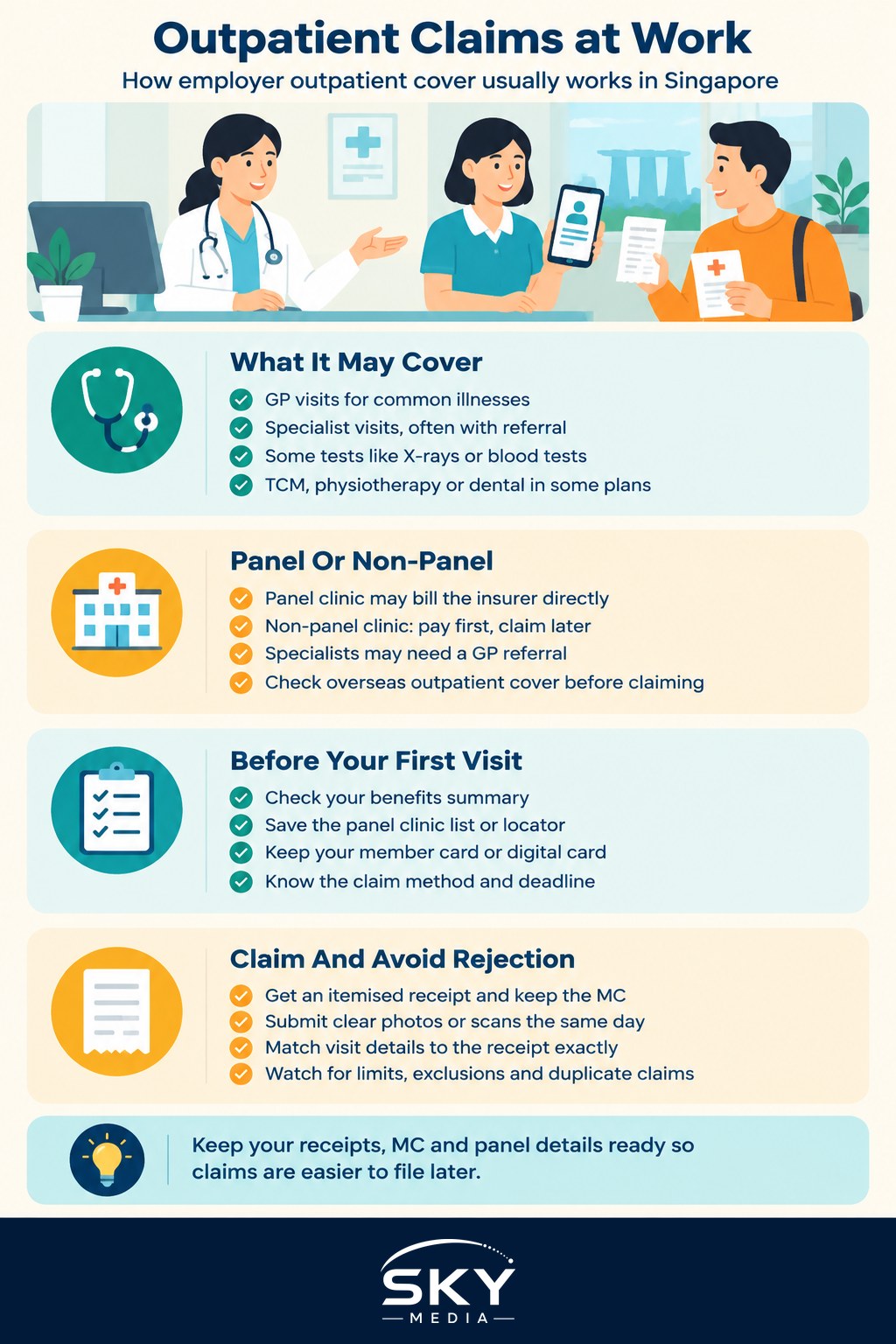
What “Outpatient” Usually Covers at Work
Outpatient care is treatment where you are not admitted to a hospital. In a workplace benefits context, it commonly includes:
- GP visits for everyday illness such as colds, fever, stomach upsets or minor injuries.
- Specialist visits, often only with a referral letter from a GP.
- Some diagnostic tests, such as X-rays or blood tests ordered by a doctor.
- Traditional Chinese Medicine (TCM) or physiotherapy, in some plans, sometimes with a separate limit.
- Dental, which is often a separate benefit or not covered at all.
Inpatient cover (hospital stays and surgery) is usually a different part of the same group policy, with its own process. Employers in Singapore are not all required to offer the same benefits, so two friends at different companies may have very different outpatient cover. If you want a wider view of how insurance claims work in general, see our guide on making an insurance claim.
Panel Clinic vs Non-Panel Clinic: The Choice That Shapes Your Claim
Most group outpatient plans work with a panel of clinics. The insurer or a third-party administrator (a company that processes claims on the insurer’s behalf) has an arrangement with these clinics. Where you go makes a big difference to how much paperwork you do.
| Situation | What usually happens at the clinic | What you do afterwards |
|---|---|---|
| Panel GP clinic | You show your staff card, app or NRIC/FIN; the clinic bills the insurer directly | Often nothing, unless there is a co-payment you pay on the spot |
| Non-panel GP clinic | You pay the full bill yourself | Submit a reimbursement claim with the receipt and any MC |
| Specialist with GP referral | Panel specialists may bill directly; others charge you | Keep the referral letter and itemised bill for the claim |
| Overseas visit while travelling | You pay locally, often in foreign currency | Check whether your plan covers overseas outpatient care before claiming |
A co-payment is a fixed amount or percentage you pay yourself even at a panel clinic. A deductible is an amount you bear before the plan starts paying. Not every plan has these, and the amounts vary, so look them up in your own benefits summary rather than assuming.
Before You See a Doctor: A Five-Minute Setup
The best time to understand your benefits is before you are sick. When you start a new job, ask HR or check the onboarding pack for:
- The benefits summary for your grade or plan. It lists outpatient limits per visit and per year, if any.
- The panel clinic list and how to search it. Many administrators have an app with a clinic locator.
- Your member card or digital card, and whether you need to activate an app account.
- The claims submission method for non-panel visits: an HR portal, an insurer app, email or a paper form.
- The submission deadline. Many plans require claims within a set number of days after the visit. Missing it is one of the most common reasons claims are rejected.
- Dependant cover. Some plans cover your spouse or children, sometimes only if you enrolled them.
Save the panel locator and your card on your phone so they are ready when you need them.
Making a Reimbursement Claim Step by Step
If you visited a non-panel clinic, or paid upfront for something the plan covers, you will usually need to submit a claim yourself. The general flow looks like this:
- Ask for the right documents at the clinic. Request an itemised receipt (not just a card payment slip) that shows the clinic name, date, your name, consultation fee and medicine charges. If you received an MC, keep it too.
- Photograph or scan everything clearly the same day. Thermal paper receipts fade.
- Open the claims channel your employer uses and choose the outpatient or GP category.
- Enter the visit details: date, clinic, diagnosis if asked, and the amount. Make sure the amount matches the receipt.
- Upload the documents and submit.
- Track the status. Approved claims are often paid with your salary or by bank transfer. The timing depends on your employer and administrator.
If your plan is handled by HR rather than an insurer, the steps may be simpler, but the same document rules usually apply.
Common Reasons Outpatient Claims Get Rejected
Most rejections are avoidable. Watch out for these:
- Late submission after the plan’s deadline.
- Missing itemisation, where the receipt only shows a total.
- Excluded items, such as supplements, cosmetic treatments, health screenings or vaccinations that the plan does not cover. Exclusions differ by policy.
- Specialist visits without a referral, if your plan requires one.
- Exceeding the per-visit or annual limit. The plan may pay part of the bill only.
- Name mismatch, for example a receipt issued under a dependant’s name when that dependant is not enrolled.
- Duplicate claims, where a panel clinic already billed the insurer directly.
If a claim is rejected and you think it should be covered, ask HR or the administrator for the specific clause they relied on.
MCs, Sick Leave and Claims Are Linked but Separate
Newcomers sometimes mix up two different things. The medical certificate (MC) is evidence for sick leave. The outpatient claim is about paying for the treatment. You may need the MC for HR’s leave records and the receipt for the medical claim, often through different screens in the same portal.
Sick leave entitlements for employees covered by the Employment Act are set out by the Ministry of Manpower (MOM), and your contract may offer more. For the employer side of these rules, our overview of the Employment Act is a useful reference. Check MOM’s website for the current rules that apply to you.
Using Other Schemes Alongside Workplace Cover
Your employer’s plan is not the only support available. Depending on your residency status, you may also be able to use:
- CHAS (Community Health Assist Scheme), which provides subsidies at participating GP and dental clinics for eligible Singapore Citizens. Check eligibility with the Ministry of Health (MOH).
- Polyclinics, government outpatient clinics that offer subsidised rates mainly for citizens and permanent residents. Foreigners can use them but usually pay non-subsidised rates.
- Personal health or travel insurance you hold yourself.
Some plans require you to claim from other sources first, or reduce the payout if another scheme already paid part of the bill. Read the “coordination of benefits” or similar section in your policy, or ask HR.
Practical Tips for Newcomers
- Keep a simple claims log with the date, clinic, amount and status.
- Ask the clinic before treatment whether they are on your panel, as panel lists change.
- Clarify when you change jobs. Cover usually ends on your last day, so visits after that are generally not claimable from the old employer.
- Remote or overseas employers may use a global insurer with its own rules. If you work for a company based outside Singapore, see our guide on remote work for a China employer from Singapore for wider points to clarify.
Outpatient benefits are part of your pay package. A few minutes of setup and careful receipts mean you can use them without stress when you actually feel unwell. For anything specific to your plan, your HR team and insurer remain the best source.
Frequently Asked Questions
What if I forget my staff card or app at a panel clinic? Many panel clinics can still look you up with your NRIC or FIN, or you can show the digital card on your phone. If the clinic cannot verify you, pay and ask for an itemised receipt, then submit a reimbursement claim. Confirm this with your administrator.
Does workplace outpatient cover work from my first day at a new job? Not always. Some plans start on your first day, while others have a waiting period or only apply after probation. Check your offer letter, benefits summary or ask HR before you rely on it, and keep receipts from early visits in case they become claimable.
Will my outpatient claim be accepted for a condition I already had? It depends on the policy wording. Some plans exclude or limit pre-existing conditions, while others cover routine visits regardless. Look for the exclusions section of your benefits summary, and ask HR or the administrator in writing if it is unclear.
Can I appeal if my employer insurance rejects an outpatient claim? Often yes. Ask HR or the administrator for the specific reason and policy clause used, then provide missing documents, such as an itemised receipt or referral letter. If the rejection is correct, such as a late claim, there may be little room, but it costs nothing to ask.
How long should I keep my receipts after claiming? Keep them at least until the claim is paid and you have checked the amount is right. Holding on a little longer is sensible in case of queries or audits. Store clear photos of the receipt and MC in one folder so they are easy to find.
Further reading: Does Insurance Cover Dental Treatment in Singapore?