
If you are new to the city, one of the first practical questions is where to go when you need to go. The good news is that public toilets in Singapore are generally easy to find and free to use, and many are kept to a good standard. Quality does vary, though. A toilet in a newer mall can feel like a hotel bathroom, while one in an older coffee shop might be a little more basic.
This guide covers where reliably clean toilets tend to be, how the Happy Toilet rating works, and how to find accessible toilets and nursing rooms.
Where to Find Public Toilets Day to Day
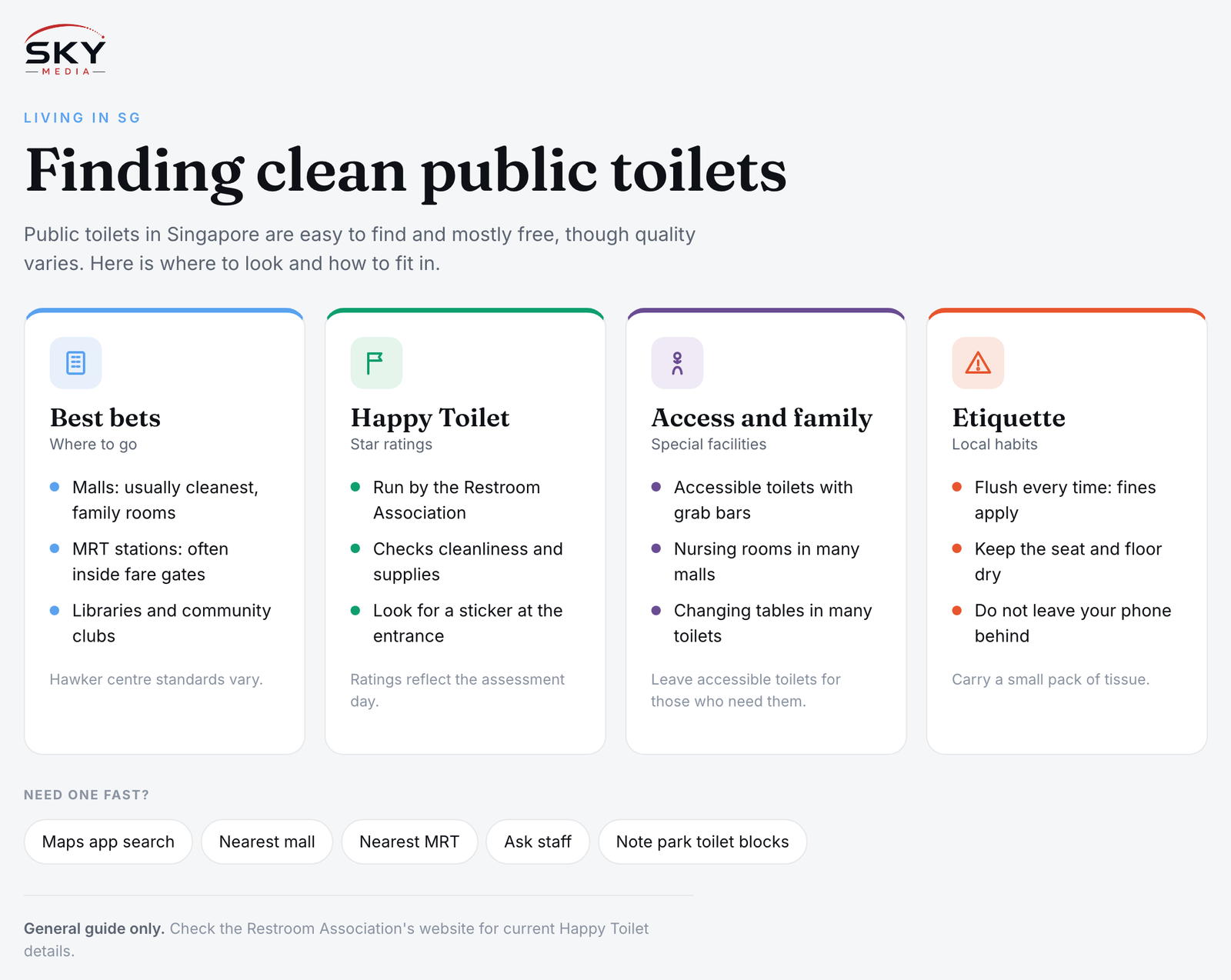
Shopping malls. Malls are usually the most reliable option. Toilets are typically on most floors, cleaned regularly through the day, and often include family rooms. Newer and more upmarket malls tend to have the best facilities. Look for signs near escalators, lift lobbies and food courts.
MRT stations. Most MRT stations have toilets, though in many stations they are inside the paid area, past the fare gates. Some are outside the gantry. If you are mid-journey, it is worth using one before you tap out. Station maps and signs will point you to them.
Hawker centres and food centres. Hawker centres have public toilets, and many have been upgraded over the years. Standards vary between centres. Some older facilities may have a small fee collected by an attendant, so keep a few coins handy just in case, although many are now free.
Community clubs, libraries and public buildings. Public libraries, community clubs and government service centres usually have clean, quiet toilets that are open to the public during opening hours.
Parks and beaches. NParks parks, park connectors and beaches such as East Coast Park have toilet blocks along the way. These are cleaned regularly but are outdoor facilities, so expect a more basic setting.
Bus interchanges. Major bus interchanges generally have toilets, which can be handy on longer journeys.
How the Happy Toilet Ratings Work
The Restroom Association (Singapore), a non-profit that campaigns for cleaner public toilets, runs the Happy Toilet programme. Toilet owners such as malls, food centres and other premises can apply to have their toilets assessed. Those that meet the standards receive a star rating, and you may see a certificate or sticker near the entrance.
The assessment generally looks at things like:
- Cleanliness and dryness of floors, basins and cubicles.
- Availability of toilet paper, soap and hand dryers or paper towels.
- Design and maintenance, such as working flush systems and good ventilation.
- Whether the facility is user-friendly, including for elderly and disabled users.
A higher star rating suggests a better experience, but ratings reflect the toilet at the time of assessment, and day-to-day conditions can still vary. Check the Restroom Association’s website for current details on the programme and rated locations.
Comparing Your Options at a Glance
| Location | What to expect | Good to know |
|---|---|---|
| Shopping malls | Usually the cleanest, often with family rooms | Busy at lunch and weekends |
| MRT stations | Convenient, cleaned regularly | Often inside the paid area |
| Hawker centres | Variable, many upgraded | Older ones may have a small fee |
| Libraries and community clubs | Quiet and generally clean | Open only during opening hours |
| Parks and beaches | Basic outdoor toilet blocks | Bring tissue just in case |
Accessible Toilets and Nursing Rooms
Accessible toilets. Most malls, MRT stations and newer public buildings have accessible toilets for wheelchair users, with wider doors, grab bars and enough space to turn. Many are also used as family toilets. If you do not need one, it is courteous to use the regular cubicles so the accessible toilet is free for those who do.
Nursing rooms. Parents with babies will find nursing rooms in many malls, some MRT stations, hospitals, libraries and larger public buildings. They typically have a private space for breastfeeding, a diaper-changing station and sometimes a sink and hot water. Mall directories and customer service counters can point you to them.
Diaper-changing stations. Many malls have changing tables in family rooms or in both the male and female toilets, which is helpful for fathers out alone with young children.
Etiquette and Local Habits
Singapore takes toilet cleanliness seriously, and there are fines for failing to flush public toilets. A few habits will help you fit in:
- Flush every time. It is not just polite; it is expected.
- Keep the seat and floor dry. Wet floors are a common complaint, so wipe up splashes if you can.
- Squat toilets. Some older facilities still have squat toilets. If you prefer a seated one, check the cubicle doors, which often show the toilet type.
- Bring tissue. Most toilets supply paper, but it can run out at peak times, especially at hawker centres and parks. A small pack of tissue is a useful habit.
- Bidet sprays. Some toilets have a handheld bidet spray. Use it carefully and leave the area dry for the next person.
- Do not leave belongings behind. Phones on top of cisterns are a common lost item.
Newcomers from mainland China will find the setup similar to modern public toilets in large Chinese cities, though toilet paper is usually supplied inside each cubicle rather than at a shared dispenser at the entrance.
Finding a Toilet When You Need One Fast
- Use your maps app. Searching for “toilet” or “restroom” in common map apps usually shows nearby options in malls and public buildings.
- Head for the nearest mall or MRT station. In most built-up areas, one is never far away.
- Ask staff. Security guards, station staff and shop assistants are used to the question and will point you in the right direction.
- Use hotel lobbies sparingly. Hotel toilets are usually meant for guests and patrons, so it is better to buy a drink at the lobby café first or choose a nearby mall instead.
- Plan for long walks. If you are going on a nature walk or long cycle along a park connector, note where the toilet blocks are beforehand.
If you or a family member feels unwell rather than just needing a toilet, our guide to finding a 24-hour clinic in Singapore can help. Parents in the middle of potty training may also find our guide to toilet training your toddler useful for planning outings.
Once you know where to look, finding a clean toilet in Singapore is rarely a problem. Malls and MRT stations will cover most of your needs, and the Happy Toilet stickers are a handy sign that a facility has met a recognised standard.