
If your car’s beams look weaker than they used to at night, the problem may not be the bulbs at all. Cloudy, yellowed lenses are one of the most common reasons headlights dim over time, and cleaning car headlights singapore drivers can often do at home is a satisfying weekend job that makes a real difference to how well you see and how well others see you. Our strong sun is a big part of the cause, so this is a very local problem. This guide explains why lenses go hazy, how to restore them safely yourself, and when a foggy headlight is a sign to visit a workshop instead.
Why Headlights Turn Cloudy Here
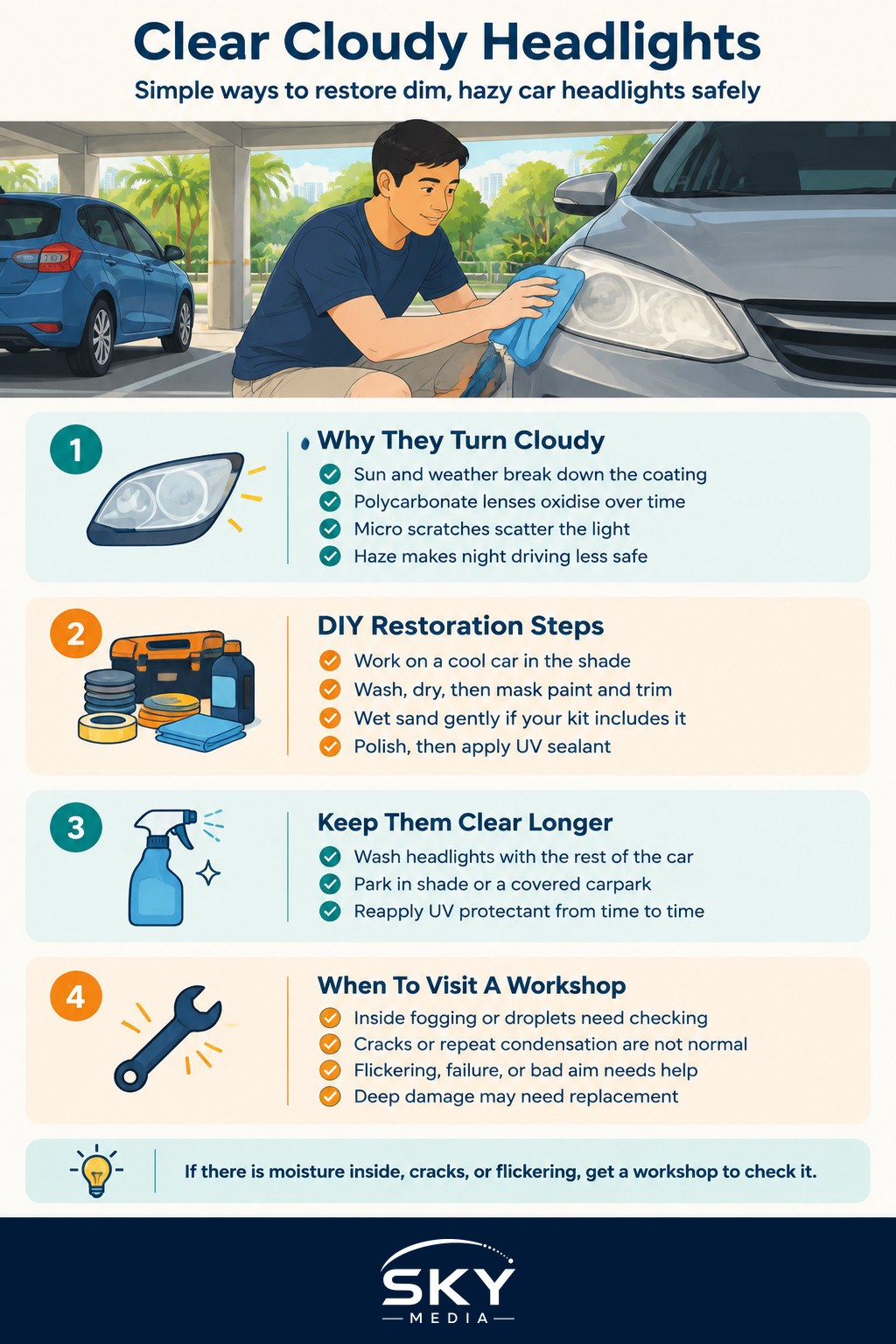
Most modern headlights are made of a tough plastic called polycarbonate rather than glass. From the factory the lens has a clear protective coating on the outside. Over the years, sunlight, heat, and the weather break that coating down. In Singapore the intense, year round sun does this faster than in cooler climates, which is why you see plenty of hazy, yellow headlights on older cars around our carparks.
Once the coating fails, the plastic underneath starts to oxidise and micro scratches build up. The surface scatters light instead of letting it pass through cleanly, so your headlights look milky and throw a weaker, more diffuse beam. That is a safety issue, especially on unlit stretches and in the rain, so it is worth sorting out. If you often drive after dark, our guide to driving at night safely in Singapore pairs well with this.
A Safe DIY Restoration, Step by Step
You can restore mildly to moderately hazy lenses at home with patience and care. Work on a cool car, in the shade, with the engine off and the handbrake on. Wear gloves and eye protection, and take your time.
- Wash the headlights and the surrounding paint, then dry them. You want no grit that could cause scratches.
- Mask off the paint and trim around each headlight with tape. This protects the bodywork from sanding and any product.
- If your kit includes wet sanding, sand gently and evenly with the grit sequence provided, keeping the surface wet the whole time. Work through the grades from coarser to finer so the fine scratches replace the coarse ones. Do not rush or press hard.
- Polish the lens to bring back clarity, following the product instructions.
- Clean and dry the lens fully, then apply a protective sealant or UV coating. This last step matters. Without a fresh protective layer, our sun will haze the bare plastic again quickly.
A dedicated headlight restoration kit bundles these steps and is designed for the job, which is safer than improvising with random household products. Follow the instructions that come with your kit rather than a generic method, since products differ.
Keeping Them Clear for Longer
Prevention helps a lot. Wash your headlights when you wash the car, and consider parking in the shade or in a covered carpark when you can, since sun exposure is the main enemy. Reapplying a UV protectant every so often keeps the fresh coating working. Building headlight care into your usual wash routine is easy, and our guide to car grooming and detailing in Singapore covers the wider habit.
When to See a Workshop Instead
DIY restoration works well for surface haze and yellowing, but not every foggy headlight is a surface problem, and some issues are safety critical.
- Fogging or water droplets on the inside of the lens means moisture has got into the sealed unit. Cleaning the outside will not fix that, and you should have it checked, since the seal or the housing may need attention.
- Cracks in the lens, condensation that keeps coming back, or a headlight that flickers or fails point to a fault beyond cleaning.
- Very deeply oxidised or damaged lenses may be too far gone to restore well and may need replacing.
- Aiming matters. If a headlight points too high or too low, cleaning it will not help and a workshop should adjust it.
Anything to do with wiring, the sealed housing, or headlight alignment is best left to a qualified workshop. If your car is due for its check, our guide to car inspection and VICOM in Singapore explains what to expect, and clear, correctly aimed headlights are part of being roadworthy.
The Bottom Line
Cloudy headlights are common in Singapore because our sun breaks down the lens coating faster than in cooler places, and the result is dimmer, less safe night driving. For surface haze and yellowing, a proper restoration kit and a patient hour or two can bring the clarity back, as long as you finish with a fresh UV protectant so it lasts. Keep them washed and parked in the shade where you can. But if the fogging is on the inside, the lens is cracked, or a light keeps failing, that is a workshop job. Clear headlights are not just about looks, they are about seeing and being seen on the road.
Frequently Asked Questions
Does toothpaste really clean cloudy headlights? It may brighten light haze briefly, but it does not rebuild the protective coating, so the cloudiness tends to return. A proper restoration kit ending with a UV sealant is more reliable. Follow the kit’s instructions rather than home tricks.
How long does a headlight restoration last? It depends on the products used and how much sun the car gets. Without a UV protective coat, haze can return within months in our sun. Reapplying a protectant now and then, and parking in shade, helps it last.
Is it cheaper to restore or replace cloudy headlights? Restoring with a kit is usually cheaper than replacing the unit, but badly damaged or cracked lenses may need replacement. Ask a workshop to compare the two for your car. Prices vary by model and workshop.
Can cloudy headlights cause a failed inspection? Weak or poorly aimed headlights can affect roadworthiness, so it is wise to fix them before an inspection. Clear lenses and correct aiming both matter. Check what is covered with the inspection centre.
Why do my headlights fog up on the inside? Moisture has probably got into the sealed unit through a worn seal, crack or vent. Cleaning the outside will not help. Have a workshop check the housing and seal, as the unit may need resealing or replacing.