
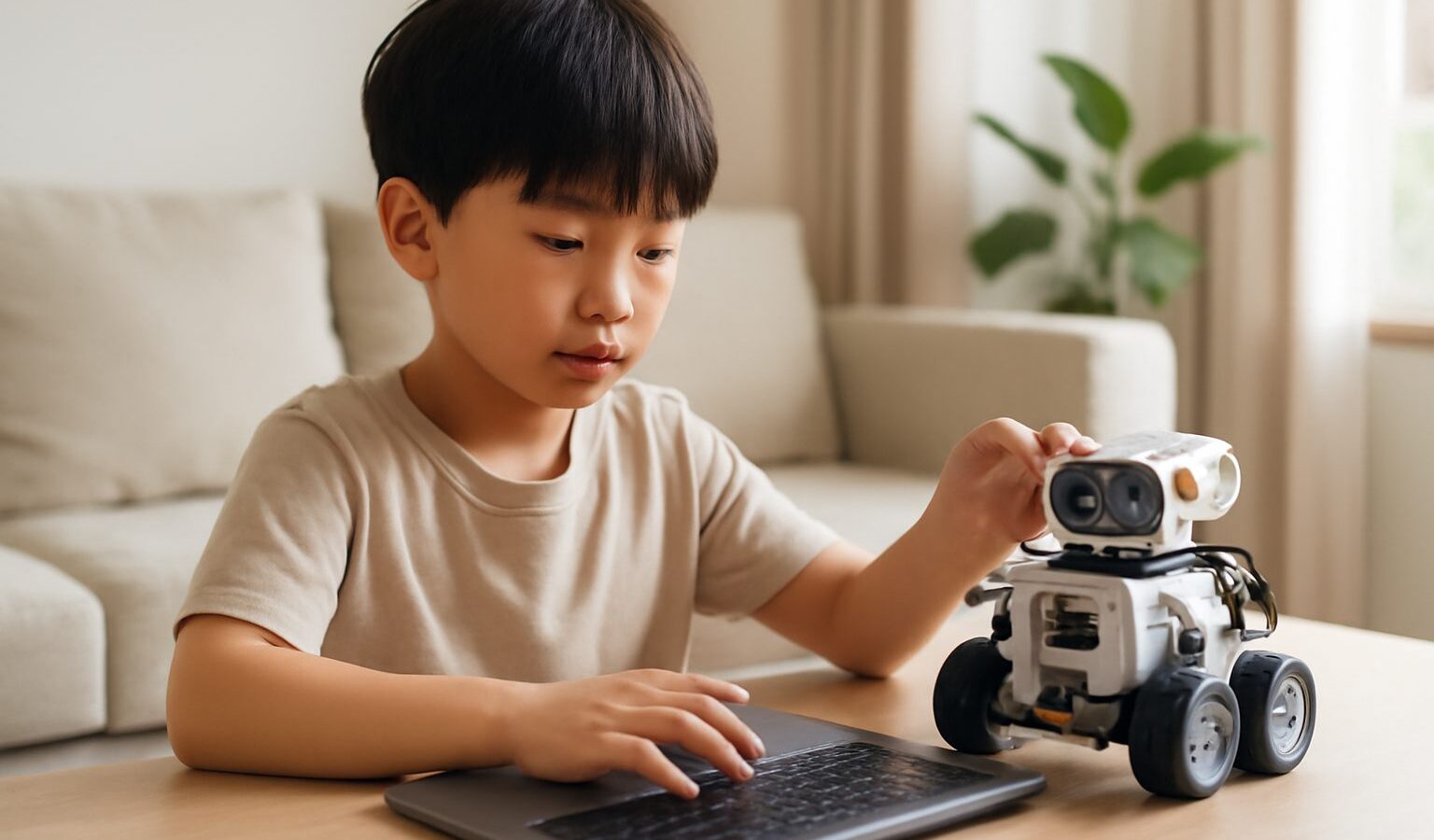
Coding for kids in Singapore has moved from niche hobby to mainstream enrichment in just a few years. Parents hear that these are the skills of the future, and children are often drawn in through games, robots and the simple thrill of making something work. But the landscape can be confusing: block coding, text coding, robotics, game design and app-making all sit under the same umbrella. This guide explains what these classes actually teach, how they progress by age, and how to choose one without getting lost in the jargon.
The reassuring news is that coding is a learnable skill, not a talent a child either has or lacks. The aim at this stage is not to produce professional programmers but to build curiosity, logical thinking and the confidence to solve problems step by step.
What Coding and Robotics Classes Teach
Most classes are less about memorising code and more about computational thinking: breaking a problem into steps, spotting patterns, and testing and fixing ideas. Those habits transfer to maths, science and everyday problem-solving.
- Block coding uses drag-and-drop blocks so children build logic without worrying about typing or syntax. Tools like Scratch are common starting points and let children make animations and simple games quickly.
- Text-based coding introduces real languages such as Python or JavaScript, usually once a child is comfortable reading and typing. This is a natural next step from blocks.
- Robotics joins code to the physical world. Children build with kits and program the robot to move, sense and react, which makes abstract logic tangible and immediately satisfying.
- Game and app design channels that same logic into projects children care about, teaching sequencing, variables and cause and effect through play.
A good class balances instruction with free exploration. Children should spend real time making their own projects, not only copying the teacher, because that is where genuine understanding and pride take root.
Matching Classes to Your Child’s Age
There is no fixed age to start, and readiness varies from child to child. The rough progression below is a guide, not a race, and plenty of children begin later and thrive.
| Stage | Rough age | Typical focus | What it looks like |
|---|---|---|---|
| Early start | Preschool to lower primary | Screen-free logic, simple robots | Sequencing games, floor robots, tactile kits |
| Foundation | Lower to upper primary | Block coding, basic robotics | Scratch projects, build-and-program kits |
| Building skills | Upper primary to lower secondary | Intro text coding, game design | Python basics, simple apps and games |
| Deeper work | Secondary and up | Text languages, advanced robotics | Python or JavaScript, competitions, real projects |
For young children, look for hands-on, screen-light activities that build sequencing and cause-and-effect thinking. From lower primary, block coding tends to click well. Text coding usually suits children who read fluently and can type with some comfort. If in doubt, most providers offer a trial class, which tells you far more than any age chart.
Choosing a Class Without the Jargon
Marketing in this space can be heavy on buzzwords. Cut through it with a few practical questions.
- What will my child actually build? Ask to see sample projects for the level. Real, varied projects are a better sign than a fixed script every child follows.
- How big is the class, and who teaches it? A smaller group and a patient, knowledgeable teacher matter more than a famous curriculum name.
- Is there a clear progression? Good providers can explain what comes after the first course so your child keeps growing rather than repeating similar tasks.
- Are extra costs involved? Some robotics courses include kit use; others expect you to buy a kit. Clarify what is included before committing, and confirm current fees directly, as they vary widely between providers.
- Does my child enjoy it? Watch how they behave after a trial. Engagement and eagerness to continue are the clearest signals that a class fits.
You do not need the most expensive or advanced option. A well-taught foundation class that your child looks forward to will do more than a high-powered course that leaves them lost.
Where to Find Coding and Robotics for Kids
Options in Singapore are plentiful and varied. Dedicated coding and robotics academies run structured, level-based courses across the island. Many general enrichment centres now include coding alongside art and academic subjects. During the school breaks, holiday camps offer an easy, low-commitment way to test interest before signing up for a term.
Schools are part of the picture too. Many primary and secondary schools run coding, robotics or STEM as co-curricular activities or clubs, and national initiatives have brought computing and digital literacy into the curriculum, so check what your child’s school already offers before paying for more. The National Library Board (NLB) periodically runs coding and maker sessions, and community clubs sometimes host affordable workshops. For self-starters, plenty of free, reputable online platforms let children explore block coding at home at their own pace.
Try to see these settings as complementary rather than competing. A club at school, a free online platform and the occasional holiday camp can together give a rich experience without a heavy weekly commitment.
Keeping It Fun and In Perspective
It is easy to feel that every child must code to succeed, but the healthiest approach is curiosity over pressure. If your child loves it, wonderful, support it and let them build ambitious projects. If they try it and prefer football or drawing, that is perfectly fine; the logical thinking coding builds shows up in many other activities too.
Watch for balance as well. Coding and robotics are engaging, but they add to screen time, so pair them with plenty of offline play, movement and rest. Celebrate the process rather than only the polished result, because a game that never quite worked can teach as much as one that did. Above all, let your child follow what genuinely interests them; motivation, more than any single course, is what carries these skills forward.
Explore More
To see how coding fits into the wider picture, read our guide to learning tech and digital skills in Singapore. If you are weighing coding against other options, our advice on choosing enrichment classes for kids can help, and for children who love to learn independently, see our tips on self-directed learning.