
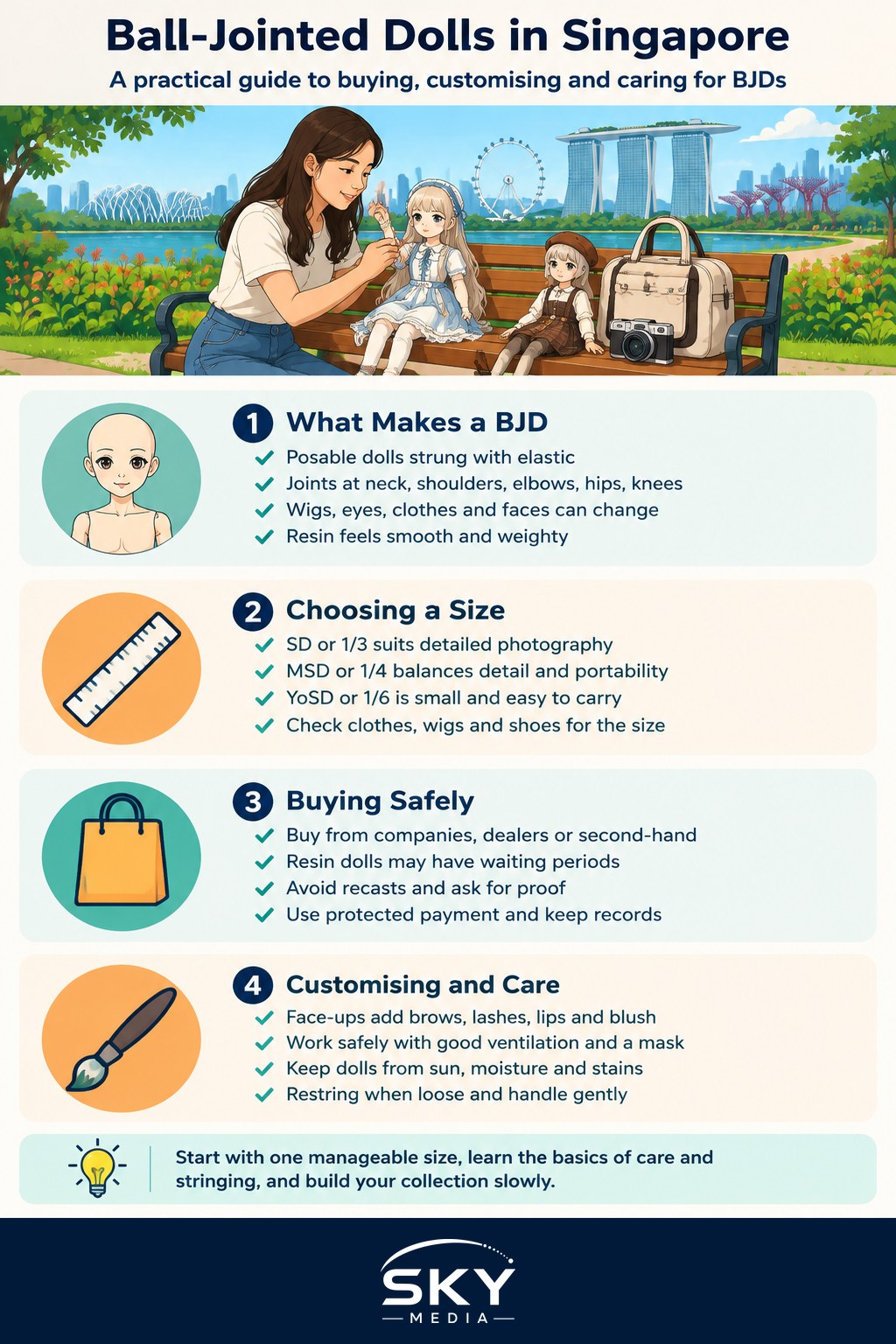
Ball-jointed dolls, usually called BJDs, sit somewhere between collectible figures, art pieces and fashion projects. They are posable dolls strung together with elastic, with joints at the neck, shoulders, elbows, hips and knees, which lets them hold natural poses for photographs. Owners change their wigs, eyes, clothes and painted faces, so no two dolls end up quite the same. If you have seen a ball-jointed doll Singapore owner photographing a beautifully styled figure in a park or at a convention and wondered how to start, this guide walks you through the basics.
It covers sizes and materials, how buying usually works, what face-up customising involves, how to care for a doll in our humid climate and how to find other collectors locally.
What Makes a BJD Different
Most BJDs are made from polyurethane resin, a dense material that gives them a smooth, porcelain-like finish and a satisfying weight. Some newer and more affordable dolls are made from vinyl or plastic, which is lighter and more durable but feels different.
A traditional BJD is held together by elastic cord running through hollow body parts. You can restring a doll yourself when the elastic loosens. Many dolls come in parts you choose separately: head (sometimes called a “sculpt”), body, hands, and sometimes alternative feet for flat shoes or heels.
The hobby is popular in East Asia, especially South Korea, China and Japan, where many of the original companies and independent artists are based. Today there are also many independent sculptors worldwide.
Understanding BJD Sizes
Sizes are often described by a fraction of human height, though exact measurements vary between makers.
| Size class | Rough height range | Good for |
|---|---|---|
| SD or 1/3 | Around 55 to 70 cm | Detailed photography, lots of clothing available, but heavy and space-hungry |
| MSD or 1/4 | Around 40 to 45 cm | A balance of detail and portability, popular with beginners |
| YoSD or 1/6 | Around 25 to 30 cm | Small and cute, easy to carry to meetups |
| Tiny and 1/8 or smaller | Under about 20 cm | Small spaces, cheaper clothes, quick to travel with |
Before you buy, check whether clothes, wigs and shoes are easy to find for that size. Wig sizes are given by head circumference, shoes by foot length, and eyes in millimetres, so note your doll’s exact measurements from the maker.
Space matters in a Singapore flat. A 1/3 doll with a display stand takes up a real shelf, and you will need somewhere to keep spare clothes and wigs too.
Buying Safely: Official Releases and Second-Hand
BJDs can be expensive, and resin dolls from established makers often have a waiting period because they are made to order. Prices vary widely by size, maker and whether a face-up is included, so compare carefully before committing.
Common ways to buy:
- Direct from the company or artist, often through limited ordering windows.
- Authorised dealers, which sometimes ship to Singapore or run group orders.
- Second-hand marketplaces and collector groups, where you can find discontinued sculpts.
Some practical points:
- Beware of recasts. A “recast” is an unauthorised copy of a doll. Experienced collectors avoid them because they infringe the original artist’s work, often use poorer resin and are not welcome in many communities. If a price looks too good to be true, ask for the original certificate and receipts.
- Check shipping and customs. Larger parcels from overseas may be subject to GST and import rules. Check current details with Singapore Customs.
- Use protected payment where possible, and keep records of every transaction.
- Ask for clear photos of second-hand dolls, especially for yellowing, scratches, or stains from dyed clothing.
Face-Ups and Other Customising
A face-up is the painted make-up on a doll’s face: eyebrows, lashes, lip colour and blush. It is the single biggest thing that changes a doll’s character.
The usual process involves:
- Preparing the head by cleaning it gently and removing old paint.
- Sealing the resin with a matte sealant spray designed for this type of work, applied in a well-ventilated space.
- Layering soft pastels with brushes for blush and shading.
- Painting fine details such as brows and lashes with watercolour or acrylic.
- Sealing again between layers and at the end.
Safety comes first. Sealant sprays and some solvents give off fumes, so work outdoors or by an open window, wear a suitable mask and gloves, and follow the product’s label. In HDB flats, avoid spraying in corridors or where neighbours might be affected. Many sealants are also humidity-sensitive, and spraying on a very humid day can leave a white, cloudy finish called “frosting”, so pick a drier day or spray in an air-conditioned but ventilated room.
If you would rather not paint, many face-up artists take commissions. Check their portfolio, timeline and shipping arrangements before sending a head.
Other common customisations include:
- Eyes, swapped for different colours and sizes.
- Wigs, in mohair or synthetic fibres.
- Clothing, either bought or sewn yourself. Sewing for dolls is a good way to practise small-scale sewing.
- Body blushing, adding subtle colour to knees, hands and other joints.
Caring for a BJD in Singapore’s Climate
Heat, sunlight and humidity are the main concerns.
- Keep dolls away from direct sunlight. UV exposure causes resin to yellow over time. Store them away from windows.
- Watch humidity. Moisture can affect wigs, clothing and stringing. A dry cabinet or a box with silica gel packs helps, especially for spare parts and wigs.
- Avoid dark clothing staining. Dyed fabric can transfer onto light resin. Use light-coloured undergarments or a barrier layer.
- Handle gently. Resin can chip. Use padded stands and do not leave dolls unsupported on high shelves.
- Restring when loose. Elastic can perish, especially in heat. Learn to restring or ask an experienced collector for help.
Finding the Local Community
BJD collectors in Singapore mostly connect online, through social media groups, chat communities and forums, and meet up in person for photo outings and gatherings. Anime and comic conventions often draw doll collectors too, and some craft fairs feature doll clothing and accessories sellers.
When you join a community:
- Read the group rules, especially on recasts and buying and selling.
- Ask before photographing someone else’s doll.
- Keep public photo shoots considerate: do not block walkways, and respect park rules.
Meetup spots often include gardens and heritage areas with good light. Be mindful of the heat, bring water and keep your doll in the shade when you are not shooting.
If you enjoy the collecting side of hobbies, our guides to collecting sneakers and the hobby of plant collecting share many of the same lessons about budgeting, authenticity and community.
A ball-jointed doll is a slow hobby. You save, wait, customise and slowly build a character. Start with one doll in a manageable size, learn the basics of care and stringing, and let your collection grow from there.
Further reading: Collecting Blind Boxes and Designer Art Toys in Singapore