

Many business owners and investors who buy commercial property in Singapore come from a background of buying homes. They know HDB flats or condos well, then discover that a strata shop or office unit plays by quite different rules. Taxes, financing, who can buy, and how tenancies work all change once the property is not residential.
This guide focuses on those differences for strata shops and offices, the most common entry point for small businesses and individual investors. It is general information, not legal, tax or financial advice. Property rules and tax rates change, so check current details with IRAS, your bank and a conveyancing lawyer before committing.
Who Can Buy and Why It Matters
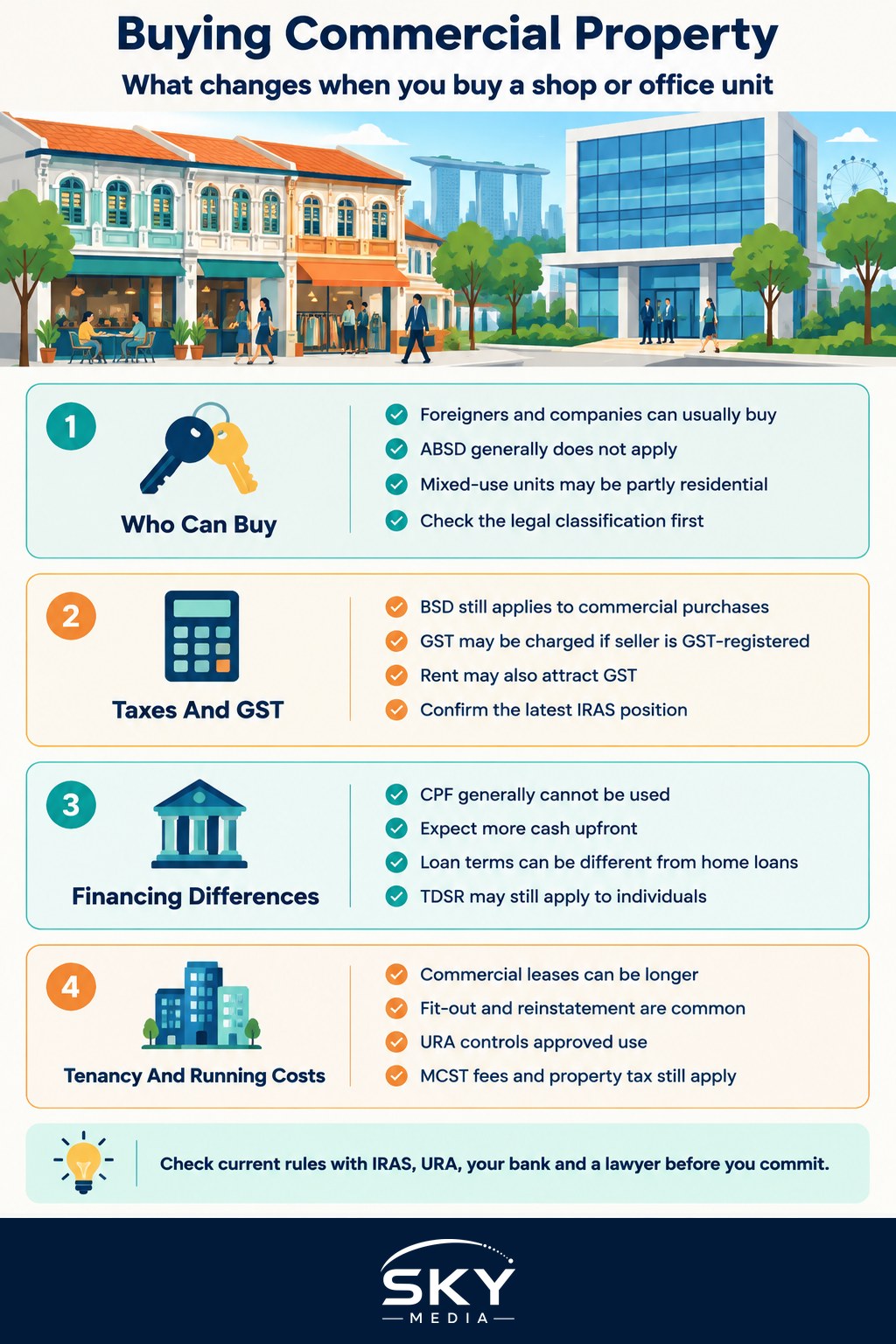
For residential property, the Residential Property Act restricts what foreigners can buy, and Additional Buyer’s Stamp Duty (ABSD) applies to many buyers. Commercial property is treated differently. In general, foreigners and companies can buy strata shops and offices without the approvals needed for landed homes, and ABSD, which targets residential purchases, does not apply to a purely commercial unit.
That makes commercial property attractive to:
- Business owners who want to own their premises rather than rent.
- Investors who already own homes and want to avoid ABSD on another residential purchase.
- Foreign buyers who are restricted in the residential market.
- Companies looking to hold property as a business asset.
One caution: mixed-use properties, such as shophouses with residential upper floors or developments with both homes and shops, may be treated partly as residential. The residential portion can bring residential rules and duties back into play. Have your lawyer confirm how the unit is classified before you sign. If you are considering holding the property under a business, our guide on buying property under a company in Singapore covers the structural points.
Stamp Duty and GST: The Biggest Surprises
Buyer’s Stamp Duty (BSD) applies to commercial purchases, but the rates for non-residential property are set separately from residential rates. Check the current table on the IRAS website and use its calculator.
Seller’s Stamp Duty (SSD) for selling within a holding period applies to residential and industrial property. Commercial shops and offices have generally been treated differently, but confirm the current position with IRAS, since this is exactly the kind of rule that can change.
Goods and Services Tax (GST) is where many home buyers get caught out. Sales and rentals of residential property are generally exempt from GST. Commercial property is different: if the seller is GST-registered, GST is normally charged on the purchase price. That can add a significant sum to what you pay upfront.
Points to raise with your lawyer and accountant:
- Is the seller GST-registered, and is the quoted price inclusive or exclusive of GST?
- If your business is GST-registered and uses the property for taxable supplies, you may be able to claim the GST back as input tax, subject to IRAS rules.
- If you are an individual investor who is not GST-registered, the GST is usually a real cost.
- If you lease the unit out, rental income may push you towards GST registration.
How Commercial Property Differs From Homes
The table below sums up the main differences for a typical strata unit. Treat it as a checklist of questions, not a final answer.
| Area | Home (HDB or private residential) | Strata shop or office |
|---|---|---|
| Who can buy | Restrictions for foreigners and some buyers | Generally open to foreigners and companies |
| ABSD | Applies to many buyers | Generally not applicable to purely commercial units |
| GST on purchase | Generally exempt | Usually charged if the seller is GST-registered |
| CPF usage | CPF OA can usually be used, subject to rules | CPF generally cannot be used |
| Bank financing | Residential loan limits and MAS rules apply | Bank-specific terms, often a lower loan amount and higher cash outlay |
| Tenancy | Residential leases, no GST on rent | Commercial leases, rent may attract GST |
| Property tax | Owner-occupier concessions possible | No owner-occupier concession, non-residential rates apply |
Financing a Strata Shop or Office
Because CPF generally cannot be used for commercial property, you will be paying the down payment and monthly instalments in cash, or through your business. Banks assess commercial loans differently from home loans:
- The loan amount offered may be lower than you are used to, so plan for a larger cash outlay.
- Banks look at your income, existing debts and, for business buyers, company financials.
- The Total Debt Servicing Ratio (TDSR), a Monetary Authority of Singapore (MAS) framework that caps how much of your income goes to debt, may still apply to individual borrowers.
- Interest rates and lock-in periods for commercial loans may differ from home loan packages.
Get an in-principle approval from more than one bank before you put down an option fee. Remember to budget for GST, BSD, legal fees, valuation and renovation together, since they arrive at roughly the same time.
Tenancy, Use and Running Costs
If you plan to lease the unit out, or buy one that already has tenants, commercial tenancies follow their own conventions:
- Lease terms: commercial leases are often longer, with renewal options and rent reviews negotiated between the parties.
- Fit-out and reinstatement: tenants usually fit out the space and may need to restore it at the end.
- GST on rent: if the landlord is GST-registered, GST is added to rent.
- Approved use: the Urban Redevelopment Authority (URA) controls what a unit may be used for. A unit approved as an office cannot simply be turned into a food outlet or clinic. Check URA approval and the strata by-laws.
- MCST charges: the management corporation strata title (MCST), the body that manages common property, charges maintenance fees and sinking fund contributions, often on a share-value basis.
- Property tax: non-residential property is taxed differently from owner-occupied homes. Check IRAS for the current approach.
For a deeper look at buying a unit that comes with a lease in place, see buying a property with existing tenants. If you are deciding whether to own or rent premises at all, our guide on renting an office or shop space is a useful counterpoint.
Due Diligence Before You Commit
Commercial property values depend heavily on footfall, access, tenant demand and the condition of the development. Before you buy:
- Visit at different times of day to judge footfall and parking.
- Check vacancy levels in the development and nearby.
- Ask for MCST meeting minutes, accounts and any planned major works.
- Confirm the tenure, approved use and any restrictions on signage, operating hours or trades.
- Review any existing lease carefully, including expiry and rent review dates.
- Factor in a realistic void period between tenants.
Buying a shop or office can be a sound move for business owners and investors, but it is a different product from a home. Line up a lawyer, an accountant and your banker early, check every rule with IRAS and URA, and run the numbers with GST and cash financing included before you sign.
Official sources: URA
Further reading: Home Above Shop Living: Buying Beside a Coffeeshop or Retail Podium