

Johor Bahru (JB) sits just across the Causeway, with prices that look strikingly low next to Singapore’s. It is no surprise that many Singaporeans consider whether to buy property Johor Bahru side, whether as a weekend home, a future retirement base, a rental investment or a place to live while working in Singapore.
But buying in Malaysia is a different system with different rules, and the low headline price is only part of the story. This guide covers the foreign buyer rules, how financing works, what the Johor Bahru to Singapore RTS Link might change, and the risks to weigh. It is general information, not legal, tax or financial advice. Rules in Malaysia are set at both federal and state level and do change, so always confirm current requirements with a Malaysian lawyer and the relevant authorities.
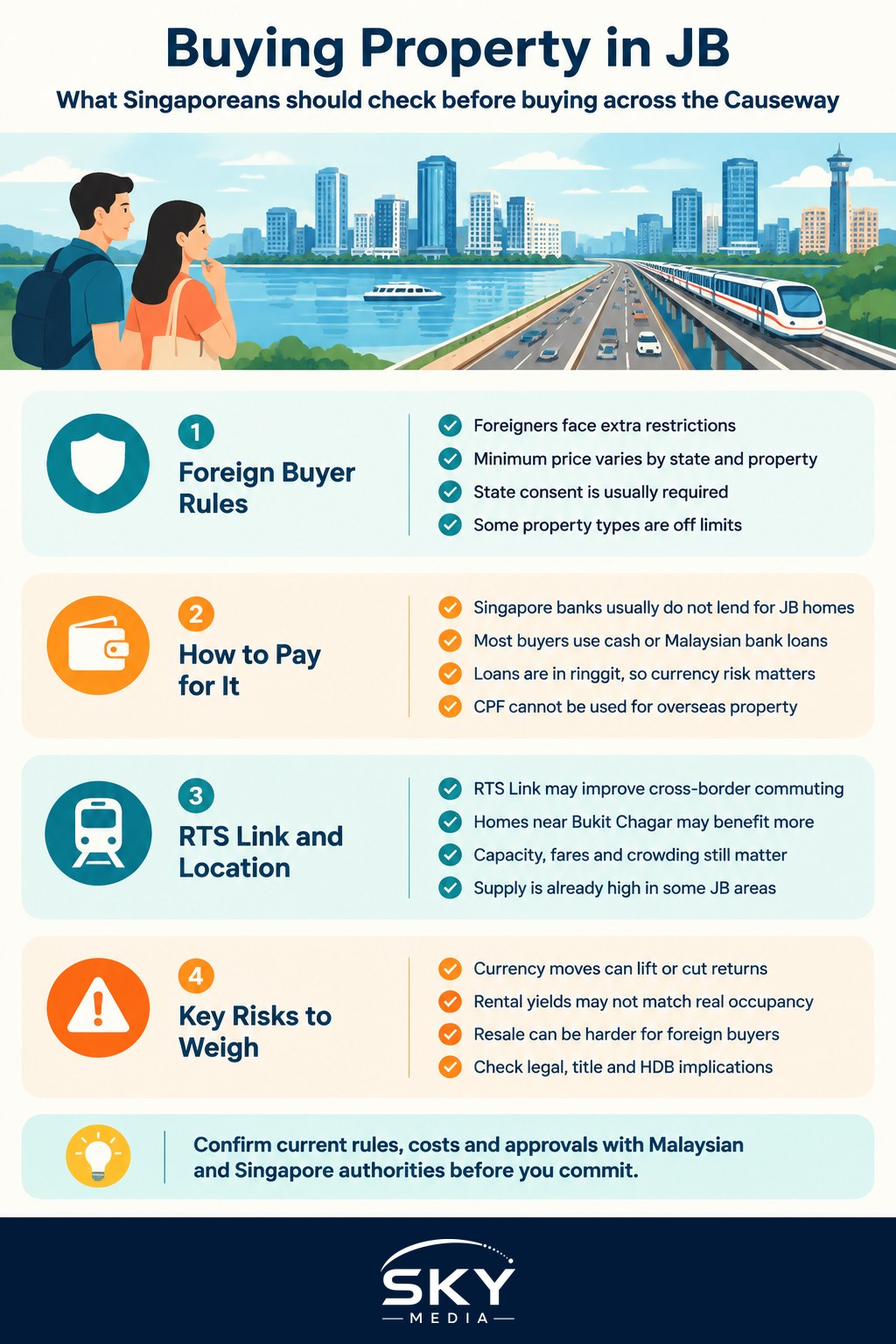
Foreign Buyer Rules and Minimum Prices
Singaporeans buying in Malaysia are treated as foreign buyers. That brings several restrictions:
- Minimum purchase price. Each Malaysian state sets a minimum price that foreigners must pay for property. Johor’s threshold has generally been around RM1 million for many residential properties, but it varies by property type and location and has been revised before. Check the current figure with the Johor state authorities or your lawyer before viewing anything.
- State consent. Foreign purchases usually need approval from the state authority. This adds time and a fee, and the purchase is not complete until consent is granted.
- Restricted property. Foreigners generally cannot buy Malay reserve land, units reserved for bumiputera buyers, or low-cost and low-to-medium-cost housing.
- Title type. Check whether the land is freehold or leasehold and whether individual strata titles have been issued. Delays in strata title issuance can complicate resale.
Malaysia’s Real Property Gains Tax (RPGT) applies when you sell, and rates for foreigners have typically been higher than for citizens. Stamp duty and legal fees apply on purchase too.
Financing a JB Property: Malaysian Loans vs Cash
Singapore banks generally do not offer mortgages for Malaysian property in the way they do for local homes. Most Singaporean buyers either pay cash or take a loan from a Malaysian bank.
Malaysian banks do lend to foreigners, but expect:
- Lower loan-to-value limits than locals typically get, meaning a bigger down payment
- Income verification, often requiring documents such as payslips, tax statements and bank statements
- Loans in ringgit, which creates currency risk if your income is in Singapore dollars
- Different interest rate structures and lock-in terms from what you know in Singapore
You cannot use your CPF savings to buy overseas property. Funds come from cash savings or overseas financing. Our guide to buying an overseas property from Singapore explains the wider considerations, including how to move funds.
How the RTS Link Could Change the Picture
The Johor Bahru to Singapore Rapid Transit System (RTS) Link is a cross-border rail line connecting Bukit Chagar in JB with Woodlands North in Singapore. It has been planned to start passenger service around the end of 2026, with co-located customs facilities so passengers clear both countries’ checks at one end. Check the current service status with official sources such as the Land Transport Authority (LTA).
For property buyers, the RTS Link is often cited as a reason for optimism, because it could make daily commuting faster and more predictable than the Causeway jams. Points to consider:
- Location matters a lot. Homes within easy reach of the Bukit Chagar station may benefit more than those far out in the suburbs.
- Much may already be priced in. Developers and sellers have marketed the RTS Link for years. Do not assume prices will jump after opening.
- Capacity and ticketing. Actual capacity, fares and peak-hour crowding will shape whether commuting is practical for you.
- Supply. JB has seen a lot of new development, especially high-rise condominiums. Oversupply has weighed on rents and resale prices in some areas.
Comparing Your Main Options
| Option | Pros | Cons |
|---|---|---|
| New launch condo near the RTS Link | Convenient for commuting, modern facilities | Higher prices, possibly priced-in gains, large supply nearby |
| Resale condo in established JB areas | Can see the actual unit and neighbourhood, rental history available | Older stock, maintenance issues, title checks needed |
| Landed home | More space, potential land value | Usually above the foreign minimum by a wide margin, security and upkeep |
| Renting in JB instead of buying | Flexibility, no capital at risk | No ownership, rent can rise |
Key Risks Singaporeans Often Underestimate
- Currency risk. Changes in the ringgit against the Singapore dollar can boost or erode your returns, both for rental income and resale.
- Rental demand. Rental yields quoted in marketing materials may assume full occupancy. Check real listings and vacancy levels in the specific development.
- Resale liquidity. Because of the foreign minimum price, your pool of foreign buyers may be limited, and locals may not be able to afford your unit.
- Developer risk. With off-plan purchases, research the developer’s track record and check whether projects have been delayed or abandoned before.
- Legal and title issues. Use an independent Malaysian lawyer, not one introduced by the seller or agent, to check titles, encumbrances and restrictions.
- Impact on Singapore housing eligibility. HDB rules can take overseas private property into account, for example when buying a new flat or applying for housing grants. Check with HDB before you buy, not after.
- Tax on rental income. Malaysian tax may apply to rent earned in Malaysia. Get advice on obligations in both countries.
If you are also considering a second property in Singapore, compare the two carefully. Our guide on buying a second property in Singapore covers ABSD and other local costs.
A Practical Buying Checklist
- Decide your purpose: own use, rental, retirement or long-term hold.
- Confirm the current Johor foreign buyer minimum price and restrictions for your target property type.
- Check HDB and other Singapore implications if you own or plan to own an HDB flat.
- Get loan pre-approval from a Malaysian bank if you need financing.
- Visit multiple times, at different times of day, including weekday peak hours.
- Appoint an independent Malaysian lawyer to handle due diligence and state consent.
- Budget for stamp duty, legal fees, consent fees, maintenance and furnishing.
- Plan how you will manage the property, especially if renting it out.
Is Buying in JB Right for You?
For some Singaporeans, a JB home offers real value: a larger space for weekends, a base for family across the border or a long-term retirement option. For others, the costs, restrictions and currency swings outweigh the low entry price.
Spend time in the area before committing. Our guide to Johor Bahru can help you get to know the neighbourhoods. Then take independent legal and financial advice, and confirm all current rules with Malaysian and Singapore authorities before you sign anything.