

Singapore builds constantly. New MRT lines, condo redevelopments, road widening and HDB upgrading mean that most residents will live near a construction site at some point. Some noise is unavoidable, but building sites must follow rules on how loud they can be and when they can work. If you need to make a construction noise complaint in Singapore, it helps to know what those rules cover and which agency to contact.
This guide focuses on building and civil engineering sites. Noise from neighbours, renovation inside your block or events is handled differently, and we cover those in separate guides linked below.
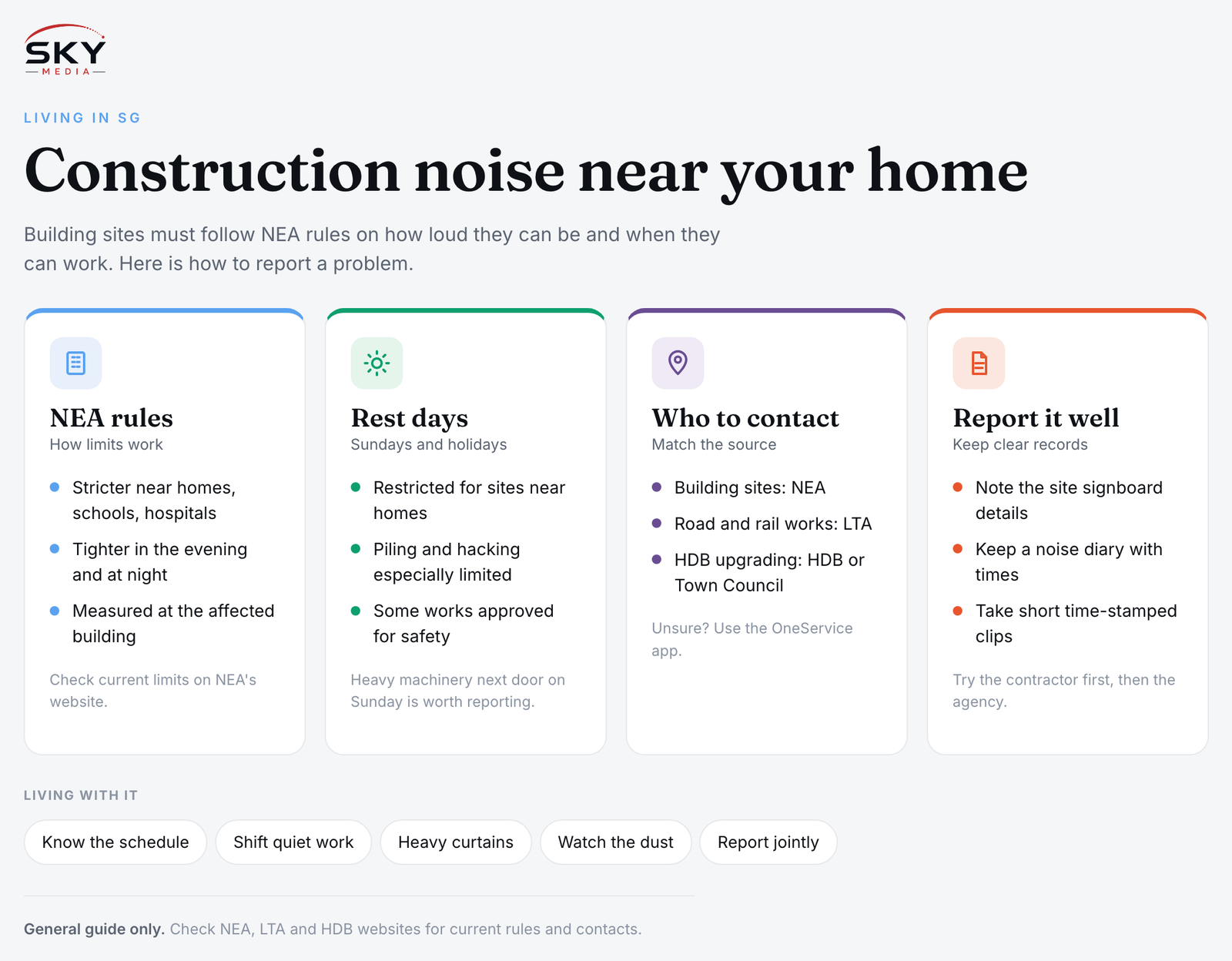
How NEA Regulates Construction Site Noise
The National Environment Agency (NEA) regulates noise from construction sites under the Environmental Protection and Management Act and its regulations on construction site noise. In broad terms, the rules work like this:
- Limits depend on what is nearby. Stricter limits apply to sites close to sensitive buildings such as hospitals, schools and homes, compared with sites surrounded by commercial or industrial premises.
- Limits change by time of day. Daytime limits are the most generous. Evening limits are tighter, and night-time limits are the strictest, because people are sleeping.
- Noise is measured at the affected building. NEA assesses noise levels at the nearby premises, not at the edge of the machinery, and uses averaged and maximum readings over set periods.
- Large sites may need monitoring. Bigger projects are often required to install noise meters and keep records, which NEA can review.
NEA publishes the actual decibel limits, the time bands and the distance criteria on its website. These details can be revised, so check the current figures there rather than relying on numbers quoted in forums or older news reports.
Sunday and Public Holiday Restrictions
Rest days get extra protection. NEA restricts construction work on Sundays and public holidays for sites near residential buildings, with especially tight rules on noisy activities such as piling, hacking and heavy machinery. In practice, many residents notice that sites near homes are quiet or doing only light work on these days.
The exact scope of the restriction, including which hours on the eve of the rest day are covered and how close a site must be to homes, is set out by NEA. If you hear heavy machinery on a Sunday or public holiday from a site right next to your block, that is worth noting and reporting, as it may fall outside what is permitted.
Some works may be allowed at night or on rest days for safety or operational reasons, for example certain road or rail works that cannot be done while traffic is running. These usually require approvals, and affected residents are often notified by the contractor or agency beforehand.
Who to Contact for Each Type of Work
Not every hammering sound is NEA’s responsibility. The right agency depends on the type of work.
| Source of noise | Agency usually responsible | What to mention in your report |
|---|---|---|
| Private building or condo construction site | NEA | Site address, times, type of noise, day of week |
| Road works, MRT and rail works | LTA, or NEA for site noise limits | Location, whether work is at night, any notice received |
| HDB upgrading or lift works in your estate | HDB or your Town Council | Block number, works type, hours observed |
| Renovation inside a neighbouring flat | HDB for HDB flats, MCST for condos | Unit floor, hours of hacking or drilling |
| Safety concerns such as falling debris | MOM or BCA | Exact location, photos, time observed |
If you are unsure, the OneService app lets you lodge a municipal feedback case, and it is routed to the relevant agency. You can also use NEA’s online feedback channel. Phone numbers and forms change from time to time, so look them up on the official agency websites.
How to Make an Effective Complaint
Agencies act on specific, verifiable information. A vague report of “constant noise” is harder to investigate than a clear record.
- Identify the site. Note the project signboard at the hoarding. Most sites display the developer, the main contractor and a contact number. This is also the first place to try for a quick fix.
- Keep a noise diary. Record the date, start and end times, and what you heard, such as piling, hacking, generators or concrete trucks.
- Note the day type. Mark whether it was a weekday, Saturday, Sunday or public holiday, and whether it was day, evening or night.
- Take short recordings. A phone video with the time visible helps show the type and timing of the noise. A phone app reading is not an official measurement, but it gives context.
- Contact the contractor first if you can. Many contractors have community liaison staff and can adjust work schedules or noisy equipment once they know there is a problem.
- Lodge your report with the right agency. Include your diary, the site details and your recordings.
- Follow up with your case number. If the problem continues, refer to the same case so the agency sees a pattern.
When NEA investigates, officers may check the site’s noise monitoring data or take their own measurements. Contractors that breach the limits can face enforcement action such as fines or stop-work orders, but outcomes depend on what is found.
Living With a Long-Term Building Site
Even when a contractor is fully within the rules, months of daytime noise can be draining. A few practical steps can help:
- Know the schedule. Many projects distribute notices or post work schedules for noisy phases such as piling. Knowing when the worst weeks are coming helps you plan.
- Shift quiet activities. If you work from home, plan calls for times when heavy works usually pause, or book a library or community space for important meetings.
- Soften the sound. Heavy curtains, rugs and soft furnishings reduce echo. Window seals help with high-pitched noise. Earplugs or white noise can help with sleep if night works are approved.
- Watch the dust too. Construction dust is another common issue. Keep windows closed during dusty phases and report excessive dust in the same way as noise.
- Talk to your neighbours. A joint report from several households with consistent records can show the scale of the problem.
If you are considering buying a home with a future development nearby, our guide to buying a home near a future construction site explains what to check before you commit.
When Construction Noise Is Not the Problem
Sometimes the noise you hear is not from a building site at all. Drilling inside a neighbouring unit falls under renovation rules set by HDB or your condo’s management corporation (MCST), not NEA’s construction site limits. For those situations, see our guide to handling inter-unit noise in condos and apartments. For seasonal festival tents and stages, our guide on living near a Seventh Month event tent covers who to contact.
Construction noise is part of life in a growing city, but it is regulated. Know the rules, keep clear records, start with the contractor and report persistent problems to the correct agency. That gives you the best chance of quieter days and nights.
Official sources: National Environment Agency (NEA)
Further reading: Noisy HDB Renovation Next Door: Permitted Hours and How to Complain · Pet Noise Complaints in Singapore and How to Handle Them