

That empty grass field next to the block looks peaceful today. In Singapore, though, open land rarely stays open forever. A plot that is vacant now may become a condo, an MRT station, a school, a road or a new HDB estate within a few years. If you are buying a home beside a future construction site, the question is not whether something will be built, but what, when and how much it will affect you.
This guide focuses on one thing: judging the disruption risk from the land next to and around the home you are considering. It sits alongside our broader guides on location, such as buying property near an MRT line and buying near good schools, which cover the long-term benefits of what eventually gets built.
Why Vacant Land Near a Home Deserves a Closer Look
Singapore plans its land use carefully and far ahead. That works in your favour, because much of what may happen next door is already mapped out in official plans. It also means that a “nice open view” is often just a pause before development.
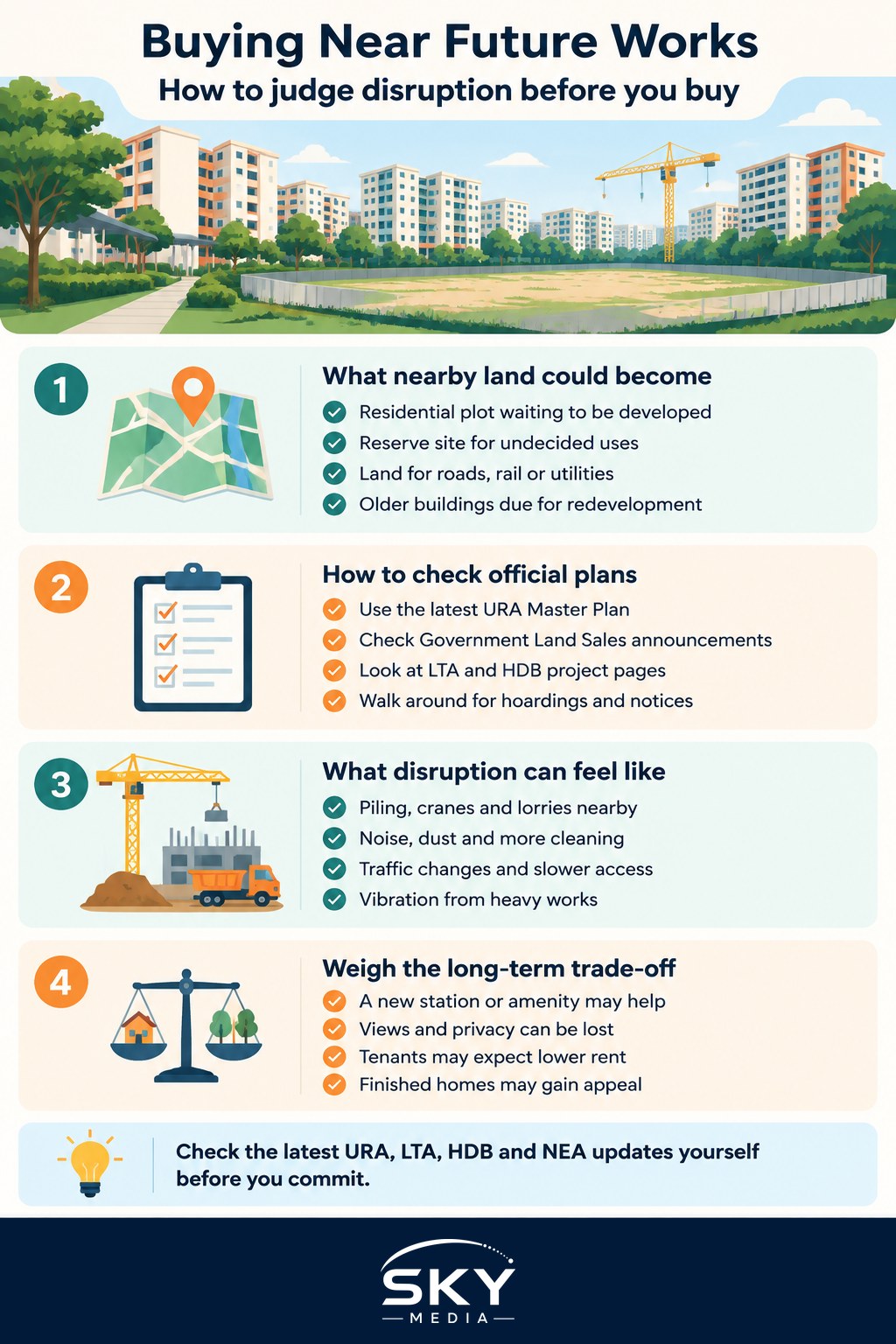
Vacant or underused land near a home can include:
- Zoned residential plots that are waiting to be sold or developed.
- Reserve sites, land set aside for uses that have not yet been decided.
- Infrastructure corridors for future roads, rail lines or utilities.
- Older buildings due for redevelopment, including collective sale sites.
- Temporary uses such as car parks, open fields or interim facilities on land zoned for something else.
Each of these carries a different level of certainty and a different kind of disruption.
How to Check What Might Be Built Next Door
Do your own homework before relying on what an agent or seller says. Useful official sources include:
- The URA Master Plan. The Urban Redevelopment Authority (URA) publishes the Master Plan, which shows the planned land use and intensity for each plot. You can view it on URA’s online map service. Look at the zoning of every plot around the home, not just the one directly next door.
- Government Land Sales announcements. URA and HDB publish land sale programmes that show which sites are being released for development.
- LTA project pages. The Land Transport Authority (LTA) announces rail lines, road works and related construction, often with maps of affected areas.
- HDB project information. For HDB estates, upcoming projects and launches are published by HDB.
- Site hoardings and notices. A walk around the area can reveal signboards listing the developer, the project and the builder.
Zoning tells you what is allowed, not exactly what will appear or when. Plans can also be reviewed over time, so treat the Master Plan as a strong guide rather than a promise, and check the latest version yourself.
Comparing Common Types of Nearby Development
| What is planned nearby | Typical disruption during works | Possible effect once completed |
|---|---|---|
| Residential condo or HDB block | Piling, concrete works, cranes, lorries over several years | Loss of view or privacy, more residents and traffic |
| MRT station or rail line | Large site, road diversions, long build period | Better transport access, more footfall around the station |
| Road widening or new expressway | Night works possible, traffic changes | More traffic noise, better connectivity |
| School, park or community facility | Moderate building works | Daytime activity, possible school drop-off traffic |
| Reserve site with no fixed use | Unknown until plans are decided | Uncertain, could be quiet or busy |
Use this as a starting point. The real impact depends on how close the site is, which way your unit faces and how long the works run.
Judging Noise, Dust and Daily Disruption
Construction in Singapore is regulated. The National Environment Agency (NEA) sets rules on construction noise, and there are restrictions on noisy work at certain times. Even so, a site next door can change daily life for a long period. Think about:
- Distance and facing. A unit facing directly onto the site will hear and see more than one on the far side of the block.
- Floor level. Higher floors can be more exposed to crane noise and dust drift, while lower floors may feel lorry movements and ground works more.
- Who is at home in the day. Retirees, people working from home, shift workers and families with babies feel daytime noise far more than people out at the office.
- Dust and cleaning. Expect to clean windows, ledges and balconies more often, and to keep windows shut on windy days.
- Traffic and access. Construction lorries, road diversions and temporary closures can lengthen your commute or make school runs slower.
- Vibration. Piling and heavy works can be felt in nearby buildings. Developers usually monitor this, but it can still be unsettling.
If you can, visit the area on a weekday morning and again in the evening. Talk to residents already living near any existing works. They will tell you what it is really like.
Weighing the Long-Term Upside Against Short-Term Pain
Not every future construction site is bad news. Some developments make a home more convenient and more attractive to future buyers or tenants. A new MRT station, park, mall or school can improve daily life once the dust settles.
Ask yourself:
- How long will I live here? If you plan to stay for many years, a few years of works may be worth it for a better finished neighbourhood.
- Is this my own home or an investment? Tenants may be harder to find, or may expect lower rent, while a large site is active nearby.
- What will I lose permanently? A blocked view, reduced sunlight or less privacy does not end when construction does.
- What will I gain permanently? Transport, amenities and green space may outweigh the losses.
Our article on the home buying timeline from start to keys can help you line up these questions with your own move date, especially if you are buying an uncompleted unit whose completion may overlap with nearby works.
Questions to Ask Before You Commit
Bring these questions to your viewing and to your property agent:
- What is the zoning of each plot around the home, according to the latest URA Master Plan?
- Has any nearby land been announced for sale, tender or redevelopment?
- Are there any rail, road or utility projects planned close by?
- Which direction does the unit face, and what would sit in front of it once nearby plots are built?
- Has the seller experienced construction disruption here before, and how did they manage it?
- If you are buying a landed home, are neighbouring houses likely to be rebuilt? Our guide to buying a landed home covers wider checks.
Agents and sellers may not know every detail, so verify key points with the official sources yourself. Plans, rules and timelines can change, so always check current information directly with URA, LTA, HDB and NEA.
Practical Ways to Live With Nearby Works
If you decide to go ahead, a few simple steps can make the construction years easier:
- Choose a unit facing away from the site where possible.
- Budget for good window seals, curtains or blinds that help with noise and light.
- Run an air purifier and clean filters more often during dusty phases.
- Note the contact details on the site hoarding so you can raise concerns with the builder.
- Keep a simple record with dates and photos if disruption becomes a problem, in case you need to report it to the relevant authority.
A future construction site next door is not automatically a dealbreaker. With good research, a realistic view of the disruption and a clear sense of what you will gain, you can decide whether the trade-off works for your household.