
Buses are the cheapest way across the Causeway, but they are not always the easiest. If you are travelling with young children, elderly parents, heavy luggage or a tight schedule, a cross border taxi between Singapore and JB can save you the hassle of getting off at both checkpoints, queuing for immigration on foot and boarding again. This guide explains how licensed cross-border taxis work, where they pick up and drop off, how to book and pay, and the rules worth knowing before you go.
If you prefer public transport, our guide to cross-border buses to Malaysia covers the bus routes in detail.
What a Licensed Cross-Border Taxi Is
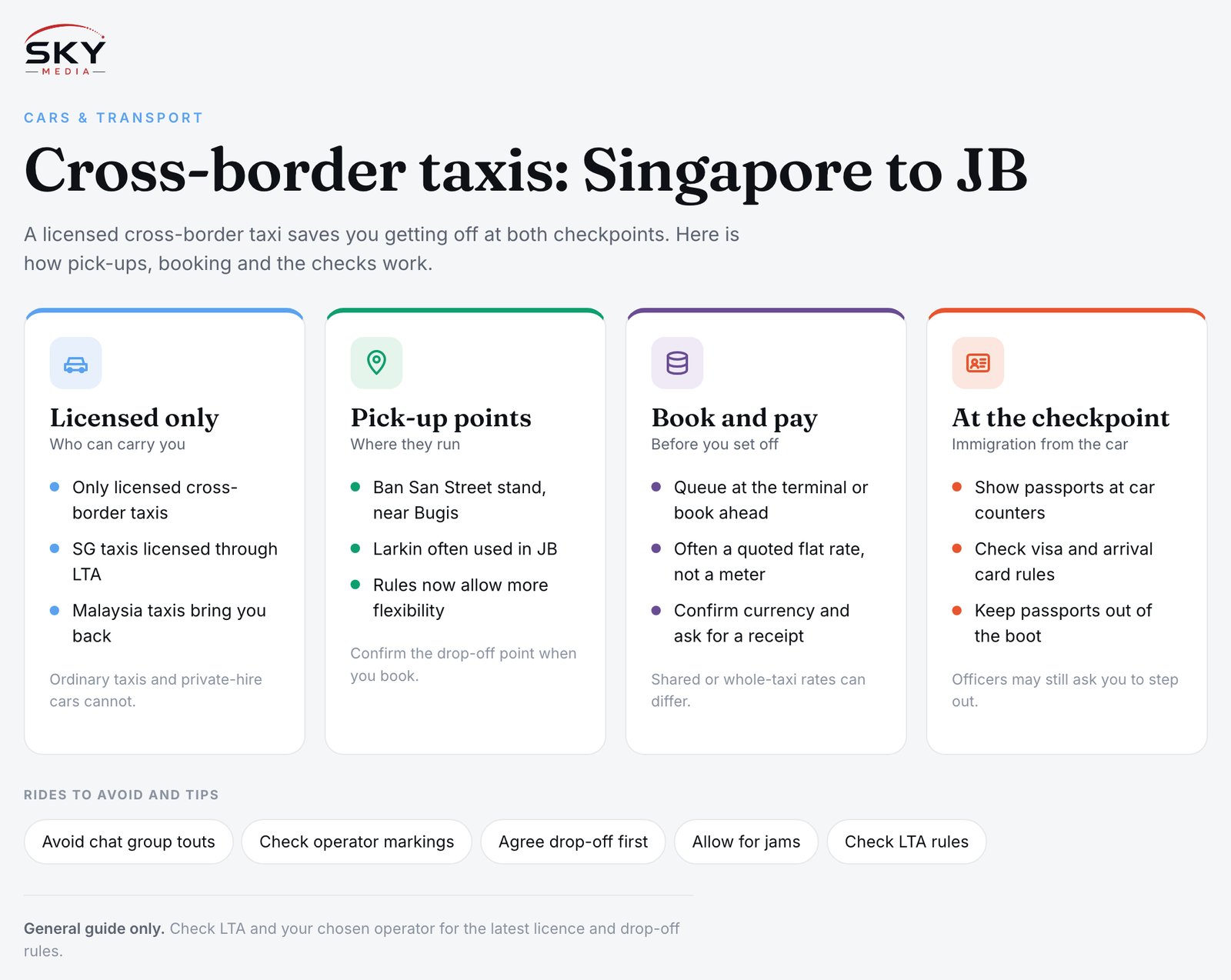
Ordinary Singapore taxis and private-hire cars cannot simply drive you into Malaysia on a normal fare. Cross-border trips are run under a separate scheme agreed between Singapore and Malaysia, and only taxis licensed for cross-border service may carry fare-paying passengers across the Causeway or the Second Link.
There are two groups of licensed vehicles:
- Singapore-registered cross-border taxis, licensed through the Land Transport Authority (LTA), which can take passengers from Singapore into Johor.
- Malaysia-registered cross-border taxis, licensed by the Malaysian authorities, which can bring passengers from Johor into Singapore.
The number of licensed vehicles is capped under the bilateral arrangement, and the two governments have revised the rules over time, including where taxis may pick up and drop off. Because these details change, check LTA’s website for the current arrangement before you travel.
Where Cross-Border Taxis Pick Up and Drop Off
Traditionally, cross-border taxis have operated between designated terminals rather than doorstep to doorstep.
- In Singapore, the long-standing cross-border taxi stand is at Ban San Street, near Queen Street in the Bugis area. This is where many people queue for a Johor-bound taxi or where Malaysian taxis drop passengers off.
- In Johor Bahru, Singapore cross-border taxis have traditionally used a designated terminal in the city, with Larkin often mentioned as the main point.
In recent years the rules have been relaxed to allow more flexible pick-up and drop-off points on each side. Exactly which locations are allowed, and whether you can be dropped at your hotel or home, depends on the current rules and on whether the taxi is Singapore or Malaysia-registered. Confirm this when you book rather than assuming a door-to-door trip.
Taxi, Bus or Train: Which Suits Your Trip
Here is a simple comparison of the main ways to cross between Singapore and Johor Bahru. Prices change, so treat this as a guide to trade-offs rather than costs.
| Option | Immigration experience | Best for | Things to note |
|---|---|---|---|
| Licensed cross-border taxi | Passengers usually clear immigration from the vehicle at the car counters | Families, seniors, heavy luggage, late-night trips | Costs more than public transport; pick-up points are limited by the rules |
| Cross-border bus | Get off at each checkpoint, clear on foot, reboard | Budget travellers, light luggage | Can be crowded at peak hours and on weekends |
| Shuttle train or the RTS Link | Clear immigration at the station | Commuters heading to central JB | Fixed stations; you still need onward transport in JB |
| Driving your own car | Clear at car counters | Frequent visitors with a car | Requires the Malaysian Vehicle Entry Permit and Touch ‘n Go setup |
For the rail option, see our explainer on the JB-Singapore RTS Link, which is changing how many people commute across.
How to Book and Pay
There are a few ways to get a licensed cross-border taxi:
- Queue at the terminal. At Ban San Street, taxis typically leave when they have passengers. You may be offered the option of sharing with others or booking the whole taxi.
- Book through an operator or app. Some cross-border taxi operators and ride apps take advance bookings, which is useful for early mornings, late nights or peak weekends. Make sure the service clearly states that it uses licensed cross-border taxis.
- Arrange a return trip. If you know your return time, ask whether you can book the reverse journey in advance with a Malaysian-licensed taxi.
On fares, do not assume a meter. Many cross-border trips are charged at a quoted flat rate, sometimes per vehicle and sometimes per passenger if shared. Rates differ between operators, times of day and festive periods, and may vary by currency. Always confirm the total price, what it includes, and whether you pay in Singapore or Malaysian dollars before you set off. Ask for a receipt.
Immigration and Travel Documents
Taking a taxi does not let you skip the checks; it just makes them more comfortable. At Woodlands or Tuas on the Singapore side, and at the Malaysian checkpoint, passengers usually stay in the car and present their passports at the vehicle counters, though officers may ask you to step out for inspection.
Before you go:
- Carry a passport valid for your trip. Check the validity rules for entering Malaysia.
- Check digital arrival requirements. Malaysia has introduced a digital arrival card for some foreign visitors. Whether you need to complete it depends on your nationality and the rules at the time, so check the Malaysian immigration website.
- Check your visa needs. Singapore citizens generally do not need a visa for short visits to Malaysia, but other nationalities, including many pass holders living in Singapore, should check their own requirements. Pass holders should also ensure their Singapore pass is valid for re-entry.
- Know the customs rules. Both countries limit what you can bring back, including duty-free allowances, alcohol and tobacco. Singapore Customs and ICA publish the current rules.
If you are new to crossing over, our guide to day trips to Johor Bahru for newcomers covers the checkpoint routine step by step.
Rules to Know and Rides to Avoid
A few points will keep your trip legal and safe:
- Use licensed taxis only. Private cars offering cheap rides across the Causeway, often advertised in chat groups or by touts near terminals, may be operating illegally. If something goes wrong, you may have little protection, and drivers carrying passengers illegally face penalties.
- Check the vehicle. Licensed cross-border taxis carry the operator’s markings and display licence details. If in doubt, ask.
- Agree on the drop-off point in advance. Because pick-up and drop-off rules apply, a driver may not be allowed to take you to every address.
- Allow extra time. Causeway traffic can be heavy on Friday evenings, weekends, school holidays and festive periods. A taxi is more comfortable in a jam, but it is still in the same queue.
- Keep valuables and documents handy. You will need your passport at each checkpoint, so do not pack it in the boot.
Making the Most of a Cross-Border Taxi
A cross border taxi between Singapore and JB is worth the extra cost when comfort and convenience matter most, such as a family day out, a trip with an elderly relative or a late return after dinner in Johor Bahru. For solo trips and light travel, buses and the train are usually better value.
Because the bilateral rules on licences, terminals and drop-off points are revised from time to time, check LTA’s website and your chosen operator for the latest arrangements before you travel.
Further reading: Renting a Car in Johor Bahru: What Singapore Drivers Should Know · The RTS Link and Cross-Border Commute to Johor