

In late 2020, Singapore became the first country in the world to approve the sale of cultivated meat, meat grown from animal cells rather than taken from a slaughtered animal. It was a small step in volume terms, but a big one symbolically, and it put the country at the centre of a global debate about the future of food.
This guide explains what cultivated meat in Singapore actually is, how it is made, how the authorities check its safety, what we know and do not know about its environmental footprint, and how to find it if you are curious to try it. For a wider look at plant-based and other alternatives, see our separate overview of alternative proteins.
What Cultivated Meat Is
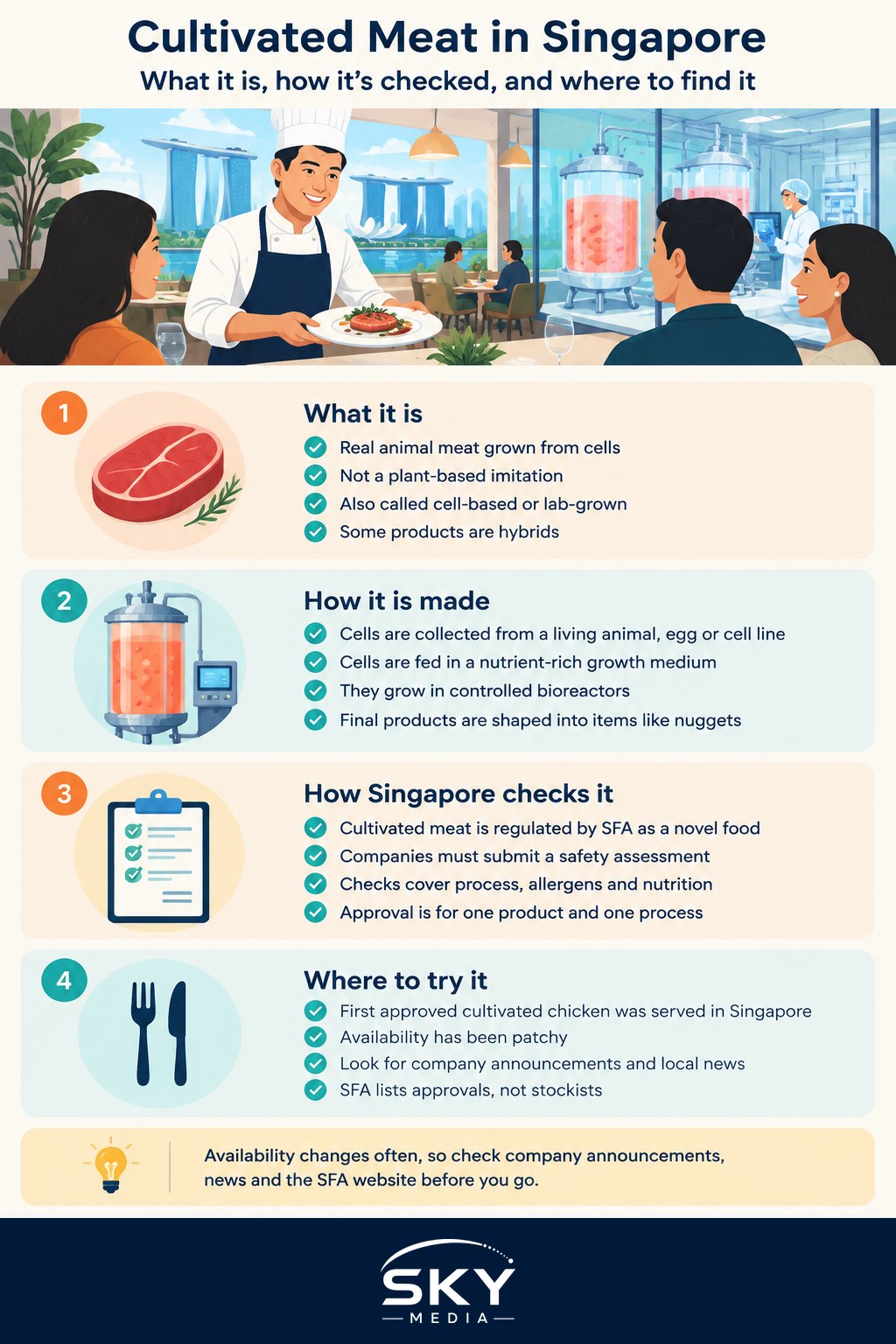
Cultivated meat, also called cell-based, cultured or lab-grown meat, is real animal meat produced by growing animal cells outside the animal. It is not a plant-based imitation. At the cellular level, it is meant to be the same kind of muscle and fat tissue you would find in conventional chicken, beef or seafood.
It is worth separating three things that often get lumped together:
- Plant-based meat: made from plant ingredients such as soy, pea or wheat, designed to look and taste like meat. Read more in our guide to plant-based meat alternatives in Singapore.
- Fermentation-based protein: proteins produced by microorganisms such as fungi or yeast.
- Cultivated meat: animal cells grown in controlled conditions to form meat.
Some cultivated products on the market are hybrids, blending a proportion of cultivated cells with plant-based ingredients. The labelling should tell you what you are eating.
How It Is Made
The process differs between companies, but the broad steps are similar:
- Collecting cells. A small sample of cells is taken from a living animal, a fertilised egg or an established cell line. The animal is not killed for this step.
- Feeding the cells. The cells are placed in a nutrient-rich liquid, called a growth medium, that supplies sugars, amino acids, vitamins, minerals and other factors the cells need to multiply.
- Growing at scale. The cells grow in bioreactors, which are steel vessels similar to those used in brewing or pharmaceuticals, kept at controlled temperature and conditions.
- Forming the product. The cells are harvested and processed into a final product, sometimes with scaffolds or added ingredients to give texture, then shaped into items such as nuggets, minced meat or pâté.
Early growth media often relied on foetal bovine serum taken from cattle, which raised both cost and ethical concerns. Many companies have worked on serum-free media, and regulators look closely at what goes into the medium.
How Singapore Regulates It
In Singapore, cultivated meat falls under the Singapore Food Agency (SFA), which regulates “novel foods”, meaning foods without a history of safe use. Before a novel food can be sold here, the company must submit a safety assessment to the SFA. This typically covers how the product is made, the cell lines and inputs used, possible contaminants, allergens and nutritional content.
The SFA has published guidance on its novel food framework and maintains information on approved products on its website. Approval applies to a specific product made by a specific process, so one company’s approval does not cover others. Rules and approvals evolve, so check the SFA website for the current position.
Singapore’s interest is closely linked to food security. The country imports the vast majority of its food, and the national “30 by 30” goal aims to build the capacity to produce a larger share of nutritional needs locally. Alternative proteins, including cultivated meat, are one part of that wider strategy.
The Environmental Footprint: Promise and Uncertainty
Supporters argue that cultivated meat could greatly reduce the land, water and greenhouse gas emissions tied to livestock farming, and remove the need to slaughter animals. Critics point out that bioreactors need a lot of energy, and that large-scale production does not yet exist.
The honest picture is that the footprint depends heavily on how the product is made:
| Factor | Conventional meat | Cultivated meat |
|---|---|---|
| Land use | Large areas for grazing and feed crops, especially for beef | Small footprint for production facilities, plus land for growth medium inputs |
| Emissions | Methane from cattle, plus feed, transport and processing | Mainly from energy used to run bioreactors; depends on how clean the power is |
| Water | Significant water for feed and animals | Lower in most projections, but depends on process |
| Antibiotics | Used in some farming systems | Controlled sterile conditions may reduce the need |
| Scale today | Mature, global industry | Still very small, with high production costs |
Studies published so far are mostly projections based on modelling rather than measurements from large commercial plants. Many suggest cultivated meat could have a lower footprint than beef, particularly when powered by renewable energy, while the comparison with chicken or pork is closer. Treat bold claims in either direction with care until real-world data catches up.
If your main goal is to cut your personal food footprint today, the most reliable steps are eating more plants, wasting less food and choosing lower-impact proteins. Our guide on eating less meat is a practical place to start.
Where to Try It in Singapore
The first approved cultivated chicken was served at a restaurant in Singapore shortly after approval, and since then cultivated products have appeared in a small number of restaurants and at least one retail outlet, as limited releases or tasting menus. Availability has been patchy: products come and go as companies scale up, run trials or pause sales.
Because the situation changes, the most reliable ways to find out what is currently available are:
- Company announcements. Producers with SFA approval usually announce where their products can be bought or tasted.
- News coverage. Local media tend to report new launches and tastings.
- The SFA website. This lists which novel foods have been approved, though not where they are sold.
- Food and sustainability events. Industry events and tasting sessions sometimes feature cultivated products.
When you do find it, check the menu or label for whether the product is fully cultivated or a hybrid with plant-based ingredients, and ask about allergens if you have any.
Questions People Often Ask
Is it safe? Products sold in Singapore must go through the SFA’s novel food assessment first. As with any new food, people with allergies should read labels carefully.
Is it halal or kosher? This depends on religious authorities and the source of the cells and inputs. In Singapore, look for certification from MUIS, the Islamic Religious Council of Singapore, rather than assuming a status.
Will it be cheap? Not yet. Production costs remain high, and prices for consumers have generally been set to be accessible at tasting scale rather than reflecting full costs.
Is it vegetarian? No. It is meat made from animal cells, even though no animal is slaughtered for each batch.
Does cultivated meat taste the same as conventional meat? It is meant to be the same kind of muscle and fat tissue, so the taste and texture are designed to be close. In practice, much depends on the product, since some are hybrids blended with plant ingredients. Tasting it is the only reliable way to judge.
How is cultivated meat different from lab-grown meat claims on plant-based products? Plant-based products are made entirely from plants such as soy or pea, while cultivated meat is grown from real animal cells. If a label is unclear, check the ingredients list for animal cells and whether the item is fully cultivated or a hybrid.
Are there allergy concerns with cultivated meat? Because it is made from animal cells, someone allergic to chicken or seafood should treat the cultivated version with the same caution. The growth medium and added ingredients can also matter. Read the label or ask the restaurant, and consult a doctor if you have severe allergies.
Why is Singapore so interested in lab-grown food? The country imports most of its food, so it wants more local sources of nutrition. Alternative proteins, including cultivated meat, fit into the national 30 by 30 goal, and Singapore’s regulatory framework has attracted companies keen to launch products here.
Can I buy cultivated meat to cook at home? Availability has been patchy, with products mostly appearing as limited releases, tasting menus and at least one retail outlet. Follow company announcements and local news for current stockists, and check the SFA website for which products are approved.
Cultivated meat is still at an early stage, and its long-term role is uncertain. But for curious eaters, Singapore remains one of the few places in the world where you can actually taste it, and see a possible future of food up close.
Official sources: Singapore Food Agency (SFA)
Further reading: Edible Insects in Singapore: What SFA Has Approved · Understanding Alternative Proteins