

If you earn in Singapore dollars but pay some bills in renminbi or another currency, exchange rates quietly affect your budget. Currency hedging in Singapore is often discussed as a topic for companies and investors, but individuals with overseas obligations face the same basic question: what happens to my plans if the rate moves against me? This guide helps newcomers, including those from mainland China, decide whether exchange-rate risk actually matters for their situation. It does not cover remittance apps or China’s foreign exchange rules, which we explain elsewhere. It is general information, not financial advice.
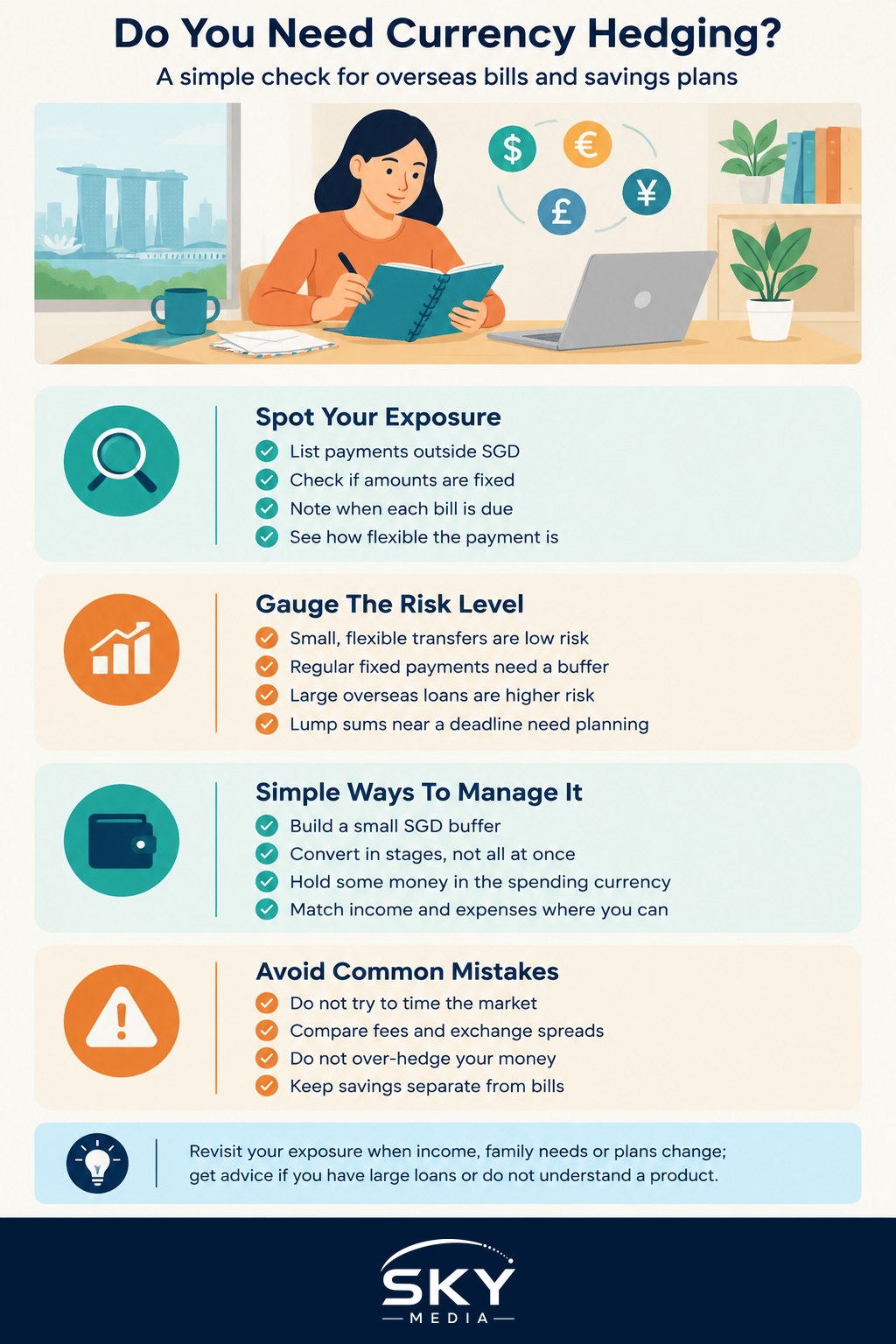
What Currency Risk Means for an Individual
Currency risk is the chance that the amount you need in one currency costs more in your income currency when the time comes to pay. For example, if you earn in SGD and must pay a fixed amount in RMB every month, a weaker SGD against RMB means you need more SGD to cover the same bill. A stronger SGD works the other way, in your favour.
“Hedging” simply means taking steps to reduce the impact of those swings. For companies, this can involve financial contracts. For most households, it is far more practical: timing, holding some money in the other currency, and building a buffer into the budget.
Exchange rates move for many reasons, including interest rates, trade and economic news, and nobody can reliably predict them. The goal of hedging is not to win against the market, but to make your obligations predictable.
Signs Your Expenses Are Exposed
Start by listing every regular or planned payment you make outside SGD. Common examples for newcomers include:
- Mortgage or loan repayments on property back home.
- Monthly support for parents or family members.
- Children’s school fees or university costs overseas.
- Insurance premiums or policies denominated in another currency.
- Planned large purchases, such as a wedding, renovation or property deposit, back home.
- Your own future move back, if you plan to return with savings.
For each one, ask four questions:
- How large is it compared with my income? A small monthly gift is barely affected; a large mortgage repayment can be.
- Is the amount fixed in the foreign currency? Fixed obligations carry the most risk.
- When is it due? A payment next month is less exposed than a lump sum in three years.
- How flexible is it? If you can delay or reduce the payment when rates are unfavourable, your risk is lower.
Deciding Whether You Need to Act
Use the comparison below to gauge how much attention your situation needs. These are general patterns, not rules.
| Your situation | Exposure level | Sensible approach to consider |
|---|---|---|
| Occasional gifts or small, flexible transfers | Low | No special hedging; transfer when convenient |
| Regular fixed monthly payments, modest in size | Medium | Build a currency buffer into your budget, review periodically |
| Large fixed obligations, such as an overseas mortgage | High | Hold some funds in the foreign currency, spread conversions over time |
| Lump sum due on a known date, such as tuition or a deposit | High near the date | Convert gradually ahead of the deadline rather than all at the last minute |
| Income and expenses both in the same foreign currency | Naturally hedged | Keep that money in that currency where practical |
If your foreign-currency payments are a small share of your income, the cost and effort of complex hedging usually outweigh the benefit. If they are a large share, some planning is worth it.
Practical Ways Households Manage Exchange-Rate Risk
Most individuals do not need complicated financial products. These everyday approaches are common.
- Build a buffer. When budgeting for a foreign-currency payment, assume the rate could be somewhat worse than today and set aside a little extra SGD. If the rate moves in your favour, the surplus becomes savings.
- Convert in stages. Rather than converting a large sum in one go, convert portions over weeks or months. This smooths out the average rate you get and reduces the regret of picking a bad day.
- Hold a foreign-currency balance. Keeping some funds in the currency you will spend means part of your future bill is already locked in. Our guide to foreign currency accounts explains how these work with Singapore banks, and our piece on multi-currency accounts for China and Singapore covers options for people with ties to both.
- Match income and spending. If you have rental income, a side income or savings already in RMB, using those to pay RMB expenses avoids converting back and forth.
- Set a review point. Check your exposure once or twice a year, or when a big change happens, such as a new mortgage or a child starting university.
Forward contracts and other hedging products do exist, usually offered by banks for larger or business needs. They involve commitments, conditions and costs that should be understood fully. If you are considering one, speak with your bank and a licensed financial adviser, and read the terms carefully.
Common Mistakes to Avoid
- Trying to time the market. Waiting for the “perfect” rate can leave you converting under pressure on a bad day.
- Ignoring conversion costs. Spreads and fees vary between banks and providers. Compare the total amount received, not just the headline rate.
- Over-hedging. Holding far more foreign currency than you will need moves the risk the other way, especially if your plans change and you stay in Singapore longer.
- Forgetting cross-border rules. Moving money in and out of some countries comes with limits and documentation. Our guide to forex controls and currency limits for China covers the China side; always check the current rules with your bank and the relevant authority.
- Mixing up savings and obligations. Investments held in foreign currency are a different question from bills you must pay. Keep them separate in your planning.
Building Currency Risk Into Your Budget
For newcomers, a clear budget is the most effective “hedge” of all. Write down your SGD income and then list your foreign-currency obligations in their own currency, with due dates. Next to each, note the SGD equivalent at today’s rate and at a less favourable rate of your own choosing. The gap between the two figures is the cushion you might need.
If that gap is small relative to your savings, you can probably relax and transfer as normal. If the gap would strain your finances, consider building the buffer, holding some foreign currency or spreading conversions. Revisit the numbers whenever your income, family commitments or plans to stay in Singapore change.
When to Get Professional Advice
Seek help from a licensed financial adviser or your bank if you have large overseas property loans, are planning to move significant savings between countries, or are being offered a hedging product you do not fully understand. Check that any adviser is properly licensed with the Monetary Authority of Singapore (MAS), the country’s financial regulator, using the register on its website. A short consultation can prevent costly mistakes and help you make currency hedging part of a calm, long-term plan rather than a source of worry.
Frequently Asked Questions
Do I need to hedge if I only send a small amount home each month? Probably not. If the payments are small or flexible, the cost and effort of complex hedging usually outweigh the benefit. Transferring when convenient and keeping a little budget cushion is normally enough.
Is converting money in stages better than all at once? For a large payment, spreading conversions over weeks or months smooths the average rate you get and reduces the regret of picking a bad day. It cannot guarantee a better rate, but it makes your cost more predictable.
Should I keep savings in RMB if I send money to China regularly? Holding some funds in the currency you will spend means part of your future bill is already locked in. Do not hold far more than you need, though, especially if you may stay in Singapore longer. Check bank account terms.
How do I compare banks when converting currency? Compare the total amount that actually arrives, not just the headline rate, because spreads and fees differ between banks and providers. Check each provider’s current charges before transferring a large sum.
When should I talk to a financial adviser about currency risk? When you have a large overseas loan, plan to move significant savings across borders, or are offered a hedging product you do not understand. Check that the adviser is licensed using the MAS register on its website.