

Cycling with a toddler is one of the easiest ways to get a family outdoors in Singapore. Park connectors, coastal paths and quiet estate roads make short rides practical, and young children usually love the breeze and the view. Before your first ride, though, you need the right setup. This child bike seat Singapore guide compares front seats, rear seats and trailers, explains helmet and rules to check, and suggests how to choose safe routes.
This is about riding with your child as a passenger. If your child is ready to pedal on their own, see our guide to teaching your child to ride a bike.
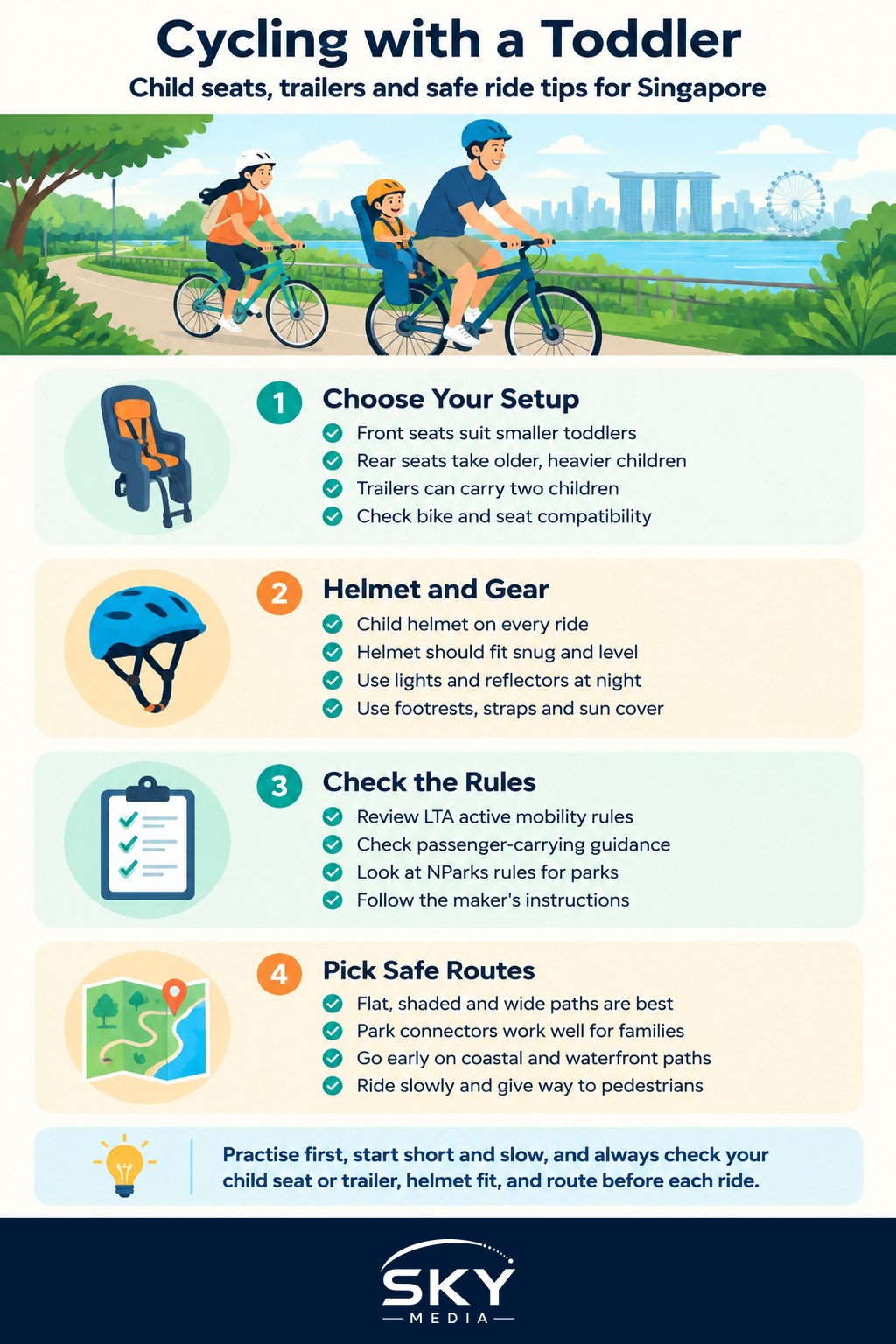
When Is a Toddler Ready to Ride Along?
Children need enough neck strength and upper body control to sit upright and support the weight of a helmet over bumps. Seat and trailer makers set minimum and maximum ages and weights for each product, and these differ between models. Always follow the manufacturer’s limits.
As a general guide:
- Your child should be able to sit unaided steadily for a sustained period.
- They should tolerate a helmet that fits well and stays put.
- If you have any concern about your child’s development or a medical condition, ask your paediatrician before you start.
Start with short, slow rides on flat paths, and stop if your child seems uncomfortable or tired.
Front vs Rear Child Bike Seats
Child bike seats bolt onto the bicycle and carry the child above the wheels. They come in two main types.
Front-mounted seats
These sit between the handlebars and the rider, usually attached to the stem or top tube.
- Pros: You can see and talk to your child, they get a great view, and the weight is centred, which some parents find easier to balance.
- Cons: They suit smaller and younger children and have lower weight limits. They can crowd your knees and steering, especially on smaller frames.
Rear-mounted seats
These attach to a rear rack or the seat tube, with the child sitting behind you.
- Pros: They take older and heavier children, often have high backs and footrests, and some recline for naps.
- Cons: You cannot see your child easily, and the weight behind the rider changes the bike’s handling, particularly when mounting and stopping.
Check that the seat suits your bike before buying. Frame shape, wheel size, rack type and available mounting points all affect compatibility. Folding bikes and some e-bikes may not accept certain seats. If you ride a folding bike, see our guide to folding bikes for commuting for frame considerations.
Bike Trailers: The Low-Down
A trailer is a small covered cart that hitches to the rear wheel of your bike, with the child seated inside in a harness.
- Pros: Low centre of gravity, so a fall of the bike does not usually tip the trailer. Room for two children in some models, plus space for bags. Covers protect against sun and light rain.
- Cons: They are wide and long, which makes narrow paths, sharp bends, barriers and crowded shared paths hard. They sit low, so they are less visible to others. Storing one in an HDB flat can be tricky.
Fly a tall safety flag and use lights so others can see the trailer, and check whether path widths and barriers on your intended route can take it.
Comparing Your Options
| Option | Typical child stage | Best for | Main drawback |
|---|---|---|---|
| Front child seat | Younger, lighter toddlers | Short rides, chatting with your child | Lower weight limit, can crowd the rider |
| Rear child seat | Toddlers to preschoolers | Longer rides, heavier children | Harder balance, cannot see child |
| Bike trailer | Toddlers to preschoolers, sometimes two | Park rides, carrying gear, stability | Width, visibility, storage space |
| Cargo bike with child seating | Toddlers and up | Frequent family riding | High cost, large and heavy |
Helmets and Safety Gear
Your child should wear a properly fitted bicycle helmet on every ride, whether in a seat or a trailer. Choose a helmet that meets a recognised safety standard and fits snugly: it should sit level just above the eyebrows, and the straps should form a V around the ears with room for about one finger under the chin.
Also consider:
- Your own helmet. Lead by example. Under LTA’s rules, cyclists must wear a helmet when riding on roads.
- Lights and reflectors. Front and rear lights are required when cycling at night, and are sensible on cloudy days.
- Foot guards and straps. Most seats have footrests with straps that stop little feet getting caught in the spokes.
- Sun protection. Toddler skin burns quickly. Ride early morning or late afternoon, use a sunshade if the seat or trailer has one, and bring water.
Rules to Check Before You Ride
Singapore’s rules for cycling are set by the Land Transport Authority (LTA) under its active mobility framework. They cover where bicycles may be ridden, speed limits on footpaths and shared paths, device dimensions, helmet requirements and safe riding behaviour. There are also rules about carrying passengers.
Rules are reviewed from time to time, so before you buy or ride:
- Check LTA’s current active mobility rules and its guidance on carrying a passenger on a bicycle.
- Check NParks’ rules for park connectors and parks, including any restrictions on cycling in certain areas.
- Make sure your child seat or trailer is used exactly as the manufacturer instructs.
If you also ride an e-bike, note that power-assisted bicycles have their own registration and rules. Our comparison of e-bikes, PMDs and bicycles explains the differences.
Choosing Safe Routes With Young Kids
The best family rides are flat, shaded, wide and away from traffic.
- Park connectors. NParks’ Park Connector Network links parks across the island with paths shared by cyclists and pedestrians. Choose quieter stretches and avoid peak weekend times on popular ones.
- Coastal and waterfront paths. Wide promenades along the coast and reservoirs are popular with families. They are busy on weekend evenings, so go early.
- Estate paths. For very short rides, shared paths within your housing estate can work, but watch for driveways, bus stops and void decks with blind corners.
Ride slowly, give way to pedestrians, and use your bell politely. Avoid main roads with a child passenger where you can, and dismount at crossings if you are unsure.
Practical Tips for Happy Rides
- Practise first without your child. Load the seat with a bag of similar weight to get used to the handling.
- Mount and dismount carefully. Always hold the bike steady and use a sturdy stand. Never leave a child in a seat on a parked bike unattended.
- Keep rides short. Twenty to thirty minutes is plenty for most toddlers. Plan a stop at a playground.
- Pack light. Water, wipes, a snack and a spare shirt cover most needs.
- Check the bike regularly. Tyres, brakes, seat bolts and harness buckles should be checked before every ride.
With the right seat or trailer, a well-fitted helmet and a calm route, cycling with a toddler can become a favourite family habit and an easy way to enjoy Singapore’s green spaces together.
Further reading: Cycling Safety Gear and Lights in Singapore