

Most Singaporeans think of Australia as Perth, Melbourne or the Gold Coast, but the closest Australian city to us is actually Darwin. A direct flight takes roughly four and a half hours, about the same as a hop to Hong Kong, and lands you at the doorstep of some of the most dramatic wilderness on the continent. This Darwin travel guide is built for Singapore travellers who want a long weekend or a week in the Top End, with the focus on the two big national parks: Kakadu and Litchfield. If you have more time in Australia, our guides to Perth and Adelaide and South Australia cover other easy routes from Singapore.
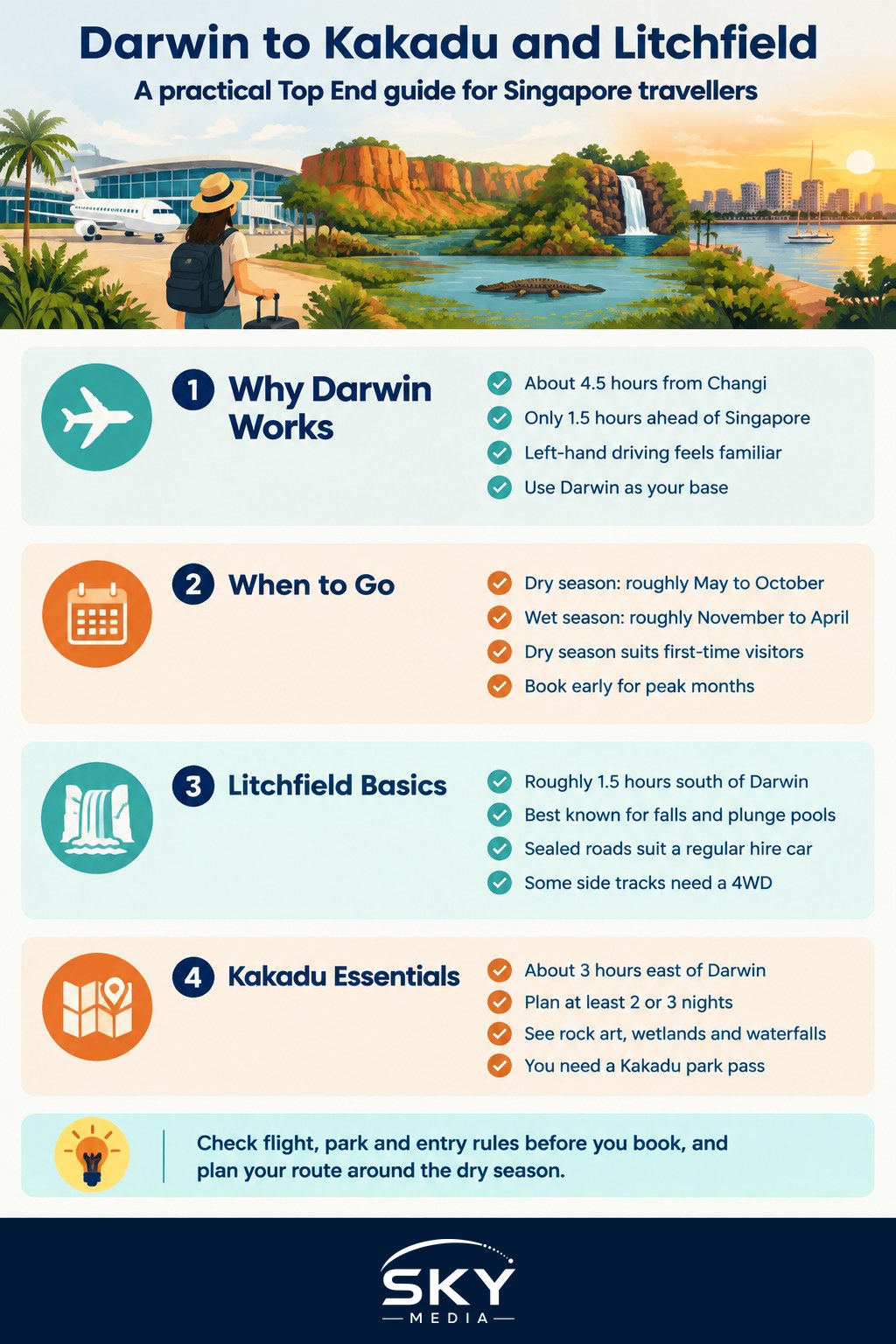
Why Darwin Works So Well as a Short Trip From Singapore
The appeal is simple. Short flight, small time difference and a completely different landscape from anything in Southeast Asia.
- Flight time: direct services between Changi and Darwin run at roughly four and a half hours. Airlines and schedules change from season to season, so check what is operating when you plan to travel. Some routes connect through other Australian cities if there is no direct option.
- Time zone: Darwin runs on Australian Central Standard Time, which is one and a half hours ahead of Singapore. Jet lag is not really a factor.
- Driving side: Australia drives on the left, like Singapore, so self-drive feels familiar. Distances are the big difference.
- Entry: Singapore passport holders visiting Australia as tourists generally need an Electronic Travel Authority (ETA), applied for through the official Australian government app. Check the Australian Department of Home Affairs website for current rules before booking.
Darwin itself is a relaxed, compact tropical city. Many visitors spend a day or two there at the start and end of the trip, and use it as a base for the parks.
Dry Season vs Wet Season: Timing Your Top End Trip
Timing matters more for the Top End than almost anywhere else in Australia. The region has two main seasons rather than four.
- Dry season (roughly May to October): clear skies, lower humidity and cooler nights. Most roads, waterfalls and walking tracks in Kakadu and Litchfield are open, and this is when tours and markets run at full swing. It is also peak season, so book accommodation and car hire early.
- Wet season (roughly November to April): heavy rain, storms and floods. Waterfalls are spectacular from the air, but many roads and sites close, some only reopen once rangers have checked them for safety and crocodiles. Some tours do not run at all.
The shoulder months at either end can be lovely but less predictable. If this is your first trip and Kakadu is the goal, aim for the middle of the dry season. September school holidays fit neatly into this window for Singapore families.
Litchfield National Park: The Easy Day Trip
Litchfield is roughly a one and a half hour drive south of Darwin, which makes it the natural first stop or a comfortable day trip.
What to expect:
- Waterfalls and plunge pools: Florence Falls, Wangi Falls and Buley Rockhole are the best known. Swimming is often allowed at designated spots in the dry season, but only when the park says so. Signs at each site tell you whether it is open.
- Magnetic termite mounds: tall, flat mounds aligned north to south, one of the park’s signature sights, viewed from a boardwalk.
- Short walks: many sights are reachable on short, well-marked tracks, which suits families and less active travellers.
Litchfield’s main sights are reachable on sealed roads, so a regular hire car is usually fine for the core loop. Some side tracks need a 4WD, so check before you go.
Kakadu National Park: Worth the Extra Days
Kakadu is Australia’s largest national park and is listed for both its natural and cultural value. It is jointly managed by its Bininj and Mungguy Traditional Owners and Parks Australia. The park entrance is roughly three hours’ drive east of Darwin, and the park itself is huge, so plan at least two or three nights inside it rather than attempting a day trip.
Highlights commonly on first-time itineraries:
- Rock art sites: Ubirr and Burrungkuy (Nourlangie) have ancient Aboriginal rock art galleries. Ubirr’s lookout at sunset is a classic Kakadu moment.
- Yellow Water (Ngurrungurrudjba) cruise: a boat cruise on the wetlands, known for birdlife and crocodiles. Early morning and sunset departures are popular.
- Waterfalls: Jim Jim Falls and Twin Falls are reached on rough tracks that typically need a 4WD or a tour, and are only open in the dry season. Other, more accessible pools and gorges open at different times of the year.
- Cultural centre: visiting the park’s cultural centre early in your trip gives useful context about Country, the seasons and the Traditional Owners.
You need a Kakadu park pass to visit. Passes are bought online through Parks Australia; check the official Kakadu website for current pass types and prices. Respect signs that ask you not to photograph certain sites or enter certain areas, as these reflect cultural wishes.
Self-Drive or Tour: Which Suits You?
This is the biggest planning decision. Here is how the main options compare.
| Option | Best for | What to watch |
|---|---|---|
| Self-drive in a 2WD car | Litchfield and Kakadu’s sealed-road sights, flexible itineraries | Long distances, fatigue, wildlife on roads at dusk; no access to 4WD-only sites |
| Self-drive in a 4WD | Experienced drivers who want Jim Jim or Twin Falls | Higher hire cost, rental terms on unsealed roads, river crossings need care |
| Small-group or day tours | First-timers, non-drivers, families who prefer not to drive | Fixed schedules, less freedom, book early in peak months |
| Darwin base with day trips | Short trips of three to four days | Long day returning from Kakadu; better for Litchfield than Kakadu |
If you drive, read your rental agreement carefully. Many standard contracts restrict unsealed roads or night driving outside towns. Fuel stops are far apart, so fill up whenever you can. Driving at dawn and dusk raises the risk of hitting wildlife.
Crocodile, Heat and Water Safety
The Top End is genuinely wild, and a few rules keep everyone safe.
- Crocodiles: saltwater crocodiles live in rivers, billabongs, estuaries and the sea. Only swim where signs clearly say swimming is permitted, never near the water’s edge at dusk, and never clean fish or prepare food at the edge. “No swimming” means no swimming.
- Box jellyfish: dangerous stingers are present in coastal waters, especially in the warmer months. Darwin’s beaches are not for casual swimming during stinger season; use pools instead and follow local advice.
- Heat and hydration: even in the dry season, days are hot. Carry plenty of water on every walk, wear a hat and walk early. Tell someone your plans on remote tracks, as phone coverage can be patchy.
- Wildlife: do not feed or approach animals, including birds and wallabies.
Darwin City Before and After the Parks
Allow time for Darwin itself. Dry-season sunset markets at Mindil Beach are a local institution, with food stalls and the sun dropping into the sea; check which evenings they run. The waterfront precinct, the botanic gardens and the city’s museums give a good introduction to Top End history, including Cyclone Tracy and the city’s wartime story. The food scene reflects strong Southeast Asian links, so do not be surprised to find laksa that holds its own against home.
Simple Planning Checklist
- Check direct flight schedules and book early for September school holidays.
- Apply for your ETA through the official channel well before departure.
- Buy your Kakadu park pass online and note which sites are open for the season.
- Decide on 2WD, 4WD or tours, then book car hire or tour seats.
- Pack light long sleeves, a hat, insect repellent, a refillable water bottle and sturdy shoes.
- Get travel insurance that covers the activities you plan.
A Top End trip trades city shopping for rock art, wetlands and waterfalls, all a short flight from Changi. Go in the dry season, respect the crocodile signs, and give Kakadu the time it deserves.
Frequently Asked Questions
How many days do I need for Darwin, Litchfield and Kakadu? Plan three to four days for a short Darwin base trip with Litchfield, or about a week if you add Kakadu. Kakadu is huge and about three hours’ drive east of Darwin, so allow at least two or three nights inside it rather than a day trip.
Is Darwin suitable for Singapore families with young kids? Yes, it has a short direct flight, a small time difference and short, well-marked walks at Litchfield. Go in the dry season, keep to areas where swimming is permitted, carry plenty of water, and use pools rather than beaches during stinger season.
Do I need a visa to visit Darwin as a Singapore passport holder? Tourists on Singapore passports generally need an Electronic Travel Authority, applied for through the official Australian government app. Apply well before departure, and check the Australian Department of Home Affairs website for current rules before booking.
Can I swim at the beaches or waterholes in the Top End? Only where signs clearly say swimming is permitted. Saltwater crocodiles live in rivers, billabongs and the sea, and box jellyfish are found in coastal waters, especially in warmer months. Use pools in stinger season, and never swim at dusk.
Which Kakadu sights need a 4WD or a tour? Jim Jim Falls and Twin Falls are reached on rough tracks that typically need a 4WD or a tour, and open only in the dry season. Check your rental agreement too, since many contracts restrict unsealed roads.
Further reading: Mongolia From Singapore: Ulaanbaatar, the Gobi and Ger Camps · Uluru from Singapore: A Travel Guide