

Dating a widower or widow can be a deeply rewarding relationship. Your partner has already shown they can love fully and commit for the long haul. But they also carry a loss that does not disappear when they start dating again, and you are stepping into a life that was shaped by someone else. This guide is written for you, the new partner. It looks at how to make room for their grief, how to handle memories of the late spouse, and how to approach in-laws, children and family loyalty without losing sight of your own needs.
Every person grieves differently, and every family handles loss in its own way. Treat the ideas below as starting points for conversation, not rules.
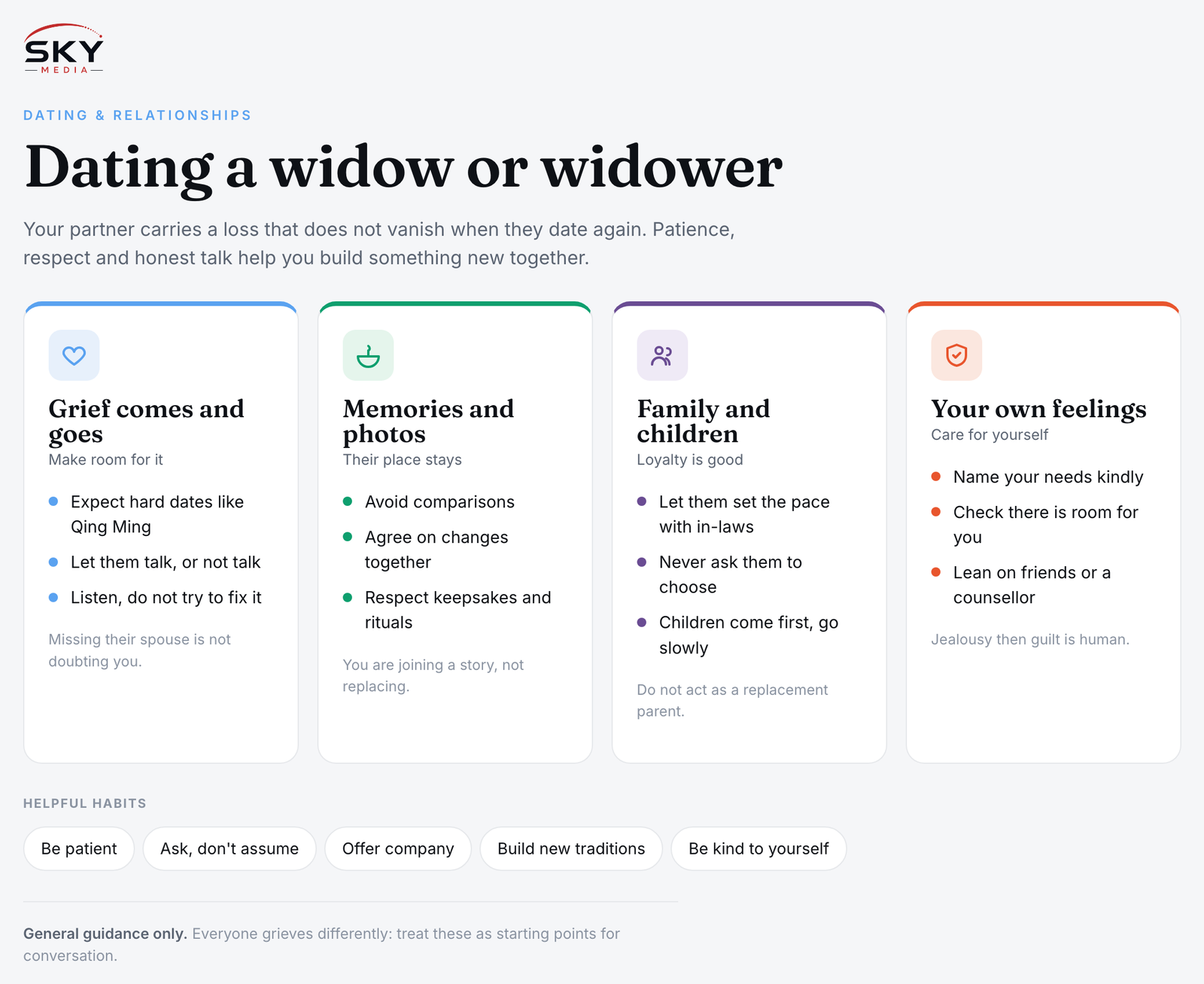
Understanding Grief That Comes and Goes
Grief rarely moves in a straight line. Your partner may seem settled for months and then have a hard week around a birthday, a wedding anniversary, the date of the death, Qing Ming, a festival meal or a hospital smell that brings everything back. This is normal and it does not mean they are “not over it” or that they love you less.
A few things help:
- Expect the hard dates. Gently ask which days tend to be difficult. Many people appreciate a partner who quietly remembers and checks in, without making a big deal of it.
- Let them talk, or not talk. Some people want to share stories about their late spouse. Others prefer to keep that part private for a while. Follow their lead.
- Don’t try to fix it. Grief is not a problem to be solved. Listening, sitting together and offering practical help, like handling dinner on a tough evening, usually means more than advice.
- Separate grief from doubt. Missing someone who died is not the same as being unsure about you. Both can be true at different times, but most often it is simply grief.
Building patience takes practice. If waiting feels hard, our guide on how to become more patient has practical habits that also help in relationships.
Memories, Photos and the Late Spouse’s Place
One of the most common worries for a new partner is how much space the late spouse still takes up. You may notice wedding photos on the wall, their clothes still in the wardrobe, or a framed portrait on a family altar. In many Singapore homes, a deceased family member is also remembered through prayers, offerings or yearly rites, which are part of family and religious life, not a statement about the new relationship.
Try to think of it this way: you are not replacing anyone. You are joining a story that includes them. Partners who accept this tend to feel less threatened over time.
Practical points to keep in mind:
- Avoid comparisons. Do not ask whether you are “better” or “like” the late spouse, and gently steer away if your partner keeps comparing.
- Talk about the shared home carefully. If you move in together, it can be emotionally easier to agree on what stays, what is stored and what is given to family, rather than one person changing things alone. Some couples choose a fresh home for a new start, but that is a big decision best made together and without pressure.
- Respect keepsakes. Items like rings, letters or a favourite watch often matter hugely. They may later be kept for the children or returned to the late spouse’s family.
- Ask before you change rituals. If your partner visits a columbarium, a grave or a temple on certain dates, ask whether they would like company. Some will, some prefer to go alone.
Helpful vs Less Helpful Responses
The table below compares common situations and how a new partner might respond.
| Situation | More helpful response | Less helpful response |
|---|---|---|
| They mention their late spouse during dinner | Listen, ask a gentle question, and let the story finish | Change the subject quickly or look visibly upset |
| A death anniversary is coming up | Ask how they would like to spend the day and offer support | Plan a celebration that clashes with the date |
| Photos of the late spouse are still on display | Share how you feel calmly, and agree on changes together over time | Remove or move photos without discussing it |
| Their former in-laws invite them to a family event | Encourage them to go, and accept that you may not be invited at first | Treat the invitation as disloyalty to you |
| They have a sudden low mood out of nowhere | Offer company or space, whichever they prefer | Take it personally or ask “what did I do?” |
Family Loyalty, In-Laws and Children
When someone loses a spouse, they often keep strong ties with the late spouse’s parents, siblings and wider family. In Singapore, where families can be close knit and grandparents may be involved in childcare, these relationships may continue for years. Your partner may still attend Chinese New Year reunion dinners, Hari Raya visits, Deepavali gatherings or Christmas lunches with their former in-laws.
This loyalty is a sign of good character, not a threat. Some former in-laws warmly welcome a new partner. Others need time, because seeing their child’s spouse with someone new can reopen their own grief. A few tips:
- Let your partner set the pace for introductions. They know their family best.
- Be courteous and low key at first. Small gestures, like greeting elders properly and bringing a modest gift where it is customary, go a long way. Our guide on how to be more diplomatic offers ways to handle sensitive conversations gracefully.
- Do not ask your partner to choose. Asking them to cut contact with their late spouse’s family usually backfires and causes real hurt.
If there are children, they come first. They have lost a parent and may feel that liking you is a betrayal. Move slowly, avoid trying to act as a replacement parent, and support your partner’s decisions on discipline and routine. Children often warm up when they see that you respect their late parent’s memory. If a child seems to be struggling with grief, your partner may wish to speak with the school counsellor or a professional counsellor who works with bereaved children.
Looking After Your Own Feelings
Being supportive does not mean ignoring yourself. It is normal to feel jealous of someone who has passed away, and then guilty for feeling that way. These feelings are human. What matters is how you handle them.
- Name your needs kindly. “I’d love it if we could make some new traditions of our own” lands better than “you still live in the past.”
- Notice whether there is room for you. Over time, you should feel that you have a real place in their life, with your own memories, plans and future together. If after a long period you still feel like a temporary guest, it is fair to raise it.
- Watch for signs they are not ready. Some people date too soon after a loss. If your partner cannot talk about the future at all, or seems to be using the relationship to avoid grieving, a frank and caring conversation may be needed.
- Get support for yourself. Talk to a trusted friend, or consider a relationship counsellor. Family service centres and private counsellors in Singapore can help couples work through grief and blending families.
Friendships matter here too, because you need people outside the relationship who listen to you. See how to be a good friend for ways to keep those ties strong.
Building a Future Together
A healthy relationship with a widow or widower does not require them to forget. It asks both of you to hold the past with respect and build something new alongside it. Over time, many couples find their own rhythm: a yearly visit to remember the late spouse, a separate set of traditions for the two of you, and a family that grows to include everyone.
Be patient, be honest and be kind, to them and to yourself. The love your partner had before is not competition. It is part of why they know how to love you well.
Further reading: Dating in Your 40s and Beyond