

Singapore sits at the centre of a lot of regional business, so plenty of people here spend part of every month in Jakarta, Bangkok, Shanghai or further. If you are dating someone who travels for work, you are not in a long-distance relationship. You live in the same city, you might even share a flat, yet your partner keeps disappearing for three days here and a week there, often at short notice. That in-and-out pattern brings its own challenges: plans that collapse, routines that never settle and the strange awkwardness of the first evening back.
This guide is about that specific rhythm. It is less about missing someone across years and more about building a relationship that can absorb constant small departures and returns.
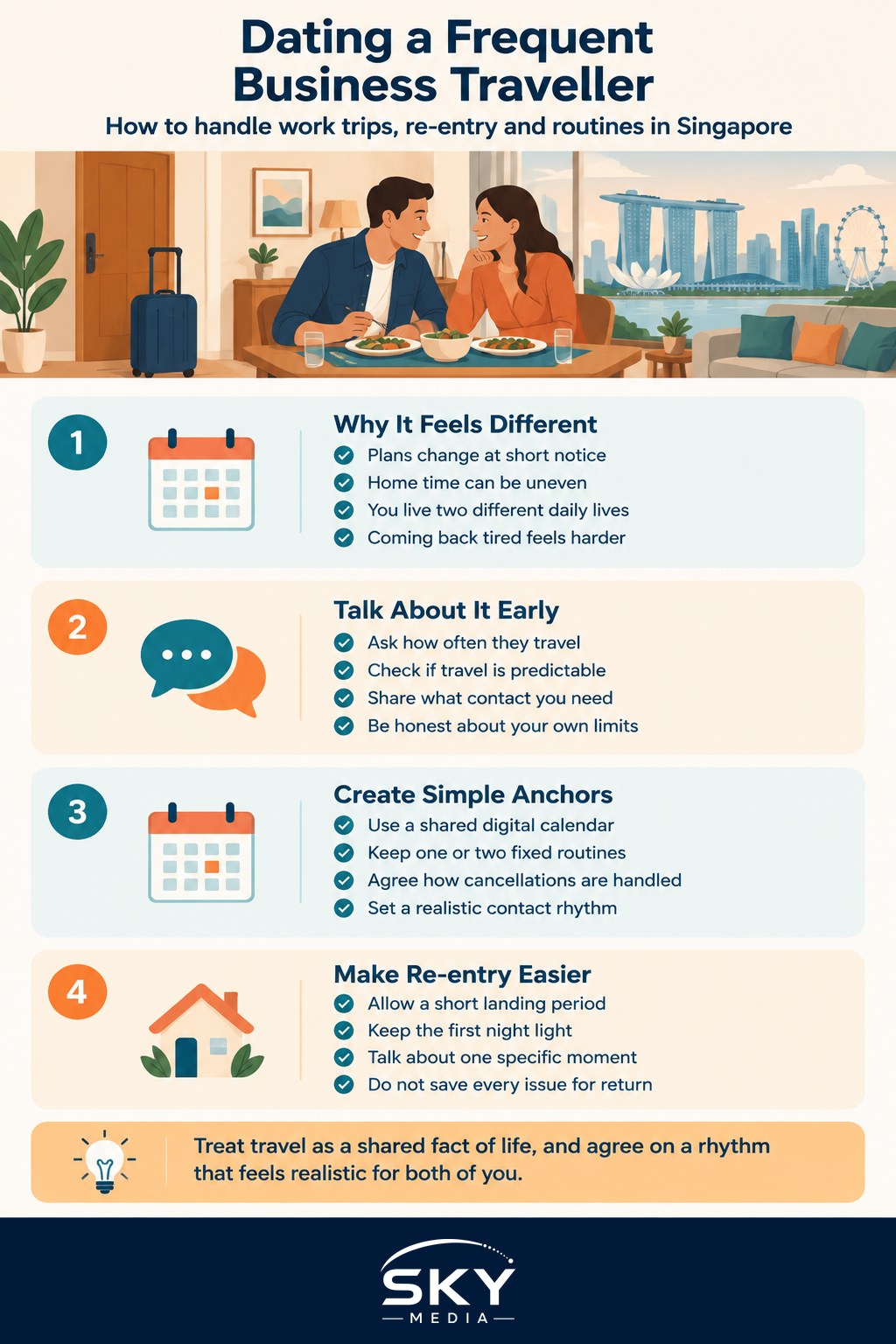
Why Frequent Work Travel Is Different From Long Distance
In a long-distance relationship, the distance is the stable fact. Both people know where they stand and build habits around it, such as a fixed weekly call. With frequent work travel, the only stable fact is unpredictability.
A few things make it harder than it looks:
- Short notice. A client meeting gets moved, and your Saturday dinner disappears on Thursday night.
- Uneven time at home. One month your partner is around almost every evening, the next month they are away for half of it.
- Two different lives. While away, they live on hotel breakfasts, long meeting days and airport lounges. You keep running the ordinary week in Singapore. Neither life is easy, but they are not the same.
- The re-entry gap. Coming home tired, possibly after a red-eye flight, is not the same as coming home ready to connect.
Naming these patterns early helps. Many couples fight about the symptoms (a missed call, a cancelled date) when the real issue is that nobody has agreed how the travel will be handled.
Talk About the Travel Pattern Early and Honestly
If you are still in the early stages of dating, ask about the job in a curious, not suspicious, way. How often do they travel? Is it predictable, such as the same week every quarter, or reactive? Is it likely to increase with a promotion or decrease after a project ends? What do they actually enjoy about it?
Then be honest about what you need. Some people are perfectly happy with a partner who is away a lot because they value their own space. Others find that it brings up insecurity, especially if trust has been broken before. If that is you, our guide on dating someone new when you still distrust people may help you separate old fears from present facts.
Neither preference is wrong. What matters is saying it out loud before resentment builds.
Build a Shared Calendar and a Few Fixed Anchors
Unpredictable schedules need some structure underneath them. Practical couples tend to settle on a few habits:
- A shared digital calendar where trips go in as soon as they are booked, even if tentative. Seeing the month at a glance prevents a lot of disappointment.
- One or two anchors that rarely move. This might be Sunday breakfast at your usual hawker centre when both of you are in town, or a standing call on the second night of every trip.
- A rule for cancellations. For example, if a trip forces a cancelled plan, the travelling partner suggests a replacement date before they leave.
- Agreed contact rhythm while away. Some couples want a short message every day, others prefer one proper call per trip. Time zones and long workdays matter, so agree on something realistic rather than ideal.
If your schedules also clash at home, for instance because one of you works shifts, the ideas in how to date when you work opposite shifts pair well with these.
What Each Partner Can Do
The burden should not fall only on the person staying in Singapore. Here is a simple split of responsibilities that many couples find fair.
| Situation | What the traveller can do | What the partner at home can do |
|---|---|---|
| Trip is booked | Add it to the shared calendar straight away and share hotel city and rough schedule | Note any plans that clash and raise them early, not the night before |
| During the trip | Send a short check-in at a time that suits both time zones | Keep your own week full with friends, hobbies and rest, not waiting by the phone |
| Plans get cancelled | Apologise plainly and offer a new date before leaving | Say honestly if it stings, then let it go once a new plan is agreed |
| First evening back | Tell your partner how tired you are and what you need | Avoid loading the evening with errands, news and plans all at once |
| After several trips in a row | Protect a full weekend together with no laptop | Ask for that weekend directly if it is not offered |
Use this as a starting point and adjust it. Some people at home actually enjoy the solo time and want less contact, not more.
Handling the Return Home
Re-entry is where many couples quietly struggle. The traveller lands wanting quiet, a shower and familiar food. The partner at home has been holding things together and wants attention, conversation or help with chores that piled up. Both needs are reasonable, and they collide.
A few ideas that help:
- Agree a short landing period. An hour, or even a night, where the returning partner can unpack and rest without being asked for much.
- Have a small ritual. A simple meal together, a walk around the neighbourhood park or ordering from the same place every time. It marks the switch back to shared life.
- Share the week properly. Rather than “how was it?”, ask about one specific moment. The traveller should ask about your week too. It is easy for the person who has just flown in to treat their trip as the main story.
- Do not save every disagreement for the return. Raising five frustrations on the first night back makes homecoming feel like a review. Pick the important one, or wait for the weekend.
Keeping Your Own Life Full
One of the healthiest things the partner at home can do is keep a satisfying life that does not depend on the other person being around. That means friends you see regularly, a hobby or class, time with family and enough rest. This is not about pulling away; it simply means your mood and week are not hostage to a flight schedule.
It also makes the relationship more interesting. You both have stories to bring back.
If children are involved or planned, the logistics change a lot. Our guide on coping when your partner travels for work looks at the household side in more detail.
When the Travel Becomes the Problem
Sometimes the pattern simply does not work. Warning signs include:
- You feel more like a scheduler than a partner.
- The travelling partner rarely asks about your life or makes time when home.
- Trips keep expanding, and there is no conversation about whether that suits you both.
- You notice persistent anxiety, loneliness or resentment that does not ease between trips.
None of these automatically means the relationship should end. They do mean it is time for a frank talk about the job, the future and whether either of you is willing to change something. A relationship counsellor can help if conversations keep going in circles, and many couples find it useful before things reach a breaking point.
A Relationship Built for Comings and Goings
Dating someone who travels for work in Singapore can be a good fit, especially if both of you value independence and are willing to plan a little more than other couples. The key is to treat the travel as a shared fact of life, not one person’s private inconvenience. With a clear calendar, a few dependable anchors, a gentle approach to homecoming and full lives on both sides, the coming and going can become just part of how your relationship works.
Further reading: Dating Someone on a Work Pass in Singapore: Planning a Future Together