

Open a laptop to revise one topic and, within minutes, you have fourteen browser tabs, three YouTube explainers, a group chat pinging, and a nagging feeling that everyone else has a better set of notes. That feeling has a name. Information overload is what happens when the amount of material coming at you outpaces your ability to sort, absorb and act on it. In Singapore, where students juggle heavy syllabuses, tuition, co-curricular activities and a phone that never stops buzzing, it is one of the most common reasons revision stalls.
The good news is that information overload is a workflow problem, not a sign that you are slow or incapable. You do not need to read everything. You need a way to decide what deserves your attention, a way to switch off the rest, and a routine that turns a pile of material into something you actually understand. This guide walks through all three, grounded in local study life.
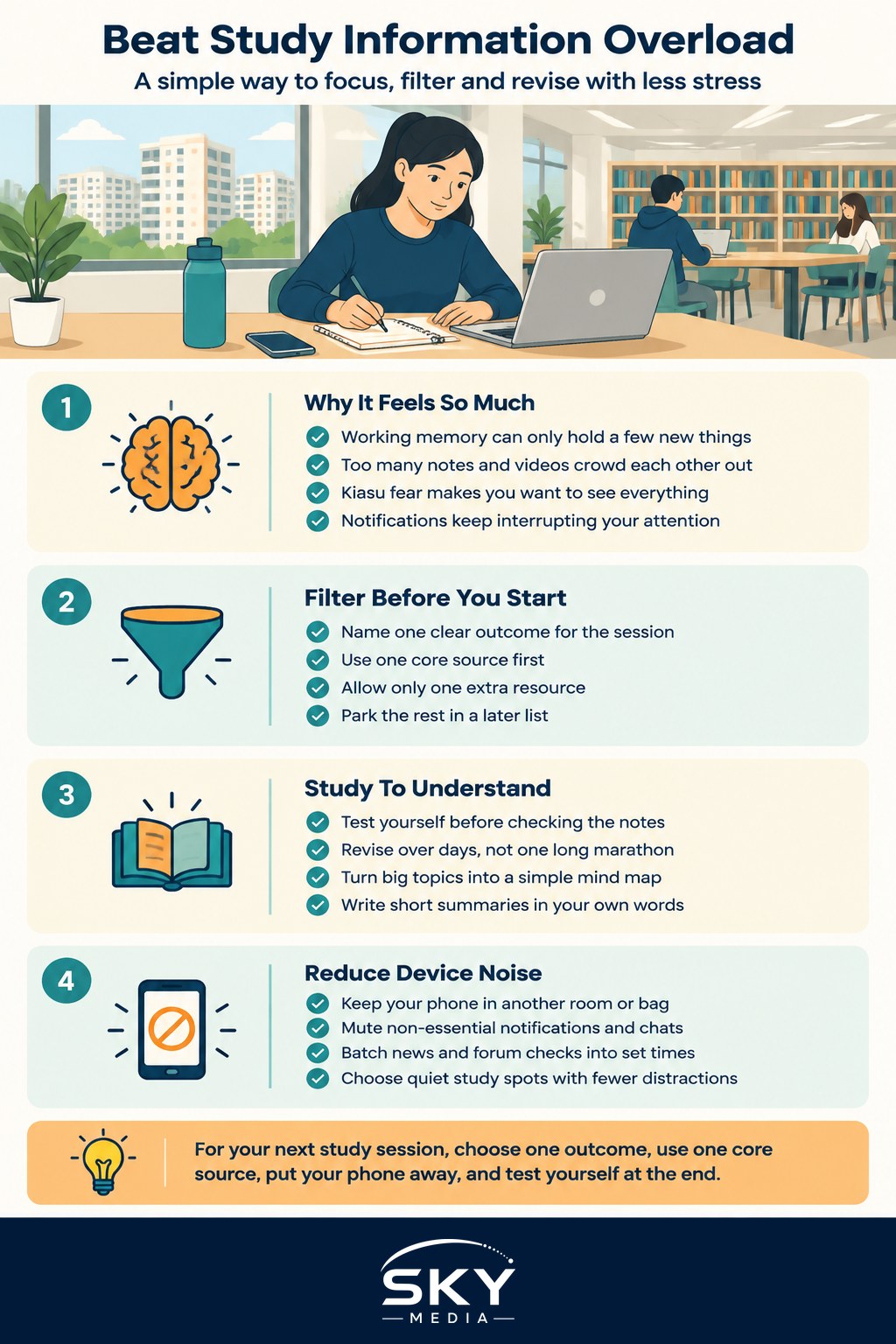
Why Your Brain Feels Swamped
Human working memory is small. It can hold only a handful of new items at once, which is why cramming ten concepts in one sitting feels like carrying too many grocery bags up an HDB staircase: something always slips. When you pour in more material, past a point, you do not learn more, you simply drop things and feel anxious about it.
Three forces make this worse today. First, abundance: for every topic there are notes, videos, past-year papers, apps and forum threads, far more than any one person can use. Second, the fear of missing out, sharpened by kiasu culture, which whispers that if you have not seen every resource, you are behind. Third, the design of your devices, which are built to interrupt you. Each notification is a fresh demand on the same small working memory you were trying to use for algebra.
Recognising these forces matters because it moves the problem out of your character and into your environment. You are not lazy or scattered by nature. You are a normal person using tools that compete for a limited resource, and that is something you can manage.
Filter Before You Study, Not While You Study
Most overwhelm comes from trying to choose and learn at the same time. The fix is to separate the two jobs. Do a short, ruthless filtering pass first, then study only what survives.
A simple filtering routine before any revision session:
- Name the one outcome. Finish the sentence “By the end of this hour I will be able to…” If you cannot, you are collecting, not studying. Pick a single skill, such as solving a particular type of equation or explaining one process.
- Pick one core source. Choose your primary text: usually your teacher’s notes or the textbook aligned to your syllabus. This is your spine. Everything else is optional.
- Cap the extras. Allow yourself at most one supplementary resource, for example a single video if the core source leaves a gap. Close the other tabs. You can reopen them later if a real question remains.
- Park the rest. Drop every other link into one “later” list. Parking beats deleting because it quiets the fear that you will lose something useful, without letting it clutter today.
This pass takes five minutes and saves the hour that follows. It also breaks the trap of judging your progress by how much you have gathered. A neat folder of forty PDFs teaches nobody anything; ten minutes of active practice on the right one does.
Turn Incoming Material Into Understanding
Once you have filtered, the goal is to process material, not just move your eyes over it. Passive rereading is where information overload does its quiet damage: it feels productive, so you keep piling on more, yet little sticks.
Switch to methods that force your brain to do the work. Active recall, testing yourself from memory before checking, tells you fast what you actually know, so you stop rereading things you have already mastered. See our guide on using active recall to study. Pair it with spaced repetition, revisiting material over days rather than in one marathon, which our piece on spaced repetition for better memory explains. To compress a sprawling topic into something small enough to hold, try mind mapping for studying, which turns pages of notes into one page of connected ideas.
The table below shows how the same behaviours change once you treat overload as a workflow issue.
| Situation | Overloaded habit | Calmer habit |
|---|---|---|
| Starting a session | Open every resource “just in case” | Name one outcome, open one core source |
| Finding a new link | Read it immediately, lose your thread | Drop it in a “later” list, keep going |
| Revising a chapter | Reread and highlight passively | Test yourself, then review only the gaps |
| Feeling behind | Collect more notes to feel safe | Practise questions on what you already have |
| End of the day | Measure hours spent scrolling | Measure what you can now explain |
Notice that every calmer habit does less collecting and more doing. That is the whole shift.
Tame the Devices That Feed the Flood
Willpower is a poor defence against a phone engineered to interrupt. Change the environment instead. Put the phone in another room or bag while you work; out of sight genuinely lowers the pull. Turn off non-essential notifications, and if group chats spike during exam season, mute them and set one or two fixed times to catch up. Our guide to building a distraction-free study routine has more, and if you struggle to stay on task once you sit down, improving focus and concentration is worth a read.
Study spots help too. A quiet corner of a National Library branch, a community club study room, or a tidied HDB study corner gives your brain fewer things to react to. The point is not to be spartan, but to remove the small, constant demands that drain the working memory you need for the actual material.
A few more practical guardrails:
- Batch your input. Read news, forums and chats at set times rather than all day, so information arrives in scheduled doses instead of a constant drip.
- Prefer one good source to five average ones. Depth beats breadth; you remember a topic you worked through once properly, not five you skimmed.
- Write to think. A short summary in your own words, closing the notes as you write, both processes the material and shows you the gaps.
When Overload Tips Into Stress
There is a difference between a messy workflow and genuine distress. If the flood of information leaves you unable to sleep, constantly on edge, or convinced you can never catch up, that is worth taking seriously and it is common around major exams. Treat it as a wellbeing matter, not a character flaw. Talk to a trusted adult, a teacher or your school counsellor; naming the pressure out loud often shrinks it. If you feel overwhelmed and need to talk to someone, mindline (1771) and the Samaritans of Singapore (SOS, 1767) are there. For the wider picture, see handling academic pressure as a student and, if revision has been relentless, avoiding study burnout.
Keep results in proportion, too. One paper, one grade, one topic you found hard is a single step in a long journey, not a verdict on your future.
Start Small, Starting Today
You will not conquer information overload by finding the perfect app or the ultimate note-taking system; chasing those is often overload in disguise. You beat it by choosing less, on purpose, and going deeper on what you keep. For your next session, try just this: name one outcome, open one core source, put your phone in another room, and test yourself at the end. Do that a few times and the swamped feeling loosens its grip, because you are finally letting your small, capable working memory do one thing well at a time.
Frequently Asked Questions
How do I know which study resource is good enough to use? Choose the one that matches your syllabus and explains clearly, which is usually your teacher’s notes or the aligned textbook. Use a second source only to fill a specific gap. If you finish a resource and can answer questions on it, it was good enough.
Is it okay to use AI tools and summaries when I study? They can help as a starting point, but summaries should not replace your own thinking. Use them to get an overview, then close them and test yourself. Check facts against your teacher’s materials, since AI tools can be wrong or off-syllabus.
Why do I forget things even after reading them many times? Rereading feels familiar but does not train recall, so memory stays weak. Close the notes and try to retrieve the content, then check what you missed. Spacing the practice over several days helps it last.
How should I organise my digital notes so they do not pile up? Keep one place for each subject with a simple structure, such as topic folders and a short summary at the top. Delete or merge duplicates every week. A small, tidy set that you revisit is worth more than a huge archive you never open.
Should I mute study group chats during exams? Often yes. Muting them during study blocks and checking at set times protects your focus. If the group is useful, keep one purposeful thread for questions and mute the rest. Do tell friends so no one thinks you are ignoring them.