

Plenty of newcomers arrive in Singapore with a career plan and soon add a learning plan: a part-time master’s, a professional certificate, a language course or an evening diploma. If you are thinking about part-time study on an Employment Pass (EP) or a Dependant’s Pass (DP), the first question is usually whether you also need a Student’s Pass. This guide explains how the passes interact, what to confirm before you enrol and how to choose a course that fits around your work or family life.
This is general information, not immigration advice. Pass rules are set by the Ministry of Manpower (MOM) and the Immigration & Checkpoints Authority (ICA), and they can change. Always confirm your own situation on the official websites or with the agency directly before paying fees.
How the Student’s Pass Fits With Work and Dependant Passes
In Singapore, the Student’s Pass is issued by ICA to foreigners who come here mainly to study, typically on a full-time course at an approved institution. It is a separate pass from the work passes that MOM issues, such as the EP and S Pass, and from the DP, which MOM issues to the spouse and children of eligible work pass holders.
The key idea is that your existing pass is what lets you live in Singapore. If you already hold a valid long-term pass such as an EP or DP, you are not in Singapore “as a student”, so many part-time and short courses can be taken without switching passes. ICA’s own guidance on the Student’s Pass explains who must apply and how foreigners holding other long-term passes are treated.
Where things get more complicated:
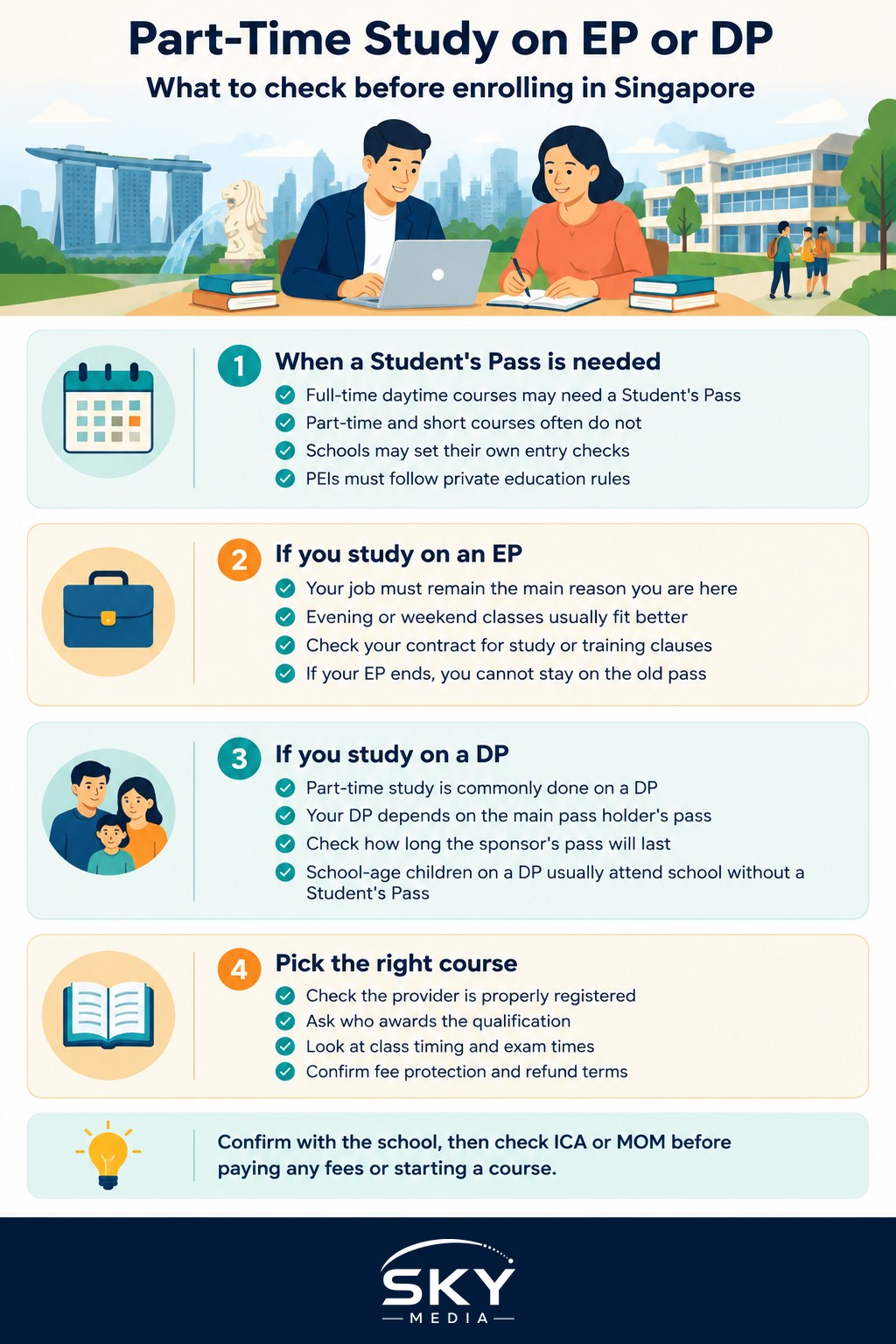
- Full-time programmes. A full-time course with daytime classes most of the week is a different matter, and the institution may require a Student’s Pass or ask you to confirm with ICA.
- Institution rules. Each school sets its own admission checks for foreign students.
- Course type. Programmes at private education institutions (PEIs) are regulated by the Committee for Private Education under the Skills and Workforce Development Agency (SWDA, formed in 2026 from Workforce Singapore and SkillsFuture Singapore), and the PEI must follow rules on which students it can enrol and on what basis.
If you want a fuller picture of the passes themselves, our guide to Singapore work passes explains the EP, S Pass and other categories.
Studying Part-Time on an Employment Pass
An EP is tied to a specific job with a specific employer. Studying part-time does not usually conflict with that, as long as the job remains your main reason for being in Singapore and your employment continues. Points worth thinking through:
- Your job comes first. Your EP exists because of your employment. If a course would require you to cut your hours sharply or leave your role, that changes the basis of your pass, and you should check with MOM before going ahead.
- Tell your employer. You do not normally need your employer’s permission to attend evening or weekend classes, but your contract may have clauses on outside commitments, training bonds or study leave. If your company is sponsoring the course, read the bond terms carefully.
- If your EP ends mid-course. If you change jobs, your new employer must apply for a fresh pass. Our guide to transferring your EP to a new employer covers how that works. If your EP is cancelled and you have no new pass, you cannot simply stay on to finish your course. You would need another valid basis to remain, which may mean applying to ICA for a Student’s Pass if you switch to full-time study and the school supports it.
- Fees and subsidies. Many government subsidies for adult learning, including SkillsFuture Credit, are for Singapore Citizens, and subsidised fees at local universities are generally for citizens and permanent residents. Expect to pay the international or non-subsidised rate and budget accordingly.
Studying Part-Time on a Dependant’s Pass
The same principle applies: your DP is your basis for living here, and part-time study is commonly done on that pass.
Some practical points for DP holders:
- Your pass depends on your sponsor’s pass. If the main pass holder’s EP ends, your DP ends too. A course that runs for two or three years should be weighed against how long you expect to stay.
- Work and study are separate questions. Whether you can take on a job while studying is governed by MOM’s rules for your pass, not by your school. Our guide to working on a Dependant’s Pass explains the current approach, and you should check MOM’s site before accepting any paid work, including internships that come with a course.
- Children on a DP. School-age children on a DP generally attend school without a Student’s Pass, but admission routes for international students differ between government schools and international schools. Check with the school and MOE for current arrangements.
- Switching passes. If you later want to move to full-time study, ask ICA and your chosen school how that affects your DP. Do not cancel one pass before the other is confirmed.
If you are still weighing up which pass suits your family, see Dependant’s Pass vs LTVP in Singapore.
Which Situation Applies to You
The table below gives a general picture. It is a starting point for your own checks, not a ruling on any individual case.
| Your situation | Usual position | What to check |
|---|---|---|
| EP holder, evening or weekend course | Commonly studied on the EP | Course schedule, employer contract, ICA guidance |
| DP holder, part-time diploma or degree | Commonly studied on the DP | How long the main pass will last, institution admission rules |
| EP or DP holder, full-time daytime programme | May need a Student’s Pass or ICA’s confirmation | ICA Student’s Pass page, school’s international office |
| Pass ends partway through the course | Cannot remain on the old pass | New work pass, DP, or Student’s Pass options with MOM or ICA |
| Online course from an overseas university | No Singapore study pass involved | Recognition of the qualification by employers |
Choosing a Part-Time Course That Works
Once the pass question is settled, the next step is choosing well. Singapore has a wide range of providers: autonomous universities with part-time degrees, polytechnics with part-time diplomas, PEIs offering partnered degrees with overseas universities, and professional bodies running certifications.
Before you enrol, it helps to check:
- Registration status. For a PEI, check that it is registered with the Committee for Private Education, and look up whether it holds EduTrust certification if that matters for the course.
- Who awards the qualification. For partnered programmes, the degree is often awarded by the overseas university. Ask how it is recognised in your home country as well as in Singapore.
- Class timing. Many part-time programmes run on weekday evenings and weekends. Check how often you must attend in person and whether exams fall during working hours.
- Fee protection and refunds. Ask how fees are protected, what the refund policy is, and what happens if you have to withdraw because your pass ends.
Questions to Ask Before You Pay
A short checklist makes the process smoother:
- Ask the admissions team directly: “I hold an Employment Pass (or Dependant’s Pass). Can I enrol on this course without a Student’s Pass?” Get the answer in writing.
- Read ICA’s current Student’s Pass guidance for holders of other long-term passes.
- Check your pass expiry date against the course end date.
- If on an EP, review your employment contract and any company study policy.
- If on a DP, check MOM’s rules before taking on any course-linked work placement.
Sort out the pass question first, choose a properly registered provider, and plan for what happens if your circumstances change.
Official sources: Ministry of Manpower (MOM)
Further reading: Jobs Foreigners Cannot Do in Singapore on a Work Pass