

If your everyday conditioner no longer feels like enough, hair masks are the next sensible step. They are simply richer, more concentrated treatments designed to sit on your hair a little longer and repair or hydrate more deeply than the quick rinse-out you use every day. In Singapore’s climate, where sun, chlorine, salt water, aircon and constant tying-up all take a toll, a weekly deep conditioning session can be the difference between hair that feels dry and straw-like and hair that stays soft and manageable through the humidity.
This guide explains what deep conditioning actually does, how hair masks differ from your daily conditioner, how to pick the right one for your hair, and how to use them so you get real results rather than a greasy, weighed-down mess.
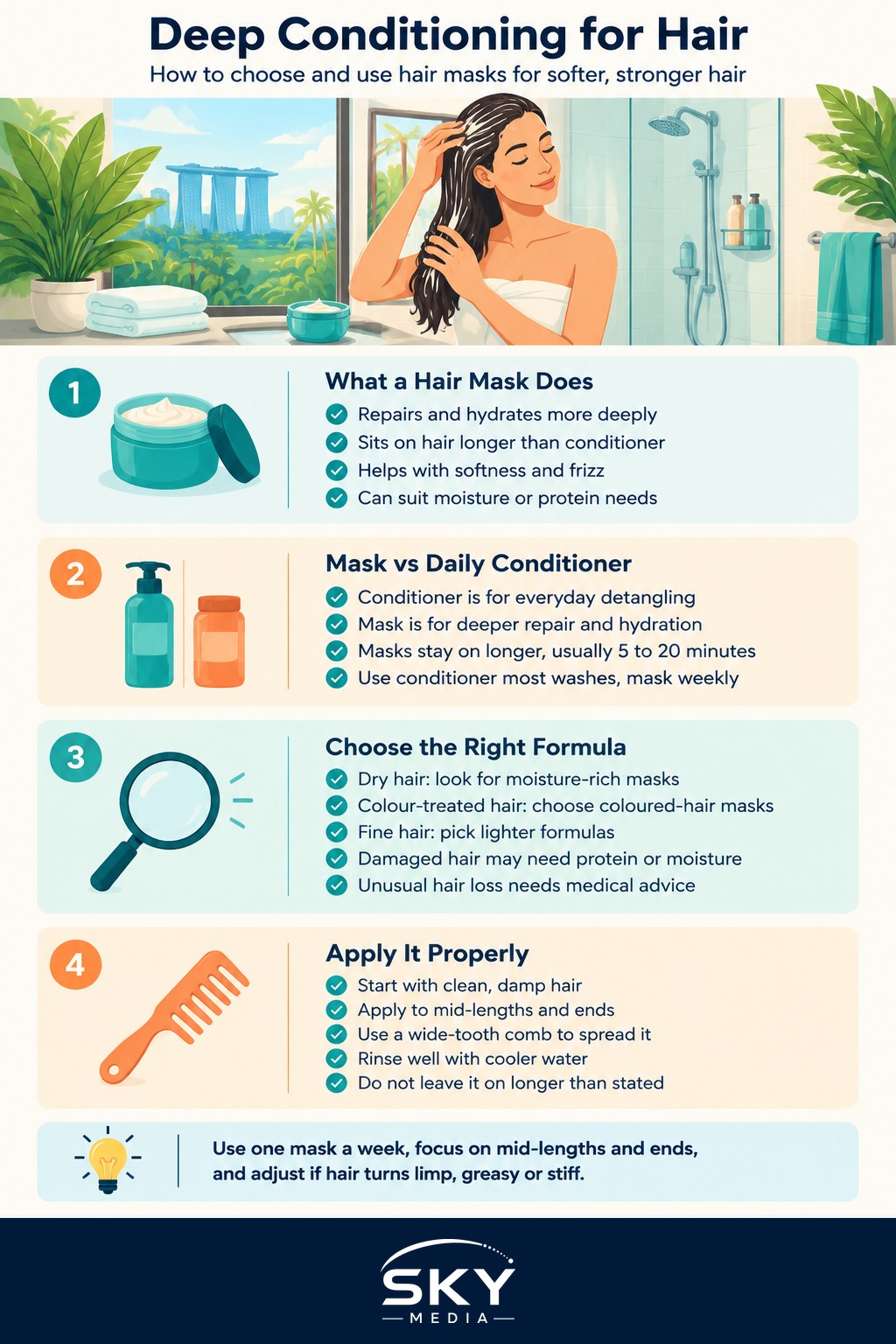
What Deep Conditioning Actually Does
Your hair takes a quiet beating over a normal week. UV rays break down the protein and colour in each strand even on cloudy days, chlorine from the pool strips moisture, salt water roughens the cuticle, and the sheer humidity means many people wash more often and tie their hair back tightly. Add heat styling or colour treatments and the outer layer of each strand, the cuticle, starts to lift and fray.
Deep conditioning works by giving that damaged cuticle more time and more concentrated ingredients to smooth things over. A daily conditioner mostly coats the surface and detangles. A treatment mask carries a heavier dose of moisturising and softening ingredients, and because you leave it on longer, more of it has a chance to penetrate and settle. The result is hair that feels softer, looks less frizzy, and handles the daily heat with less breakage.
It helps to know what your hair is actually short on. Broadly, treatments fall into two camps. Moisture-focused masks tackle dryness, dullness and frizz, which is what most people in a hot, humid climate need. Protein-focused treatments help rebuild strength in hair that is chemically treated, bleached or snapping easily. Using the wrong one, or overusing protein, can leave hair stiff and brittle, so it pays to match the treatment to the problem.
Hair Masks vs Daily Conditioner
People often use the words interchangeably, but they do different jobs and are not meant to replace one another. Think of your daily conditioner as maintenance and a mask as a periodic deep repair.
| Feature | Daily conditioner | Hair mask / deep treatment |
|---|---|---|
| Main job | Detangle and smooth after washing | Repair, strengthen or deeply hydrate |
| How long it stays on | About one to two minutes | Five to twenty minutes, per instructions |
| How often | Most or every wash | Usually once a week |
| Texture | Lighter, easy to rinse | Richer, more concentrated |
| Best for | Everyday softness | Dryness, damage, colour, heat stress |
The takeaway is that a mask does not replace your conditioner and your conditioner cannot do what a mask does. On mask days, many people skip the regular conditioner entirely, since the treatment already smooths and softens. On other days, the lighter conditioner keeps things manageable without weighing hair down in the heat.
How to Choose a Hair Mask for Your Hair
There is no single best product, only the one that suits your hair’s current state. Read how your hair behaves rather than trusting the front of the tub.
- Dry or frizzy hair: Look for a moisture-rich mask with ingredients like glycerin, shea butter, argan or coconut oil, or panthenol. This is the most common need in Singapore’s humidity, where hair can feel parched underneath despite the muggy air.
- Colour-treated or bleached hair: Choose a mask made for coloured hair, ideally one that balances moisture with a little protein to rebuild strength without stiffness.
- Fine or limp hair: Go for a lightweight formula and keep it off the roots. Rich butters can flatten fine hair fast in this weather.
- Thick, coarse or curly hair: This hair type usually drinks up richer, creamier masks and benefits from a longer treatment time.
- Chemically straightened or rebonded hair: A gentle moisturising mask helps keep processed hair supple; always follow any specific aftercare your salon gave you.
If your hair is very damaged, snapping easily, or you are unsure whether you need moisture or protein, a hairdresser or trichologist can assess it properly. And if you notice unusual, sudden or patchy hair loss rather than ordinary dryness, that is worth raising with a doctor or pharmacist rather than treating at home, since it can point to something a mask will not fix.
How to Apply a Hair Mask Properly
Technique matters as much as the product. Using a mask well is what separates soft, bouncy results from a limp, oily let-down.
- Start with clean, damp hair. Shampoo first, then gently squeeze out excess water with a towel. Dripping-wet hair dilutes the mask; a damp canvas lets it grip.
- Focus on the mid-lengths and ends. These are the oldest, most damaged parts of your hair. Keep the mask off your scalp unless the product is specifically a scalp treatment, since roots get oily fast in the heat.
- Comb it through. A wide-tooth comb spreads the mask evenly and helps with detangling at the same time.
- Leave it for the stated time, not longer. More time rarely means more benefit. Leaving a mask on all night, unless it is designed as an overnight product, can leave hair limp or greasy.
- Rinse thoroughly with cooler water. A cooler final rinse helps smooth the cuticle and cuts down frizz, which is handy before stepping back into the humidity.
You do not need heat or a fancy cap for a mask to work, though wrapping your hair in a warm towel can help a richer treatment sink in. Once a week is plenty for most people. Overdoing deep conditioning, especially with protein, can make hair feel coated, stiff or oddly brittle.
Fitting Masks into a Tropical Routine
The main mistake in this climate is treating hair as if it needs the same rich, heavy care as it would in a cold, dry country. It usually does not. Because so many of us wash frequently and sweat through the day, over-conditioning is a real risk, and it shows up as flat, greasy-looking hair by lunchtime.
Anchor your treatment to one wash a week, perhaps the weekend, when you are not rushing out into the heat. If your hair is fine or you live in aircon most of the day, once a fortnight may be enough. Pay attention after each session: hair that feels wonderfully soft and looks bouncy is well treated, while hair that turns limp, oily or straw-stiff is telling you to use less, less often, or to switch between a moisture mask and a protein one. Patch test any new product on a small section first if your scalp is sensitive, and remember that daily sun protection for your hair, such as a hat or shade during peak hours, protects the results your mask gives you.
Explore more
A deep treatment works best as part of a bigger picture, so it helps to start with choosing shampoo and conditioner for your hair type and to understand how hair oiling and scalp treatments complement a mask. If chlorine and strong sun are wearing your hair down, our guide on protecting your hair from sun and chlorine pairs neatly with a weekly deep conditioning habit.
Frequently Asked Questions
Can I use a hair mask on my scalp? Generally no, unless the product is specifically made as a scalp treatment. Masks are designed for the mid-lengths and ends, and putting them on the roots can make hair oily and flat fast in the heat. If your scalp is a problem, ask a pharmacist or dermatologist.
Can leaving a hair mask on longer give better results? Not really, as more time rarely means more benefit. Stick to the time on the label, and only leave a mask overnight if it is made for that. Leaving it too long can make hair limp or greasy.
How do I know if my hair needs moisture or protein? Dry, dull, frizzy hair usually wants moisture, while hair that stretches, snaps or has been bleached or chemically treated may need some protein. Too much protein can leave hair stiff and brittle. If you are unsure, a hairdresser or trichologist can assess it properly.
Is it okay to use a hair mask on rebonded or coloured hair? Yes, a gentle moisturising mask can help keep processed hair supple. Choose one made for coloured hair, ideally balancing moisture with a little protein, and follow any aftercare your salon gave you. Ask your stylist if you are unsure what suits your treatment.
Do I need heat or a shower cap with a hair mask? No, a mask works without any special equipment. Wrapping your hair in a warm towel can help a richer treatment settle in, but it is optional. What matters more is applying to damp hair, focusing on the ends, and rinsing thoroughly.