

For many foreign spouses, the Dependant’s Pass (DP) is what allows them to live in Singapore. It is tied to their spouse’s work pass, so a separation or divorce raises an urgent question: can I stay? Understanding what happens to your dependant’s pass after divorce, and what your alternatives are, helps you plan calmly instead of reacting at the last minute.
This is general information, not legal or immigration advice. The Ministry of Manpower (MOM) and the Immigration and Checkpoints Authority (ICA) set and update the rules, so check the current position on their websites or with them directly.
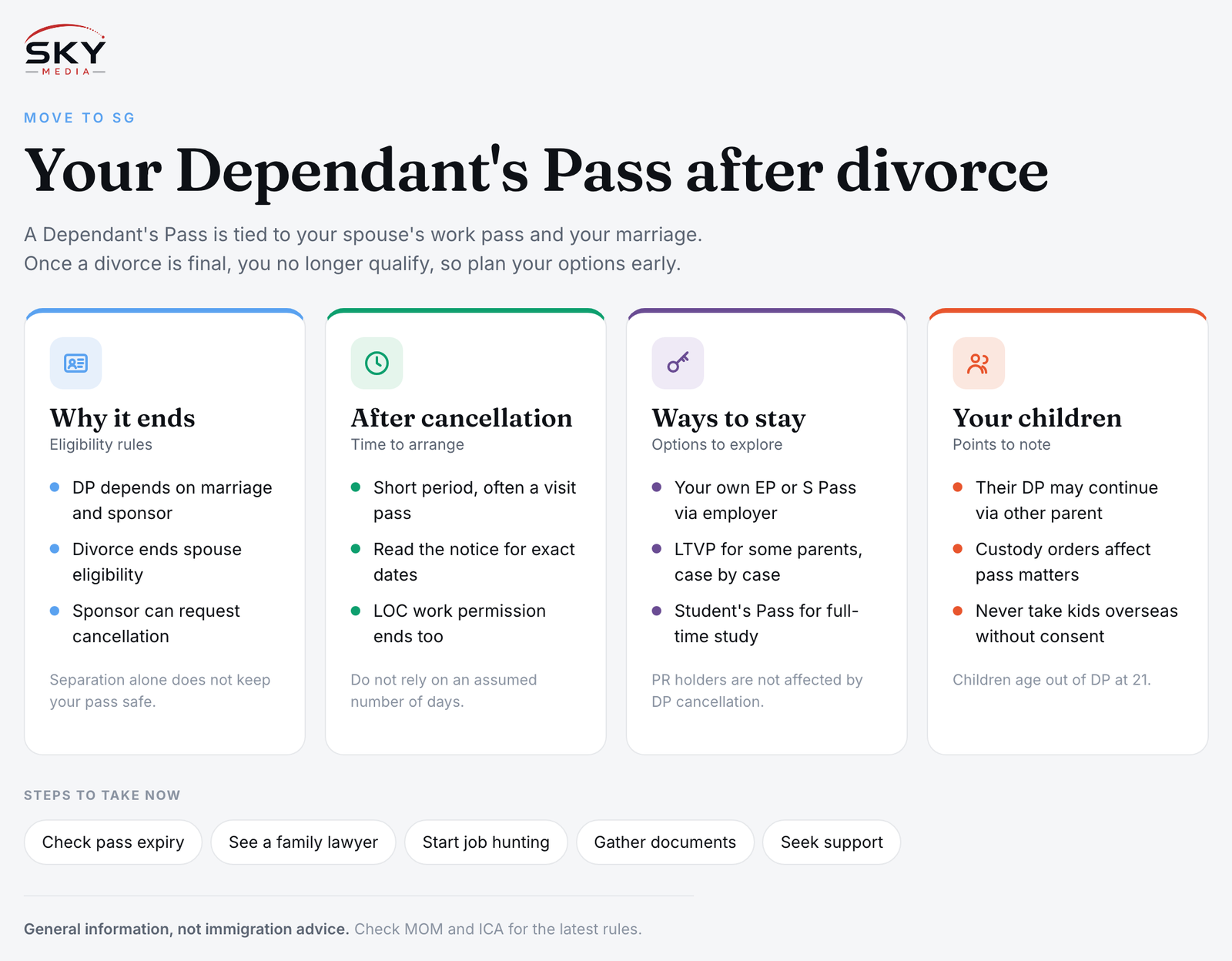
Why Divorce Affects Your Dependant’s Pass
A DP is issued by MOM to the legally married spouse (and eligible children) of an Employment Pass (EP) or S Pass holder. Your eligibility depends on two things: the main pass holder’s pass, and your marriage to them.
- Divorce ends eligibility. Once a divorce is final, you are no longer the pass holder’s spouse, so you no longer qualify for a DP as their dependant. The DP is expected to be cancelled.
- The sponsor controls the DP. The DP is applied for through the main pass holder’s employer. The employer or the main pass holder can generally request cancellation, sometimes even before a divorce is final.
- Your children’s passes may continue. Children on a DP are linked to the parent who holds the work pass. If that parent remains in Singapore on a valid pass, the children may stay on their DPs, subject to MOM rules.
Separation Versus Divorce
Many couples separate long before a divorce is finalised, and the pass position can be different at each stage.
During separation. Legally you are still married, so in principle you still meet the definition of a spouse. However, the DP depends on the sponsor and their employer continuing to support it. If your spouse asks for it to be cancelled, MOM may act on that request. Do not assume your pass is safe just because the divorce is not final.
When the divorce is final. You stop qualifying as a spouse. Plan for your DP to end around this time if it has not already.
Practical step: check your pass status regularly using MOM’s online services, and ask your lawyer to consider your immigration position as part of the divorce discussions, especially if you have children in Singapore.
Cancellation and How Long You Can Stay
When a DP is cancelled, you do not usually have to leave the same day. MOM or ICA typically provides a short period to make arrangements, often through a Short-Term Visit Pass. The length of this period is stated in the cancellation notice or by the authorities, and it can vary. Do not rely on an assumed number of days; read the notice carefully and ask ICA if anything is unclear.
Use this time to:
- apply for another pass if you are eligible,
- arrange accommodation, banking and your children’s needs,
- prepare to leave if no other option works, including shipping belongings and closing accounts.
Note that if you were working on a Letter of Consent (LOC) through your DP, that permission ends when the DP ends. You cannot keep working on it. See our guide to working on a Dependant’s Pass for how the LOC is linked to the DP.
Your Options to Stay in Singapore
Whether you can remain depends on your own circumstances. The main routes to explore are:
| Option | Who it may suit | Who decides | Key point |
|---|---|---|---|
| Your own work pass (EP, S Pass or other) | Those with a job offer from a Singapore employer | MOM | The employer applies; you must meet the criteria for that pass in your own right |
| Long-Term Visit Pass (LTVP) | Certain parents of Singapore citizen or PR children, and some other specific groups | ICA | Eligibility is limited and assessed case by case |
| Student’s Pass | Those enrolling in an approved full-time course | ICA | Tied to the school and course |
| Short-Term Visit Pass | Those winding up affairs before leaving | ICA | Temporary, not a basis for living here long term |
| Permanent Residence | Those who already hold PR | Not affected by DP cancellation | PR is a separate status with its own conditions |
Getting your own work pass. This is the most common route. If you find a job, your new employer applies for an EP, S Pass or another pass based on your qualifications, salary and the job. Your eligibility is assessed on your own merits, not your former spouse’s. Start job hunting early if you think divorce is likely.
Long-Term Visit Pass. ICA offers LTVPs to certain groups, and some parents of Singapore citizen or PR children may be considered. It is not automatic and it does not give a right to work by default. Check the latest criteria on the ICA website and our comparison of the Dependant’s Pass and LTVP.
Students. If you plan to study full time, an approved institution can support a Student’s Pass application through ICA.
If Your Children Are Staying in Singapore
Children are often the deciding factor. Some practical points:
- Their pass may depend on the other parent. If your former spouse keeps the work pass, the children’s DPs usually continue through them.
- Custody and care arrangements matter. Court orders on custody, care and control, and access affect where children live, and may be relevant to pass applications. Discuss this with your family lawyer.
- Do not take children overseas without the proper consent. Leaving Singapore with a child without the other parent’s agreement or a court order can have serious legal consequences.
- Turning 21. Children age out of DP eligibility at 21. Our guide to what happens when a child on a DP turns 21 explains the options.
Steps to Take Now
If divorce or separation is on the horizon:
- Check your pass and its expiry date through MOM’s online services.
- Speak to a family lawyer about the divorce and ask them to consider your immigration position too.
- Start looking for work if you want to stay, so a new employer can apply for your own pass.
- Gather your documents: passport, marriage certificate, children’s birth certificates, school records and any court orders.
- Check your finances, including your own bank account, savings and any joint accounts.
- Seek support. If you are facing family violence, contact the police in an emergency, and reach out to a Family Service Centre or a family violence specialist centre for help. Your safety comes first, and your pass status should not stop you from seeking protection.
A divorce is hard enough without uncertainty about where you will live. Knowing how the DP works, and acting early, gives you the best chance of staying in Singapore if that is what you and your children need.
Official sources: Ministry of Manpower (MOM)
Further reading: What Happens to Your Family’s Dependant’s Passes When You Change Jobs