
If you have ever walked past a busy restaurant on a weekend morning, spotted stacks of little bamboo baskets steaming away, and wondered what all the fuss was about, this guide is for you. Dim sum in Singapore is one of those shared rituals that locals grew up with and newcomers quickly fall in love with. It is unhurried, sociable, and best enjoyed over a pot of hot tea with people you like. Here is everything you need to walk in feeling confident and walk out happily stuffed.
What is dim sum (and what is yum cha)?
Dim sum refers to the food itself: a large family of small, bite-sized dishes, both savoury and sweet, that are shared around the table. Most are steamed, though plenty are fried, baked, or braised. The name loosely translates as “to touch the heart,” which is a lovely way to think about food meant to be nibbled rather than wolfed down.
Yum cha, meanwhile, means “to drink tea,” and it describes the whole occasion: gathering to sip tea and graze on dim sum, usually from mid-morning into the early afternoon. In Cantonese food culture the two go hand in hand, and you will hear both terms used in Singapore. When someone invites you to yum cha, they are inviting you to a relaxed dim sum meal, tea very much included.
The classic dim sum dishes to know
You do not need to memorise a whole menu. Start with these crowd favourites and you will already order like a regular. These are the dim sum dishes that appear on almost every table.
- Har gow are steamed prawn dumplings wrapped in a thin, translucent skin. A good one is plump, juicy, and lets you almost see the pink prawn through the wrapper. This is often the dish people use to judge a kitchen.
- Siew mai are open-topped pork dumplings, usually crowned with a dot of orange from fish roe or diced carrot. Savoury, springy, and endlessly moreish.
- Char siew bao are fluffy steamed buns filled with sweet barbecued pork. Soft, pillowy, and a reliable favourite with children and adults alike.
- Cheong fun, also written as chee cheong fun, are silky rolled rice noodle sheets, often filled with prawn, char siew, or eaten plain, then drizzled with a sweet soy sauce. Slippery and comforting.
- Lo mai gai is glutinous rice steamed in a lotus leaf with chicken, mushroom, and sometimes sausage. Fragrant and filling, it is practically a meal on its own.
- Egg tarts round things off on a sweet note, with a wobbly custard centre set in a crisp or flaky pastry shell. Order them near the end so they arrive warm.
Once you are comfortable, branch out into steamed spare ribs, custard buns, carrot cake, spring rolls, and turnip pastries. Half the fun is trying something new each visit.
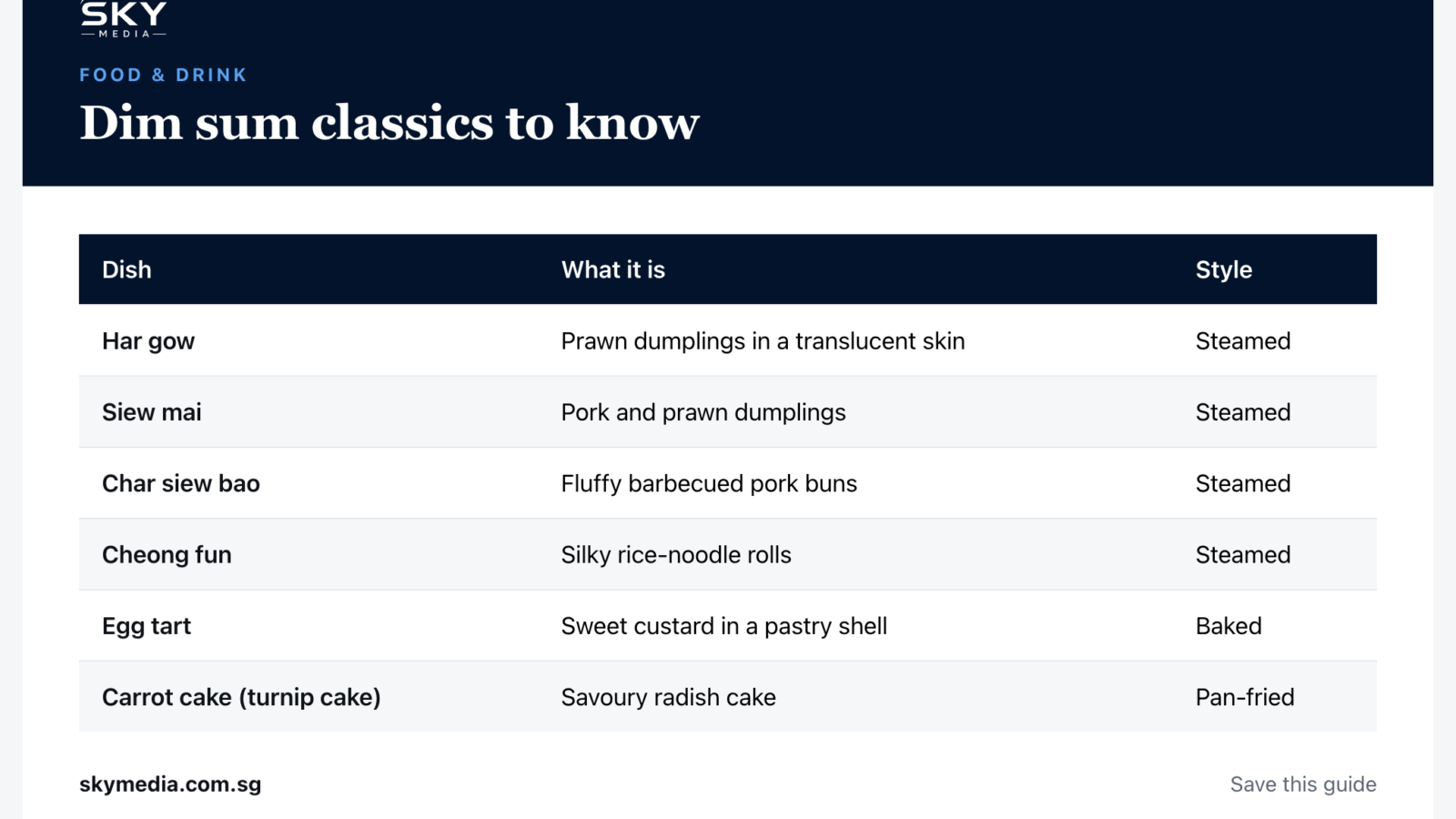
Here are the classics worth knowing:
| Dish | What it is | Style |
|---|---|---|
| Har gow | Prawn dumplings in a translucent skin | Steamed |
| Siew mai | Pork and prawn dumplings | Steamed |
| Char siew bao | Fluffy barbecued pork buns | Steamed |
| Cheong fun | Silky rice-noodle rolls | Steamed |
| Egg tart | Sweet custard in a pastry shell | Baked |
| Carrot cake (turnip cake) | Savoury radish cake | Pan-fried |
How ordering works: trolley versus order sheet
There are two common ways dim sum reaches your table, and Singapore has both.
The trolley (dim sum cart)
At more traditional spots, servers wheel trolleys of freshly steamed dishes around the room. When a cart rolls by, you peek under the lids, point at what you want, and the server places the dish on your table and marks your bill card. It is interactive and a little theatrical, and it lets you see the food before you commit. The catch is that you are at the mercy of the rotation, so if you want something specific, keep an eye out or ask.
The order sheet
Most modern restaurants use a printed order sheet (increasingly a tablet or QR-code menu). You tick the dishes and quantities you want, hand it over, and the kitchen prepares everything fresh. This is easier if you are new, because you can read descriptions, pace your ordering, and add more rounds as you go.
A gentle tip: order in a few small waves rather than all at once. Dim sum is best eaten hot and fresh off the steamer, and ordering in rounds keeps the table lively without overwhelming it.
Tea culture at the table
Tea is not an afterthought at yum cha; it is half the point. When you sit down, staff will usually ask which tea you would like. Common choices include:
- Pu’er, dark and earthy, prized for cutting through richer, oilier bites.
- Tieguanyin, a fragrant oolong that is smooth and floral.
- Chrysanthemum, light, slightly sweet, and caffeine-free, popular with families.
- Jasmine or green tea, clean and refreshing all-rounders.
A few small customs make the tea flow smoothly. Pour for others before yourself, starting with the eldest at the table, as a sign of respect. When your pot runs low and you want a refill, leave the lid ajar or tilt it open on top of the pot; this is the quiet signal for staff to top up the hot water.
Etiquette: the small gestures that matter
Dim sum comes with a few gentle customs. None are strict rules, but knowing them helps you feel at home.
- Tap your fingers to say thank you. When someone pours your tea, lightly tap two or three fingers on the table beside your cup. This wordless “thank you” lets the conversation carry on uninterrupted. It is one of the most charming habits at the table, and doing it marks you as someone in the know.
- Serve others, not just yourself. Use the serving chopsticks or spoon provided to move food to shared plates, and offer the last piece rather than grabbing it.
- Share everything. Dishes land in the middle for the whole table. Take one or two pieces at a time so everyone gets a turn.
- Pace yourself. Baskets keep coming, so ease in and leave room. It is a marathon, not a sprint.
Quick tips for your first yum cha
- Go with a group of three or more so you can try more dishes.
- Start with one or two steamed classics, then adjust as the plates arrive.
- Save egg tarts and sweet buns for the end.
- Signal for tea refills with the tilted lid.
- Tap your fingers whenever someone pours for you.
Best times to go
Dim sum is traditionally a morning-to-lunch affair, and the classic window is roughly mid-morning through early afternoon, with weekends being the liveliest. Many restaurants also serve dim sum at dinner these days, so you are not limited to daytime.
If you dislike crowds and long waits, arrive earlier, around opening, or aim for a weekday. Weekend late mornings are peak family time and can mean queues, especially near festive periods and holidays. Booking ahead for a larger group is always wise. As a rough guide, budget a modest sum per person for a satisfying spread, though this varies widely between casual eateries and upscale dining rooms.
Halal-friendly notes
Traditional dim sum leans heavily on pork and is usually not halal. That said, Singapore’s diverse food scene means halal-certified dim sum is increasingly available, with kitchens swapping in chicken, beef, prawn, and vegetable fillings. If eating halal matters to you, look for a valid halal certificate displayed at the premises, or check the restaurant’s official channels before you go rather than assuming. When in doubt, ask the staff directly; they are used to the question.
Ready to pull up a chair
Dim sum rewards the curious. You do not need to know every dish or custom to enjoy it; you just need to show up hungry, share generously, and let the trolleys or the order sheet guide you. Start with har gow and siew mai, pour tea for your neighbour, tap your thanks, and before long the whole ritual will feel like second nature.
Explore more: Must-try hawker food in Singapore and Hawker centre etiquette