

For a senior who uses a wheelchair, or a caregiver who drives a parent to medical appointments, finding a parking space close to the entrance is not a convenience. It can decide whether an outing is possible at all. Singapore’s accessible parking lots, marked with the wheelchair symbol, are reserved for vehicles displaying a valid label under the Parking Label Scheme for persons with disabilities.
This guide explains how the disabled parking label Singapore scheme generally works, who it is meant for, how to apply and what to keep in mind once you have one. It is general information only. Eligibility criteria, documents and procedures are set by the administering agency and can change, so always confirm the current requirements on the official SG Enable website before applying.
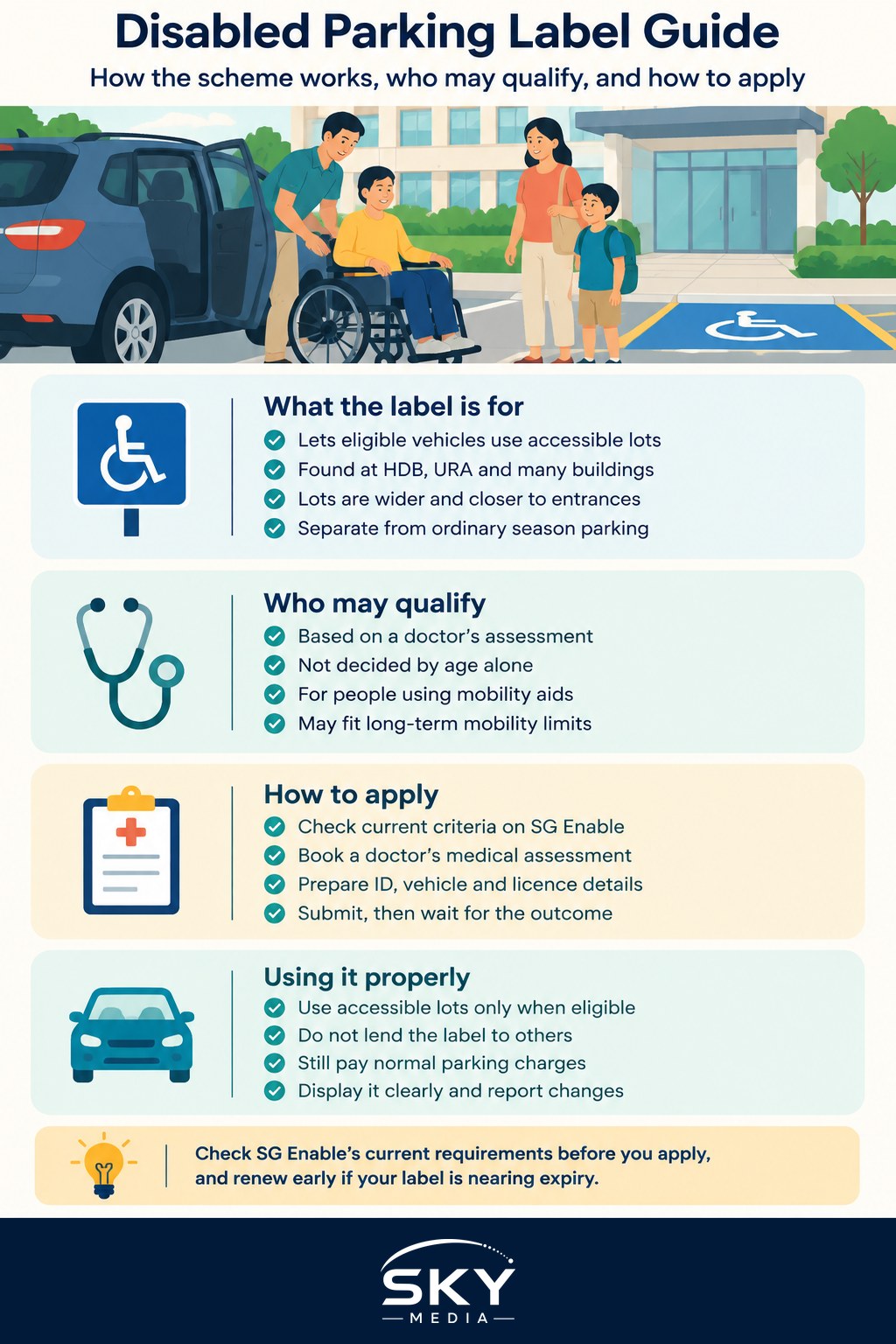
What the Parking Label Scheme Is For
The scheme lets eligible vehicles park in the accessible lots found at HDB car parks, URA (Urban Redevelopment Authority) car parks, shopping centres, hospitals and many other buildings. These lots are wider than standard ones, which gives room to unfold a wheelchair, open doors fully and transfer safely, and they are placed near lifts and entrances.
The scheme is administered by SG Enable, the government agency that supports persons with disabilities in Singapore. It is separate from ordinary season parking. If you also need to park regularly at your HDB block, you will still need a season parking arrangement, as explained in our guide to applying for an HDB season parking label.
The Two Classes of Label
The scheme has two classes of label, aimed at different situations. The comparison below gives a general overview. Check SG Enable’s website for the exact current criteria.
| Label class | Intended for | Who drives | Key point to check |
|---|---|---|---|
| Class 1 | A person with a disability who drives themselves | The person with the disability | Medical certification of the disability and a valid driving licence |
| Class 2 | A person with a disability who cannot drive and has significant difficulty walking | A family member or caregiver | Medical certification and the registered vehicle details |
| Both classes | Use of accessible lots only when the eligible person is in the vehicle or, for Class 1, driving it | As registered | Validity period and renewal steps |
In plain terms, Class 1 is for drivers with disabilities, and Class 2 is for caregivers who drive someone who needs the accessible lot. A senior with mobility difficulties may qualify under Class 2 if a doctor certifies that their condition meets the scheme’s criteria. Being elderly on its own does not usually qualify a person. The deciding factor is the medical assessment of their mobility.
Who May Qualify
Eligibility is based on a doctor’s assessment rather than age or a diagnosis alone. Situations that commonly lead people to explore the scheme include:
- Using a wheelchair, walking frame or other mobility aid.
- Permanent or long-term conditions that severely limit walking, such as some effects of stroke, amputation or neuromuscular conditions.
- Conditions where walking even a short distance from a standard lot would be unsafe.
Temporary injuries, such as a broken leg that is expected to heal, may be treated differently from permanent conditions. Do not assume eligibility either way. Speak to your doctor, who can advise whether to proceed and complete the medical portion of the application. This article is not medical advice, and only a qualified doctor can assess a person’s condition.
How to Apply: Step by Step
The general process looks like this. Exact steps, forms and supporting documents are listed on SG Enable’s website.
- Check the criteria. Read the current eligibility requirements for Class 1 and Class 2 on the SG Enable website.
- Book a doctor’s assessment. The person with the disability will need a medical assessment by a doctor, who completes the medical certification required by the scheme. This may be done at a polyclinic, a hospital specialist clinic or a GP, depending on the person’s care arrangements. Ask the clinic in advance if they can complete the form.
- Gather documents. Typically you will need identification for the person with the disability, details of the vehicle to be used, and for Class 1, the driver’s licence details. Caregivers applying for Class 2 should have their own identification and vehicle details ready.
- Submit the application. Follow SG Enable’s instructions for submission, which may be online or through other channels. Keep a copy of everything you submit.
- Wait for the outcome. SG Enable will inform you of the result and how you will receive the label. Processing times vary, so apply well before you need it.
- Display the label correctly. Follow the display instructions given with the label so that enforcement officers can see it clearly.
Any fees, processing times and validity periods are set by SG Enable and may change. Check the official website for current details rather than relying on information from friends or older forum posts.
Using the Label the Right Way
A label is a privilege tied to a specific person and situation. Misuse harms people who genuinely need the lots and can lead to enforcement action by car park operators or the authorities.
- Only use accessible lots when eligible. For Class 2, the person with the disability should be travelling in the vehicle. Parking in an accessible lot to run errands alone is misuse, even with a valid label.
- Do not lend the label. It is tied to the registered person and vehicle details.
- You still pay parking charges. The label gives access to the accessible lots. It is not a waiver of normal parking fees, unless a specific car park says otherwise.
- Display it clearly every time. A label left in the glovebox will not help if your vehicle is checked.
- Report changes. If you change your vehicle, or if the person’s condition or circumstances change, inform SG Enable as required.
Renewal and Practical Tips for Caregivers
Labels are generally valid for a set period, after which you need to renew. Note the expiry date in your calendar and start the renewal early, especially if another medical assessment is required.
A few practical tips for families caring for older relatives:
- Plan trips around accessible parking. Hospitals, polyclinics and larger malls usually have accessible lots near lift lobbies. Smaller buildings may have only one or two, so allow extra time.
- Keep a foldable wheelchair in the boot if your relative tires easily, even if they can walk short distances.
- Combine the label with other support. SG Enable and AIC (the Agency for Integrated Care) can point caregivers to transport schemes, assistive device funding and caregiver training.
- Know your HDB arrangements. If you drive your relative home often, make sure your season parking is sorted. Our guide to season parking in Singapore covers the options.
A disabled parking label takes a little paperwork, but for many families it turns stressful outings into manageable ones. Start with your doctor, check SG Enable’s current requirements, and use the lots with care so they remain available for everyone who needs them.
Official sources: Land Transport Authority (LTA)
Further reading: How to Apply for a Vehicle Parking Certificate (VPC) for a Goods Vehicle in Singapore