

Whether you need answers for peace of mind or proof for a court case, choosing the right paternity test in Singapore starts with one question: what will you use the result for? The science in most tests is similar. What differs is how the samples are collected, who verifies identities, and whether the report will be accepted by a court, a government agency or a foreign embassy.
This guide explains the difference between legal (court-admissible) and private (peace-of-mind) tests, what happens at a lab, how consent works, and what to check before you pay. It is general information, not legal advice. If the result may affect custody, maintenance, inheritance, immigration or a birth record, speak to a family lawyer first.
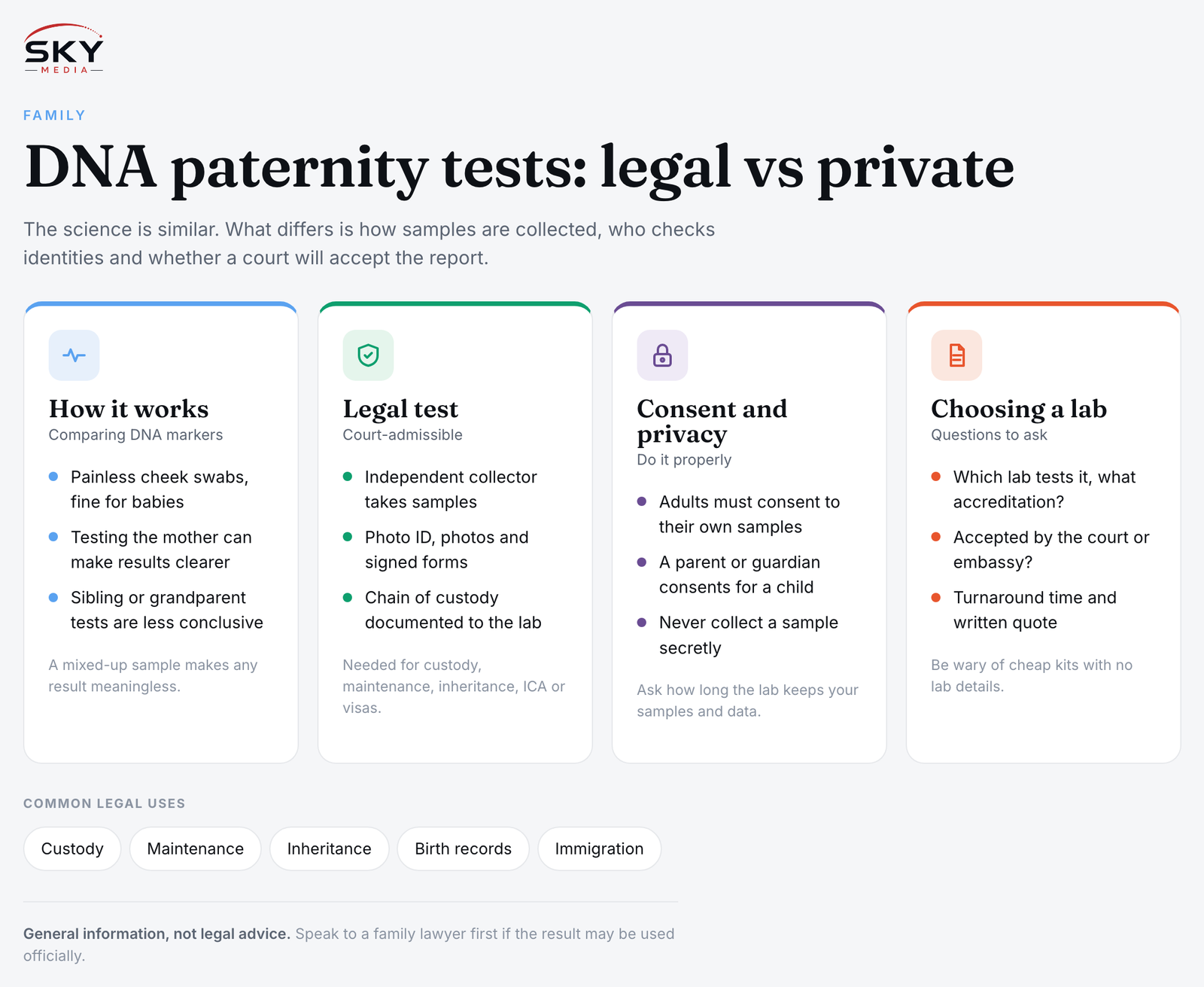
How a DNA Paternity Test Works
Every child inherits half their DNA from each biological parent. A paternity test compares a set of genetic markers in the child’s sample with those of the alleged father. If the father does not share the expected markers, he can usually be excluded. If he does, the lab calculates a probability of paternity, which for a match is typically reported as a very high percentage.
Key points to understand:
- Samples are usually cheek swabs. A soft swab rubbed inside the cheek collects cells painlessly, which makes it suitable for babies.
- Including the mother helps. Testing the mother as well lets the lab separate her contribution from the father’s, which can make results clearer. It is not always required.
- Other relationships can be tested too. Labs may offer maternity, sibling, grandparent or avuncular (aunt or uncle) tests when the alleged father is not available, but these are less conclusive than a direct parent-child test.
- Results are only as reliable as the sample. Contamination, mislabelling or a swapped sample will make any result meaningless. This is why legal tests have strict procedures.
Legal vs Private Tests: The Core Difference
The difference is not usually the laboratory method. It is the chain of custody, the documented record of who collected each sample, how each person’s identity was confirmed, and how the samples travelled to the lab without tampering.
| Feature | Legal (court-admissible) test | Private (peace-of-mind) test |
|---|---|---|
| Sample collection | By an independent collector, clinic or lab staff | Usually by the family at home with a kit |
| Identity checks | Photo ID checked, photos and signed forms for each person | No independent identity verification |
| Chain of custody | Documented from collection to lab | Not documented |
| Accepted by courts or agencies | Designed to be, subject to the court’s or agency’s own requirements | Generally not accepted |
| Typical use | Custody, maintenance, inheritance, immigration, birth record matters | Personal knowledge, private family questions |
A private test may tell you the truth, but it cannot prove who supplied each swab. If there is any chance you will later need the result for an official purpose, it is usually better to do a legal test from the start rather than pay twice.
When You Might Need a Court-Admissible Test
Common situations in Singapore include:
- Family court matters. Questions of paternity can arise in maintenance, custody and access, or divorce proceedings. The Family Justice Courts may in some cases direct that scientific tests be done. Your lawyer will advise on how testing fits into your case and whether a court order or a particular procedure is needed.
- Inheritance and estate disputes, where a person’s status as a child of the deceased is in question.
- Birth registration and records. If you need to add or change the father’s particulars on a child’s birth record, the Immigration and Checkpoints Authority (ICA) handles birth registration. Check ICA’s current requirements, as they decide what documents and evidence are needed.
- Immigration and citizenship applications, in Singapore or abroad. Some foreign embassies and immigration authorities request DNA evidence for family visas and may insist on a specific lab or panel physician. Always ask the requesting authority before booking anything.
For a broader picture of how courts work here, see Singapore’s Legal System Explained.
Consent, Privacy and the Rules Around Testing
DNA is highly personal data, and testing raises legal and ethical issues that deserve care.
- Adults must consent to their own samples being taken and tested.
- For a child, reputable labs usually require consent from a parent or guardian with legal authority over the child. If parents disagree, do not try to collect a sample secretly. Seek legal advice, as the court may need to decide.
- Testing someone without their knowledge, for example with a toothbrush or cup, is something many reputable labs will refuse to do, and it can create legal problems. It also tends to inflame an already difficult family situation.
- Data protection. Ask the lab how long it keeps samples and genetic data, who can see the results, and whether the samples are destroyed afterwards. Organisations in Singapore handling personal data must follow the Personal Data Protection Act (PDPA).
- Results go to the people named in the consent forms. Agree in advance who receives the report.
Choosing a Lab and Understanding Costs
Several clinics and laboratories in Singapore offer DNA relationship testing, and some act as collection points for accredited labs overseas. When comparing providers, check:
- Accreditation. Ask which laboratory actually performs the analysis and what accreditation it holds for relationship (parentage) testing. ISO/IEC 17025 is a commonly cited standard for testing labs.
- Legal acceptance. If you need a legal test, ask whether its reports have been used in Singapore court proceedings or for the specific embassy you are dealing with. Confirm this with your lawyer or the authority too.
- Who collects the sample. For legal tests, confirm the collector is independent and what identity documents each person must bring, such as NRIC, passport or the child’s birth certificate.
- Turnaround time and report format. Ask how long results typically take, whether faster options cost more, and whether you receive a hard copy, a digital report or both.
- What drives the price. Costs vary between providers and change over time. Legal tests usually cost more than home kits because of supervised collection and paperwork. Extra people tested, urgent results, overseas collection or less common relationship tests usually add to the price. Get a written quote that lists everything included.
Be wary of very cheap online kits with no clear lab details, no stated accreditation and no information about how your data is handled.
Prenatal Paternity Testing
Some providers offer non-invasive prenatal paternity testing, which analyses fragments of the baby’s DNA found in the mother’s blood alongside a sample from the alleged father. This is a different service from routine prenatal screening, although it uses related technology. To understand how screening tests work, read Understanding NIPT and Prenatal Genetic Testing in Singapore.
Speak to your obstetrician before any prenatal test. Invasive procedures that sample fluid or tissue from the womb carry medical risks and are generally done only for medical reasons, not for paternity alone.
Looking After Everyone Involved
A paternity test can change relationships, and the emotional side is often harder than the paperwork.
- Think about the child first. Consider when, how and whether to tell a child, depending on their age. A family counsellor can help plan this.
- Prepare for either result. Talk through what each outcome would mean before you get the report.
- Use support services. Family Service Centres and counselling services can support adults and children through difficult family news. If the matter is going to court, the Family Justice Courts also have information on support available to families.
Taking time to choose the right type of test, the right lab and the right support makes the process fairer and less stressful for everyone, especially the child at the centre of it.