

Many seniors who find love again later in life are surprised to learn that saying “I do” can quietly undo their estate plans. So, does marriage revoke a will in Singapore? In most cases, yes. Under the Wills Act, a will is generally revoked when the person who made it marries, unless the will was made in contemplation of that marriage. If you made a will years ago, perhaps after being widowed or divorced, and you are now planning to remarry, that will may stop having legal effect on your wedding day.
This article explains how the rule works, what happens if you do nothing, and the practical steps to take before or after a remarriage. It is general information, not legal advice. Every family is different, so speak to a lawyer for your own situation.
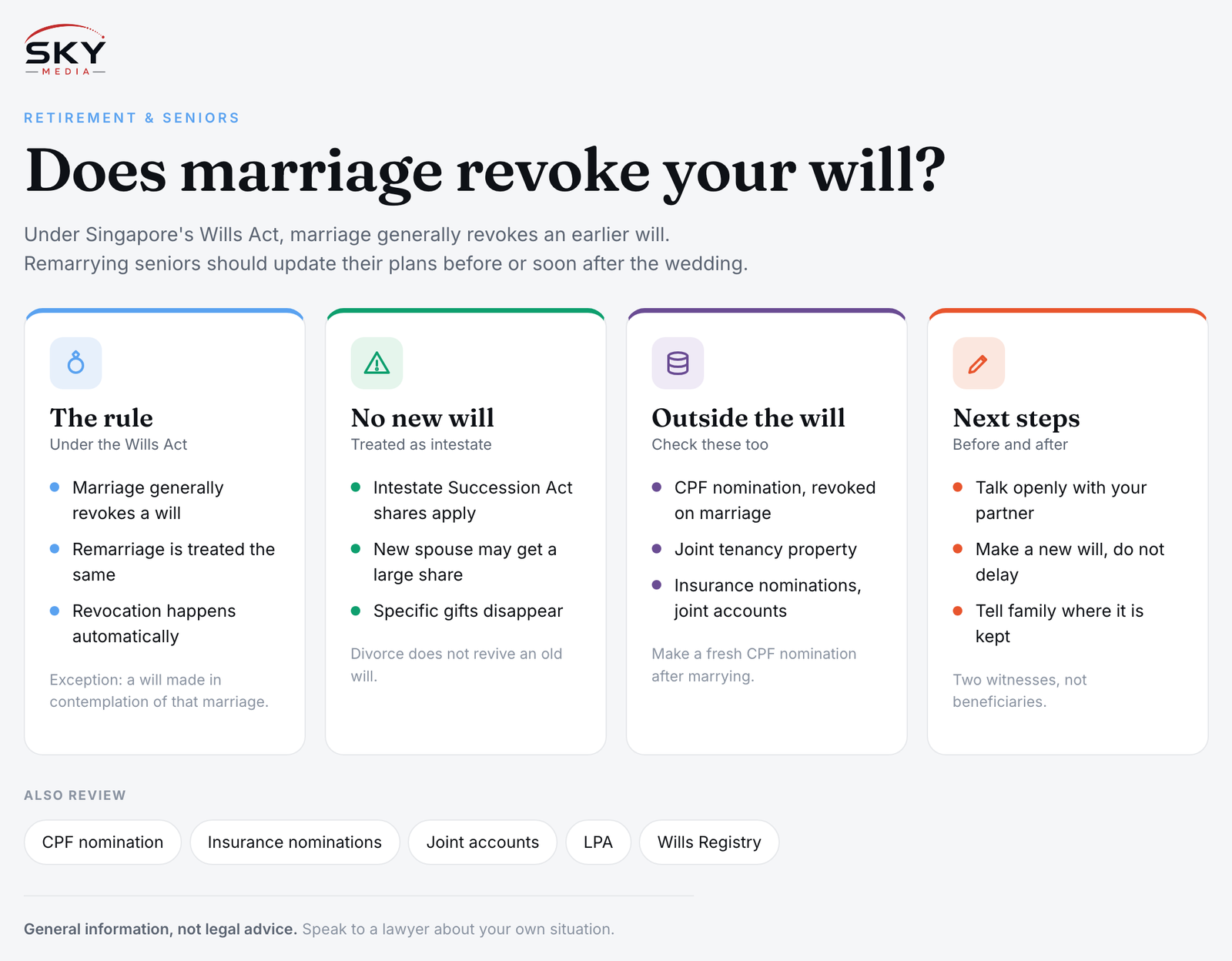
How the Wills Act Treats Marriage
Singapore’s Wills Act sets out the formal rules for making and revoking wills for non-Muslims. One of those rules is that marriage revokes a will made before it. The idea is that marriage changes your family, so an older will may no longer reflect your wishes.
The key exception is a will made in contemplation of a marriage. If the will clearly states that it is made with a particular upcoming marriage in mind, it is generally not revoked when that marriage takes place. Wording matters here. A vague reference to “my future spouse” may not be enough, and a lawyer will usually name the intended spouse and state expressly that the will is made in contemplation of marrying that person.
Other points to understand:
- It applies to remarriage too. There is no special treatment for a second or third marriage. A will made while you were single, widowed or divorced is treated the same way.
- Revocation is automatic. No one needs to tear up the document or file anything. The will simply stops being valid as a will, even if the original is still sitting in your drawer.
- A revoked will is not revived by divorce or the death of the new spouse. If you want the old wishes to apply again, you generally need to make a fresh will.
- Divorce is different. Do not assume that a divorce automatically cancels gifts to a former spouse in your will. Review your will after any divorce as well.
Muslims in Singapore are subject to the Administration of Muslim Law Act, and Muslim estates are distributed under faraid rules, with limits on what can be given by will. If you are Muslim, seek advice that covers both civil and syariah aspects.
What Happens if You Remarry Without a New Will
If your will is revoked by marriage and you never make a new one, you are treated as having died without a will, which is called dying intestate. For non-Muslims, your estate would then be divided under the Intestate Succession Act. That law sets fixed shares for a surviving spouse, children, parents and other relatives, depending on who survives you.
For remarrying seniors, this can create outcomes nobody intended:
- Your new spouse may receive a large share of assets you had always meant to leave to children from your first marriage.
- Adult children may receive more or less than you planned, because the statutory shares do not reflect informal promises or past gifts.
- Specific gifts disappear. That ring for a granddaughter or a sum for a favourite charity will not happen unless it is written into a valid will.
- Executors change. Without a will, someone has to apply to court to administer the estate, which can take longer and cause friction in a blended family.
The table below compares common situations.
| Situation | What generally happens to the old will | What to do |
|---|---|---|
| Made a will years ago, now remarrying | Revoked on marriage | Make a new will after the wedding, or one in contemplation of the marriage before it |
| Made a will expressly in contemplation of marrying your partner | Generally survives that marriage | Keep it safe, and review it if circumstances change |
| Made a will, later divorced and not remarried | Not automatically revoked | Review gifts and executor roles involving your former spouse |
| Remarried, then the new spouse passed away | The old will stays revoked | Make a fresh will reflecting your current wishes |
Assets a Will Does Not Control
A remarriage review should look beyond the will itself. Some assets pass outside your will entirely, and some of those have their own rules on marriage.
- CPF savings. CPF monies do not pass under your will. They go according to your CPF nomination. CPF Board states that an existing nomination is revoked upon marriage, so you will need to make a fresh nomination after the wedding if you want to control who receives your CPF savings. Check the current rules and make the nomination through the CPF Board website.
- Jointly owned property. A flat or house held as joint tenants passes to the surviving joint owner by survivorship, regardless of what your will says. If you co-own a home with an adult child or a new spouse, understand which form of ownership you hold. HDB flats have their own ownership and eligibility rules, so check with HDB before making changes.
- Insurance policies. Policies with a nomination of beneficiaries pay out according to that nomination. Ask your insurer whether marriage affects any existing nomination, and review who you have named.
- Joint bank accounts. Money in joint accounts may pass to the surviving holder depending on the account terms. Check with your bank.
Your Lasting Power of Attorney (LPA), which lets someone make decisions for you if you lose mental capacity, is a separate document from your will. It is worth reviewing whom you have appointed when your family situation changes. The Office of the Public Guardian has details on making or changing an LPA.
Steps to Take Before and After Remarrying
A remarriage is a good moment to tidy up your affairs as a couple. A practical checklist:
- Talk openly with your partner. Discuss what each of you wants for your own children, the home and any family heirlooms.
- Decide on timing. You can ask a lawyer to prepare a will in contemplation of your marriage before the wedding, or make a new will soon after the solemnisation. Avoid leaving it for months.
- List your assets and how each one passes. Note which are covered by your will, which by CPF nomination, which by joint ownership and which by insurance nomination.
- Make your CPF nomination again after the marriage.
- Review your insurance nominations and joint accounts.
- Tell your executor and family where your will is kept. Many people also register the existence and location of their will with the Wills Registry so it can be found.
- Revisit your LPA and any advance care plans.
Our guide to making a will as a married couple explains options such as mirror wills, which can work well for couples who want to look after each other and each set of children.
Getting the Formalities Right
A new will is only useful if it is valid. For non-Muslims, a will generally must be in writing, signed by you at the end, and signed in the presence of two witnesses who are present at the same time. Witnesses should not be beneficiaries or the spouses of beneficiaries, because gifts to them may fail. Many seniors use a lawyer, especially in blended families where the risk of a dispute is higher. Some also choose a lawyer’s assessment or a doctor’s note on mental capacity at the time of signing, which can help if the will is later challenged.
If you are still planning the wedding itself, our practical guide to getting married in Singapore covers the Registry of Marriages (ROM) process, so you can line up your will review alongside the paperwork.
Remarrying later in life is a joyful step. A few hours updating your will, CPF nomination and other arrangements means your new spouse and children are looked after as you intend.
Further reading: Will Witness Rules in Singapore and Mistakes That Can Invalidate a Will